Gould Carlos F, Bailis Rob, Balakrishnan Kalpana, Burke Marshall, Espinoza Sebastián, Mehta Sumi, Schlesinger Samuel B, Suarez-Lopez José R, Pillarisetti Ajay
Herbert Wertheim School of Public Health and Longevity Science, University of California San Diego, La Jolla, CA, United States of America.
Stockholm Environment Institute, Somerville, MA, United States of America.
Environ Res Lett. 2024 Aug 1;19(8):081002. doi: 10.1088/1748-9326/ad5d06. Epub 2024 Jul 12.
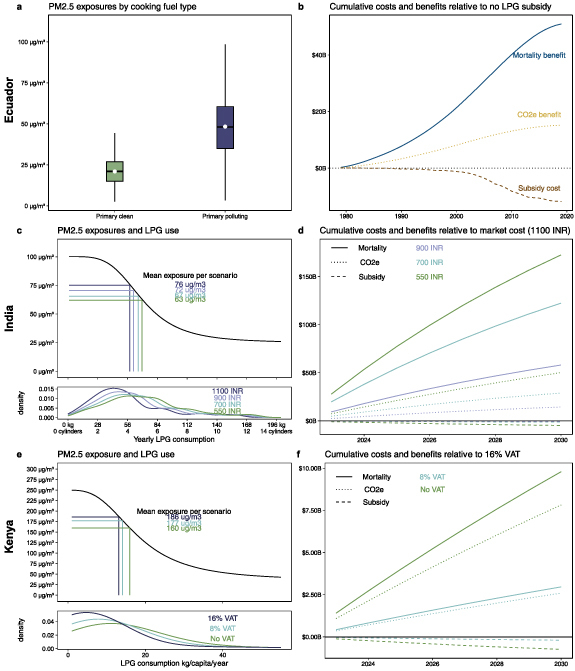
Households that burn biomass in inefficient open fires-a practice that results in $1.6 trillion in global damages from health impacts and climate-altering emissions yearly-are often unable to access cleaner alternatives, like gas, which is widely available but unaffordable, or electricity, which is unattainable for many due to insufficient supply and reliability of electricity services. Governments are often reluctant to make gas affordable. We argue that condemnation of all fossil fuel subsidies is short-sighted and does not adequately consider subsidizing gas for cooking as a potential strategy to improve public health and reduce greenhouse gas emissions.
那些以低效明火方式燃烧生物质燃料的家庭——这种做法每年因健康影响和改变气候的排放造成全球1.6万亿美元的损失——往往无法获得更清洁的替代能源,比如天然气,它虽广泛可得但价格昂贵,或者电力,由于电力供应不足和可靠性差,许多人无法获得电力。政府往往不愿让天然气价格变得可承受。我们认为,谴责所有化石燃料补贴是目光短浅的,没有充分考虑将烹饪用天然气补贴作为改善公众健康和减少温室气体排放的潜在策略。