Wang Yu, Vallée Emilie, Heuer Cord, Wang Youming, Guo Aizhen, Zhang Zhen, Compton Chris
EpiCentre, School of Veterinary Science, Massey University, Private Bag 11-222, Palmerston North, New Zealand.
China Animal Health and Epidemiology Center, Qingdao, China.
One Health. 2024 Jan 26;18:100683. doi: 10.1016/j.onehlt.2024.100683. eCollection 2024 Jun.
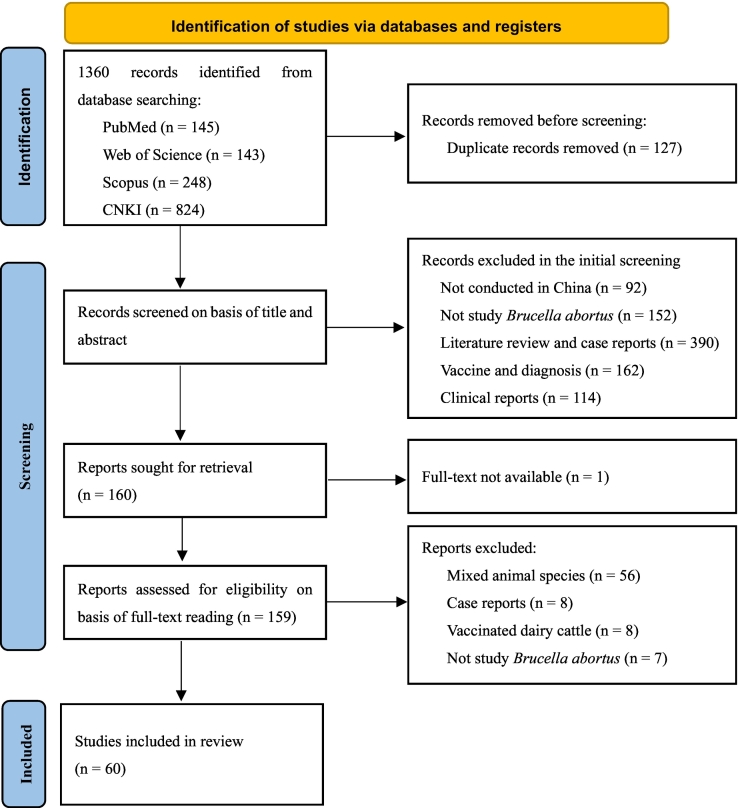
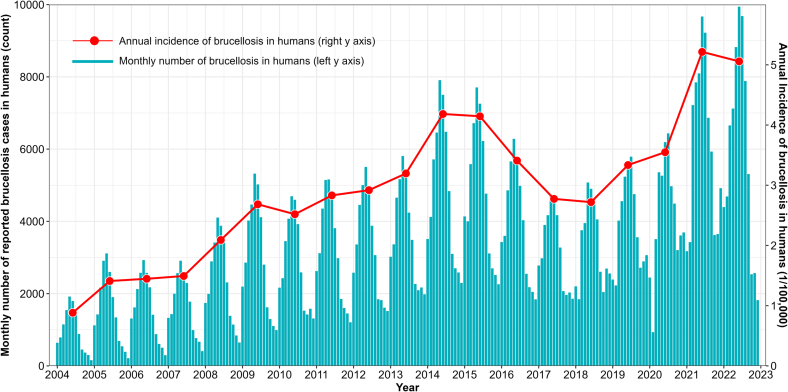
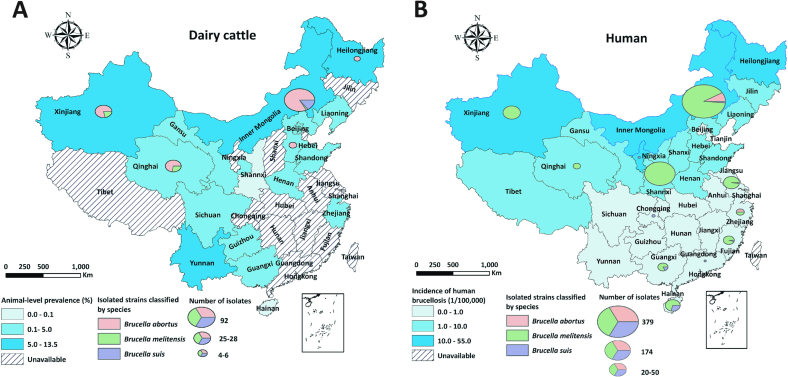
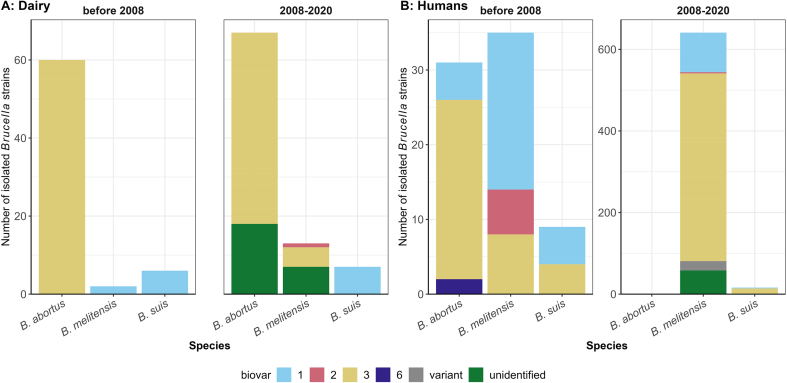
Brucellosis, caused by spp., is a re-emerging One Health disease with increased prevalence and incidence in Chinese dairy cattle and humans, severely affecting animal productivity and public health. In dairy cattle, is the primary causative agent although infections with other species occur occasionally. However, the epidemiological and comparative importance of in dairy cattle and humans remains inadequately understood throughout China due to the heterogeneity in locations, quality, and study methods. This scoping review aims to describe the changing status of infection in dairy cattle and humans, investigate the circulating species and biovars, and identify factors driving the disease transmission by retrieving publicly accessible literature from four databases. After passing the prespecified inclusion criteria, 60 original articles were included in the final synthesis. Although the reported animal-level and farm-level prevalence of brucellosis in dairy cattle was lower compared to other endemic countries (e.g. Iran and India), it has been reported to increase over the last decade. The incidence of brucellosis in humans displayed seasonal increases. The Rose Bengal Test and Serum Agglutination Test, interpreted in series, were the most used serological test to diagnose spp. in dairy cattle and humans. biovar 3 was the predominant species (81.9%) and biovar (70.3%) in dairy cattle, and biovar 3 was identified as the most commonly detected strain in human brucellosis cases. These strains were mainly clustered in Inner Mongolia and Shannxi Province (75.7%), limiting the generalizability of the results to other provinces. Live cattle movement or trade was identified as the key factor driving brucellosis transmission, but its transmission pattern remains unknown within the Chinese dairy sector. These knowledge gaps require a more effective One Health approach to be bridged. A coordinated and evidence-based research program is essential to inform regional or national control strategies that are both feasible and economical in the Chinese context.
布鲁氏菌病由布鲁氏菌属细菌引起,是一种再度出现的“同一健康”疾病,在中国奶牛和人类中的患病率和发病率均有所上升,严重影响动物生产力和公众健康。在奶牛中,布鲁氏菌是主要病原体,不过偶尔也会出现其他布鲁氏菌物种感染的情况。然而,由于地点、质量和研究方法的异质性,布鲁氏菌在中国奶牛和人类中的流行病学及相对重要性仍未得到充分了解。本综述旨在通过检索四个数据库中公开可得的文献,描述奶牛和人类布鲁氏菌感染的变化状况,调查流行的布鲁氏菌物种和生物变种,并确定推动疾病传播的因素。在通过预先设定的纳入标准后,最终综合分析纳入了60篇原创文章。尽管与其他流行国家(如伊朗和印度)相比,中国报道的奶牛布鲁氏菌病在动物层面和农场层面的患病率较低,但据报道在过去十年中有所上升。人类布鲁氏菌病的发病率呈季节性上升。串联解读的玫瑰红试验和血清凝集试验是诊断奶牛和人类布鲁氏菌属细菌最常用的血清学检测方法。布鲁氏菌生物变种3是奶牛中主要的物种(81.9%)和生物变种(70.3%),并且布鲁氏菌生物变种3被确定为人类布鲁氏菌病病例中最常检测到的菌株。这些菌株主要集中在内蒙古和陕西省(75.7%),这限制了研究结果在其他省份的普遍性。活牛移动或交易被确定为推动布鲁氏菌病传播的关键因素,但其在中国奶牛行业内的传播模式仍不清楚。这些知识空白需要通过更有效的“同一健康”方法来填补。一个协调一致且基于证据的研究项目对于制定在中国背景下可行且经济的区域或国家控制策略至关重要。