• 文献检索
  • 文档翻译
  • 深度研究
  • 学术资讯
  • Suppr Zotero 插件Zotero 插件
  • 邀请有礼
  • 套餐&价格
  • 历史记录
应用&插件
Suppr Zotero 插件Zotero 插件浏览器插件Mac 客户端Windows 客户端微信小程序
定价
高级版会员购买积分包购买API积分包
服务
文献检索文档翻译深度研究API 文档MCP 服务
关于我们
关于 Suppr公司介绍联系我们用户协议隐私条款
关注我们

Suppr 超能文献

核心技术专利:CN118964589B侵权必究
粤ICP备2023148730 号-1Suppr @ 2026

文献检索

告别复杂PubMed语法,用中文像聊天一样搜索,搜遍4000万医学文献。AI智能推荐,让科研检索更轻松。

立即免费搜索

文件翻译

保留排版,准确专业,支持PDF/Word/PPT等文件格式,支持 12+语言互译。

免费翻译文档

深度研究

AI帮你快速写综述,25分钟生成高质量综述,智能提取关键信息,辅助科研写作。

立即免费体验

儿科重症监护的长期随访——一篇叙述性综述

Long-term follow-up in pediatric intensive care-a narrative review.

作者信息

Quadir Ashfaque, Festa Marino, Gilchrist Michelle, Thompson Kate, Pride Natalie, Basu Shreerupa

机构信息

Paediatric Intensive Care Unit, The Children's Hospital at Westmead, Sydney, NSW, Australia.

The University of Sydney, Sydney, NSW, Australia.

出版信息

Front Pediatr. 2024 Jul 1;12:1430581. doi: 10.3389/fped.2024.1430581. eCollection 2024.

DOI:10.3389/fped.2024.1430581
PMID:39011062
原文链接:https://pmc.ncbi.nlm.nih.gov/articles/PMC11246917/
Abstract

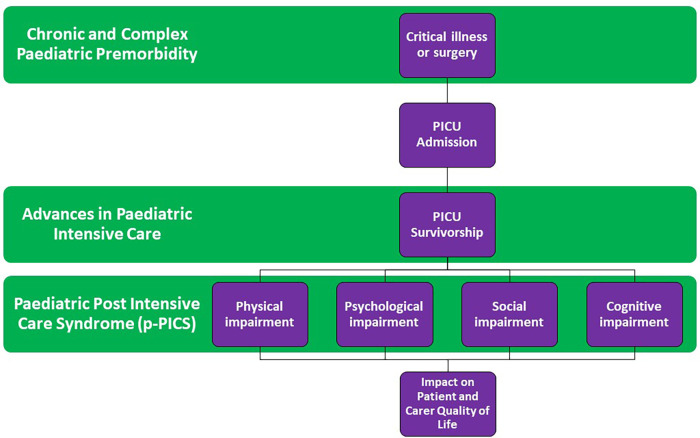
Pediatric intensive care is a rapidly developing medical specialty and with evolving understanding of pediatric pathophysiology and advances in technology, most children in the developed world are now surviving to intensive care and hospital discharge. As mortality rates for children with critical illness continue to improve, increasing PICU survivorship is resulting in significant long-term consequences of intensive care in these vulnerable patients. Although impairments in physical, psychosocial and cognitive function are well documented in the literature and the importance of establishing follow-up programs is acknowledged, no standardized or evidence-based approach to long-term follow-up in the PICU exists. This narrative review explores pediatric post-intensive care syndrome and summarizes the multifactorial deficits and morbidity that can occur in these patients following recovery from critical illness and subsequent discharge from hospital. Current practices around long-term follow-up are explored with discussion focusing on gaps in research and understanding with suggested ways forward and future directions.

摘要

儿科重症监护是一个快速发展的医学专业,随着对儿科病理生理学认识的不断深入和技术的进步,发达国家的大多数儿童现在都能在重症监护下存活并出院。随着危重病患儿死亡率的持续下降,儿科重症监护病房(PICU)幸存者数量的增加导致这些脆弱患者在重症监护后出现了重大的长期后果。尽管文献中充分记录了身体、心理社会和认知功能的损害,并且建立随访计划的重要性也得到了认可,但目前尚无针对PICU长期随访的标准化或循证方法。本叙述性综述探讨了儿科重症监护后综合征,并总结了这些患者在从危重病中康复并随后出院后可能出现的多因素缺陷和发病率。我们探讨了当前的长期随访实践,讨论的重点是研究和认识方面的差距,并提出了前进的方向和未来的发展方向。
https://cdn.ncbi.nlm.nih.gov/pmc/blobs/fc2e/11246917/716168930cbf/fped-12-1430581-g003.jpg
https://cdn.ncbi.nlm.nih.gov/pmc/blobs/fc2e/11246917/d68b521e2b27/fped-12-1430581-g001.jpg
https://cdn.ncbi.nlm.nih.gov/pmc/blobs/fc2e/11246917/92533024122c/fped-12-1430581-g002.jpg
https://cdn.ncbi.nlm.nih.gov/pmc/blobs/fc2e/11246917/716168930cbf/fped-12-1430581-g003.jpg
https://cdn.ncbi.nlm.nih.gov/pmc/blobs/fc2e/11246917/d68b521e2b27/fped-12-1430581-g001.jpg
https://cdn.ncbi.nlm.nih.gov/pmc/blobs/fc2e/11246917/92533024122c/fped-12-1430581-g002.jpg
https://cdn.ncbi.nlm.nih.gov/pmc/blobs/fc2e/11246917/716168930cbf/fped-12-1430581-g003.jpg

相似文献

1
Long-term follow-up in pediatric intensive care-a narrative review.儿科重症监护的长期随访——一篇叙述性综述
Front Pediatr. 2024 Jul 1;12:1430581. doi: 10.3389/fped.2024.1430581. eCollection 2024.
2
Long-Term Outcomes and the Post-Intensive Care Syndrome in Critically Ill Children: A North American Perspective.危重症儿童的长期预后与重症监护后综合征:北美视角
Children (Basel). 2021 Mar 24;8(4):254. doi: 10.3390/children8040254.
3
Post-intensive care syndrome: its pathophysiology, prevention, and future directions.重症监护后综合征:其病理生理学、预防及未来方向。
Acute Med Surg. 2019 Apr 25;6(3):233-246. doi: 10.1002/ams2.415. eCollection 2019 Jul.
4
Transitions from short to long-term outcomes in pediatric critical care: considerations for clinical practice.儿科重症监护中从短期到长期结局的转变:临床实践考量
Transl Pediatr. 2021 Oct;10(10):2858-2874. doi: 10.21037/tp-21-61.
5
Characteristics of postintensive care syndrome in survivors of pediatric critical illness: A systematic review.儿童危重症幸存者的重症监护后综合征特征:一项系统综述。
World J Crit Care Med. 2017 May 4;6(2):124-134. doi: 10.5492/wjccm.v6.i2.124.
6
Creating opportunities for parent empowerment: program effects on the mental health/coping outcomes of critically ill young children and their mothers.为家长赋权创造机会:该项目对危重症幼儿及其母亲心理健康/应对结果的影响。
Pediatrics. 2004 Jun;113(6):e597-607. doi: 10.1542/peds.113.6.e597.
7
Conceptualizing Post Intensive Care Syndrome in Children-The PICS-p Framework.儿童重症监护后综合征的概念化- PICS-p 框架。
Pediatr Crit Care Med. 2018 Apr;19(4):298-300. doi: 10.1097/PCC.0000000000001476.
8
Postintensive Care Syndrome in Pediatric Critical Care Survivors: Therapeutic Options to Improve Outcomes After Acquired Brain Injury.儿科重症监护幸存者的重症监护后综合征:改善获得性脑损伤后预后的治疗选择。
Curr Treat Options Neurol. 2019 Sep 27;21(10):49. doi: 10.1007/s11940-019-0586-x.
9
Post-Intensive Care Syndrome in Children: A Concept Analysis.儿童重症监护后综合征:概念分析。
J Pediatr Nurs. 2021 Nov-Dec;61:417-423. doi: 10.1016/j.pedn.2021.10.007. Epub 2021 Oct 20.
10
Pediatric Hematopoietic Cell Transplant Patients Who Survive Critical Illness Frequently Have Significant but Recoverable Decline in Functional Status.儿科造血细胞移植患者存活危重病后常出现显著但可恢复的功能状态下降。
Biol Blood Marrow Transplant. 2018 Feb;24(2):330-336. doi: 10.1016/j.bbmt.2017.10.036. Epub 2017 Nov 8.

引用本文的文献

1
Two-year follow-up on multisystem inflammatory syndrome in children (MIS-c): findings from a tertiary paediatric hospital in Latvia.儿童多系统炎症综合征(MIS-c)的两年随访:拉脱维亚一家三级儿童医院的研究结果
Eur J Pediatr. 2025 Aug 9;184(9):542. doi: 10.1007/s00431-025-06253-y.
2
Parental presence in the pediatric intensive care unit reduces postoperative sedative requirements: A retrospective study.儿科重症监护病房中家长陪伴可降低术后镇静需求:一项回顾性研究。
World J Clin Pediatr. 2025 Jun 9;14(2):102049. doi: 10.5409/wjcp.v14.i2.102049.
3
Forging an easier path through graduation: Improving the patient transition from paediatric to adult critical care.

本文引用的文献

1
Long-term outcome in pediatric cardiac arrest survivors: Not without a neuro-prognostication guideline and structured follow-up until young adulthood.小儿心脏骤停幸存者的长期预后:离不开神经预后评估指南及直至成年早期的结构化随访。
Resuscitation. 2023 Jun;187:109802. doi: 10.1016/j.resuscitation.2023.109802. Epub 2023 Apr 23.
2
Structured Multidisciplinary Follow-Up After Pediatric Intensive Care: A Model for Continuous Data-Driven Health Care Innovation.结构化儿科重症监护后多学科随访:持续数据驱动医疗保健创新模式。
Pediatr Crit Care Med. 2023 Jun 1;24(6):484-498. doi: 10.1097/PCC.0000000000003213. Epub 2023 Feb 17.
3
为毕业创造一条更轻松的道路:改善患者从儿科重症监护向成人重症监护的过渡。
World J Crit Care Med. 2025 Mar 9;14(1):101835. doi: 10.5492/wjccm.v14.i1.101835.
A Core Outcome Measurement Set for Pediatric Critical Care.
儿科重症监护核心结局测量集。
Pediatr Crit Care Med. 2022 Nov 1;23(11):893-907. doi: 10.1097/PCC.0000000000003055. Epub 2022 Aug 29.
4
Neurodevelopmental outcomes in neonatal extracorporeal membrane oxygenation survivors: An institutional perspective.新生儿体外膜肺氧合幸存者的神经发育结局:机构视角。
J Paediatr Child Health. 2022 Oct;58(10):1811-1815. doi: 10.1111/jpc.16110. Epub 2022 Jul 5.
5
The brain in pediatric critical care: unique aspects of assessment, monitoring, investigations, and follow-up.儿科重症监护中的大脑:评估、监测、检查和随访的独特方面。
Intensive Care Med. 2022 May;48(5):535-547. doi: 10.1007/s00134-022-06683-4. Epub 2022 Apr 21.
6
Continuing Care For Critically Ill Children Beyond Hospital Discharge: Current State of Follow-up.危重症儿童出院后延续护理:随访现状。
Hosp Pediatr. 2022 Apr 1;12(4):359-393. doi: 10.1542/hpeds.2021-006464.
7
Siblings' experience during pediatric intensive care hospitalization.兄弟姐妹在小儿重症监护病房住院期间的体验。
J Pediatr Nurs. 2022 May-Jun;64:111-118. doi: 10.1016/j.pedn.2022.02.008. Epub 2022 Mar 11.
8
One-Year Multidisciplinary Follow-Up of Patients With COVID-19 Requiring Invasive Mechanical Ventilation.COVID-19 患者接受有创机械通气后的一年多学科随访。
J Cardiothorac Vasc Anesth. 2022 May;36(5):1354-1363. doi: 10.1053/j.jvca.2021.11.032. Epub 2021 Nov 27.
9
Transitions from short to long-term outcomes in pediatric critical care: considerations for clinical practice.儿科重症监护中从短期到长期结局的转变:临床实践考量
Transl Pediatr. 2021 Oct;10(10):2858-2874. doi: 10.21037/tp-21-61.
10
Long-Term Neurodevelopmental and Functional Outcomes of Normally Developing Children Requiring PICU Care for Bronchiolitis.因毛细支气管炎需入住儿科重症监护病房(PICU)的正常发育儿童的长期神经发育和功能结局
J Pediatr Intensive Care. 2020 Sep 18;10(4):282-288. doi: 10.1055/s-0040-1716856. eCollection 2021 Nov.