Core Facilities of West China Hospital, Sichuan University, Chengdu, Sichuan, 610041, People's Republic of China.
Department of Rheumatology and Immunology, West China Hospital, Sichuan University, Chengdu, Sichuan, 610041, People's Republic of China.
Int J Nanomedicine. 2024 Jul 11;19:7049-7069. doi: 10.2147/IJN.S468695. eCollection 2024.
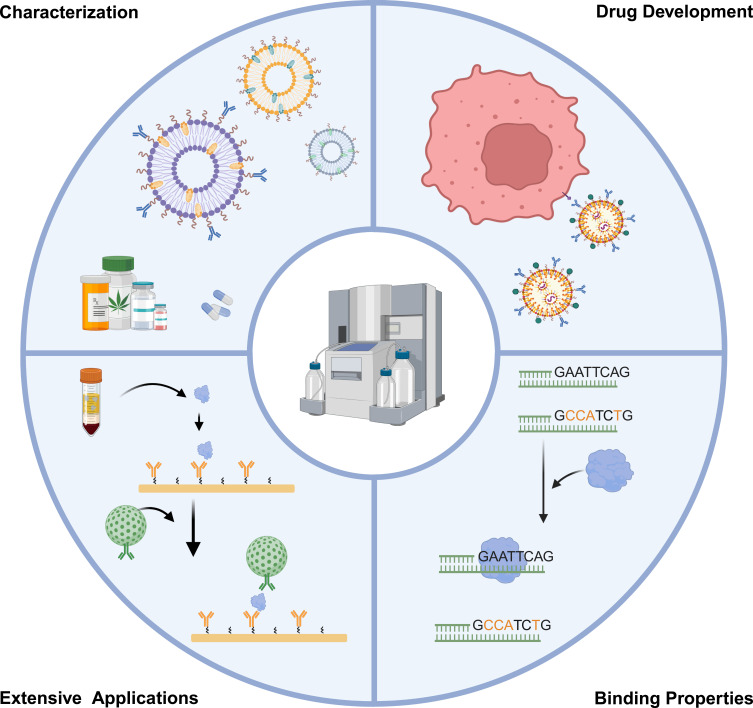
Surface Plasmon Resonance (SPR) technology, as a powerful analytical tool, plays a crucial role in the preparation, performance evaluation, and biomedical applications of nanoparticles due to its real-time, label-free, and highly sensitive detection capabilities. In the nanoparticle preparation process, SPR technology can monitor synthesis reactions and surface modifications in real-time, optimizing preparation techniques and conditions. SPR enables precise measurement of interactions between nanoparticles and biomolecules, including binding affinities and kinetic parameters, thereby assessing nanoparticle performance. In biomedical applications, SPR technology is extensively used in the study of drug delivery systems, biomarker detection for disease diagnosis, and nanoparticle-biomolecule interactions. This paper reviews the latest advancements in SPR technology for nanoparticle preparation, performance evaluation, and biomedical applications, discussing its advantages and challenges in biomedical applications, and forecasting future development directions.
表面等离子体共振(SPR)技术作为一种强大的分析工具,由于其实时、无标记和高灵敏度的检测能力,在纳米粒子的制备、性能评估和生物医学应用中发挥着关键作用。在纳米粒子的制备过程中,SPR 技术可以实时监测合成反应和表面修饰,优化制备技术和条件。SPR 可以精确测量纳米粒子与生物分子之间的相互作用,包括结合亲和力和动力学参数,从而评估纳米粒子的性能。在生物医学应用中,SPR 技术广泛应用于药物传递系统的研究、疾病诊断的生物标志物检测以及纳米粒子-生物分子相互作用的研究。本文综述了 SPR 技术在纳米粒子制备、性能评估和生物医学应用方面的最新进展,讨论了其在生物医学应用中的优势和挑战,并预测了未来的发展方向。