International Center for Tropical Agriculture (CIAT), Km 17 Recta Cali-Palmira, Cali, Colombia.
Department of Geosciences and Natural Resource Management, University of Copenhagen, Copenhagen, Denmark.
Sci Rep. 2024 Jul 16;14(1):15179. doi: 10.1038/s41598-024-65397-3.
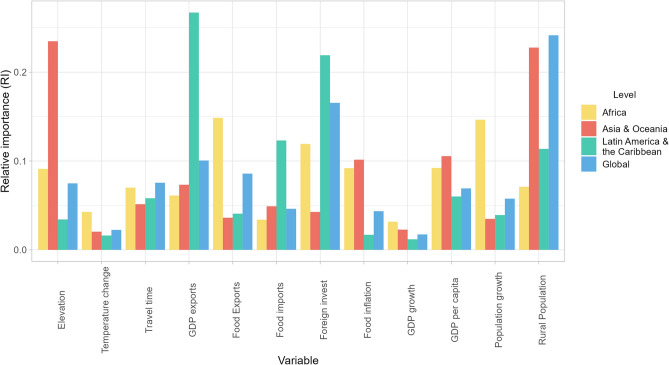
Approximately 90% of global forest cover changes between 2000 and 2018 were attributable to agricultural expansion, making food production the leading direct driver of deforestation. While previous studies have focused on the interaction between human and environmental systems, limited research has explored deforestation from a food system perspective. This study analyzes the drivers of deforestation in 40 tropical and subtropical countries (2004-2021) through the lenses of consumption/demand, production/supply and trade/distribution using Extreme Gradient Boosting (XGBoost) models. Our models explained a substantial portion of deforestation variability globally (R = 0.74) and in Asia (R = 0.81) and Latin America (R = 0.73). The results indicate that trade- and demand-side dynamics, specifically foreign direct investments and urban population growth, play key roles in influencing deforestation trends at these scales, suggesting that food system-based interventions could be effective in mitigating deforestation. Conversely, the model for Africa showed weaker explanatory power (R = 0.30), suggesting that factors beyond the food system may play a larger role in this region. Our findings highlight the importance of targeting trade- and demand-side dynamics to reduce deforestation and how interventions within the food system could synergistically contribute to achieving sustainable development goals, such as climate action, life on land and zero hunger.
2000 年至 2018 年期间,全球森林覆盖面积变化的约 90%归因于农业扩张,使粮食生产成为森林砍伐的主要直接驱动因素。虽然先前的研究集中在人类与环境系统的相互作用上,但有限的研究从粮食系统的角度探讨了森林砍伐问题。本研究通过使用极端梯度提升 (XGBoost) 模型从消费/需求、生产/供应和贸易/分配的角度分析了 40 个热带和亚热带国家(2004-2021 年)的森林砍伐驱动因素。我们的模型在全球范围内(R = 0.74)和亚洲(R = 0.81)和拉丁美洲(R = 0.73)解释了大部分森林砍伐的可变性。结果表明,贸易和需求方动态,特别是外国直接投资和城市人口增长,在这些规模上影响森林砍伐趋势方面发挥着关键作用,这表明基于粮食系统的干预措施可能有效减少森林砍伐。相比之下,非洲的模型表现出较弱的解释能力(R = 0.30),这表明该地区可能存在超出粮食系统的因素发挥更大作用。我们的研究结果强调了针对贸易和需求方动态的重要性,以减少森林砍伐,以及粮食系统内的干预措施如何协同促进实现可持续发展目标,如气候行动、陆地生命和零饥饿。