Nomir Ahmed G, El Sharaby Ashraf, Hanafy Basma G, Abumandour Mohamed M A
Department of Anatomy and Embryology, Faculty of Veterinary Medicine, Damanhour University, Damanhour, 22511, Egypt.
Department of Anatomy and Embryology, Faculty of Veterinary Medicine, Alexandria University, Post Box: 22758, Alexandria, 21944, Egypt.
BMC Vet Res. 2024 Jul 16;20(1):318. doi: 10.1186/s12917-024-04141-5.
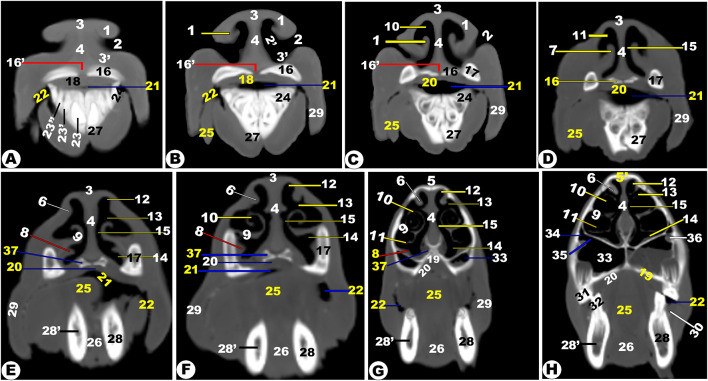
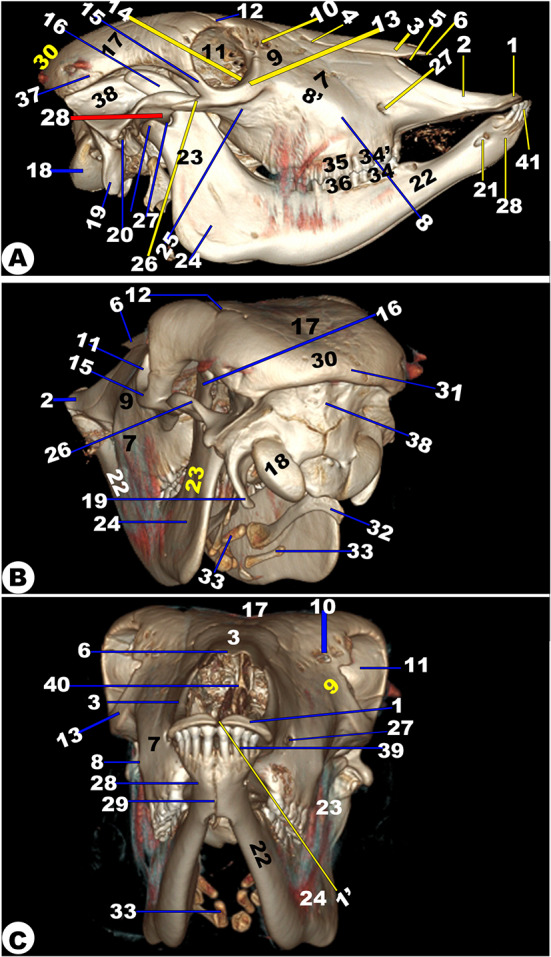
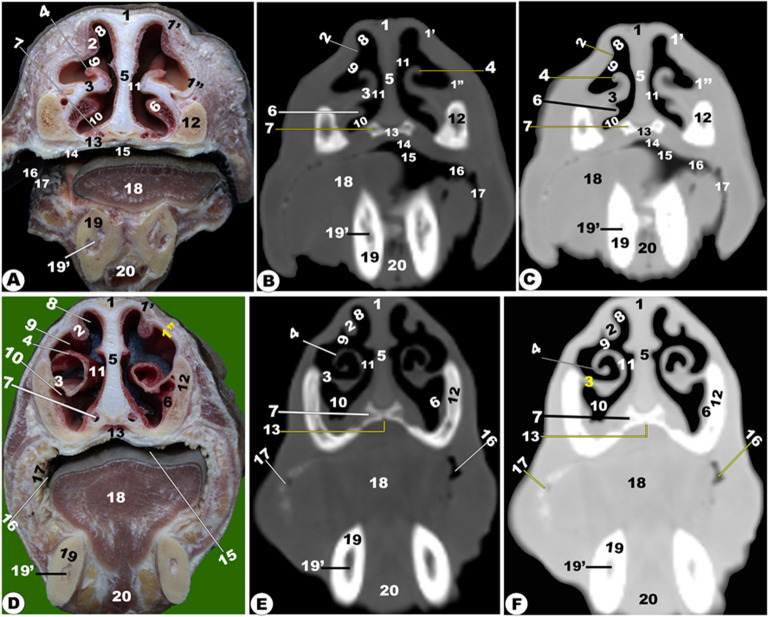
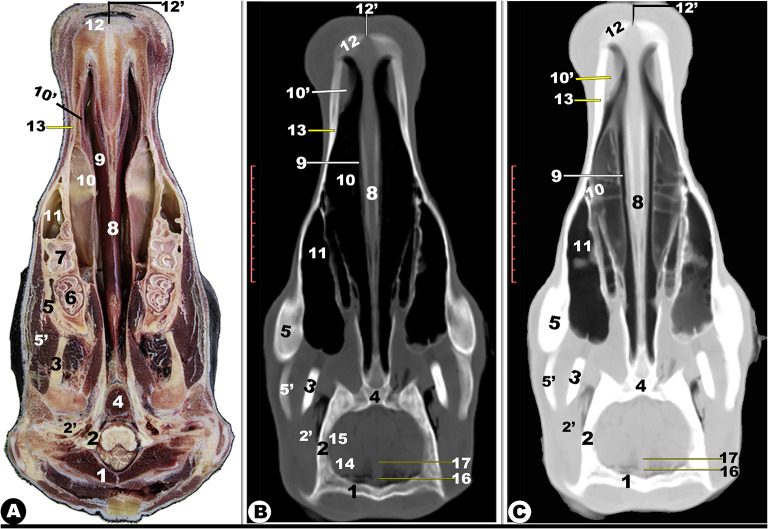
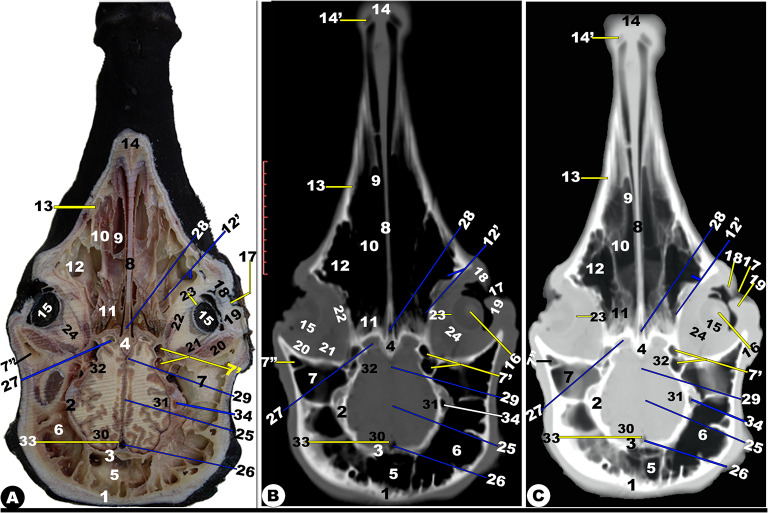
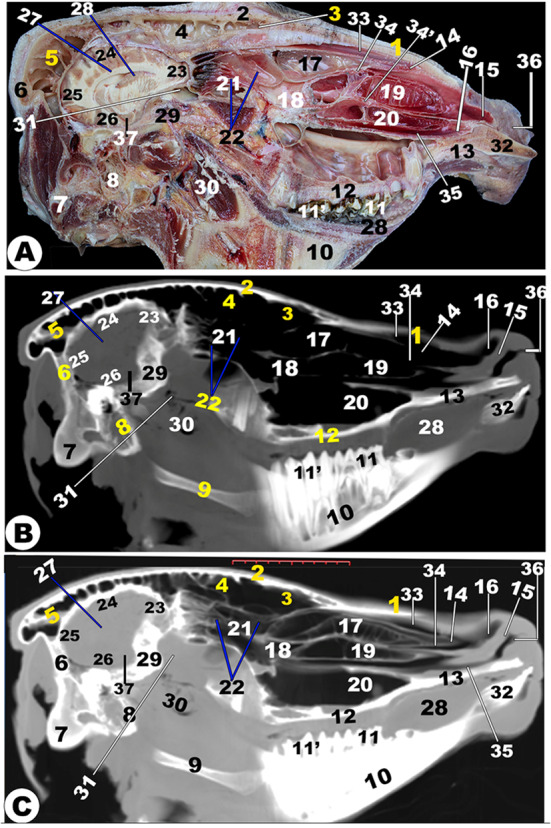
The research was designed to use computed tomography (CT) with 3D-CT reconstruction imaging techniques and the various anatomical sections-plana transversalia, frontalis, and dorsalia-to describe the anatomical architecture of the Zebu cattle head. Our study used nine mature heads. The CT bone window created detailed images of cranial bones, mandibles, teeth, and hyoid bones. All of the head cavities were evaluated, including the cranial, orbital, oral, auricular, and nasal cavities with their paranasal and conchal sinuses. The septum nasi, attached to the vomer and maxillary bones, did not reach the nasal cavity floor caudally at the level of the second premolar teeth, resulting in a single median channel from the choanae to the nasopharynx. The positions, boundaries, and connections of the paranasal sinuses were clearly identified. There were four nasal conchal sinuses (that were named the dorsal, middle, ethmoidal, and ventral) and five paranasal sinuses that were described as the following: sinus frontalis, maxillaris, palatinorum, and lacrimalis, as defined in the different anatomical sections and computed tomographic images. The complicated sinus frontalis caused the pneumatization of all bones that surrounded the cranial cavity, with the exception of the ethmoidal and body of basisphenoid bones. The sinus maxillaris was connected to the sinus lacrimalis and palatinorum through the maxillolacrimal and palatomaxillary openings, and to the middle nasal meatus through the nasomaxillary opening. Our findings provide a detailed anatomical knowledge for disease diagnosis to internal medicine veterinarians and surgeons by offering a comprehensive atlas of the Zebu cattle anatomy.
本研究旨在使用计算机断层扫描(CT)结合三维CT重建成像技术以及各种解剖切面——横断面、额面和背面——来描述瘤牛头的解剖结构。我们的研究使用了九个成熟的牛头。CT骨窗生成了颅骨、下颌骨、牙齿和舌骨的详细图像。对所有头部腔隙进行了评估,包括颅腔、眶腔、口腔、耳腔和鼻腔及其鼻窦和鼻甲窦。附着于犁骨和上颌骨的鼻中隔在第二前磨牙水平尾侧未到达鼻腔底部,导致从后鼻孔到鼻咽有一条单一的中通道。明确确定了鼻窦的位置、边界和连接。有四个鼻甲窦(分别命名为背侧、中间、筛窦和腹侧)和五个鼻窦,在不同的解剖切面和计算机断层图像中描述如下:额窦、上颌窦、腭窦和泪窦。复杂的额窦导致围绕颅腔的所有骨骼气化,但筛骨和蝶骨体除外。上颌窦通过上颌泪管开口和腭上颌开口与泪窦和腭窦相连,并通过鼻上颌开口与中鼻道相连。我们的研究结果通过提供瘤牛解剖结构的综合图谱,为内科兽医和外科医生的疾病诊断提供了详细的解剖学知识。