Presigny Charley, Corsi Marie-Constance, De Vico Fallani Fabrizio
Sorbonne Université, Institut du Cerveau - Paris Brain Institute - ICM, CNRS, Inria, Inserm, AP-HP, Hôpital de la Pitié Salpêtrière, Paris, France.
Nat Commun. 2024 Jul 18;15(1):6038. doi: 10.1038/s41467-024-50176-5.
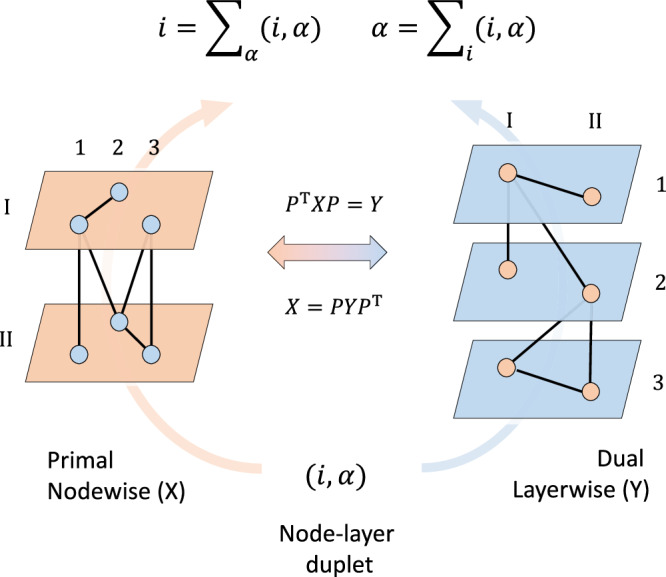
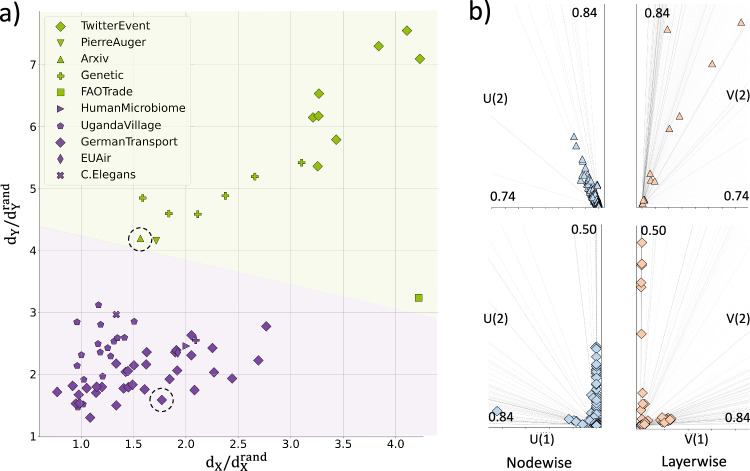
Real-world networks typically exhibit several aspects, or layers, of interactions among their nodes. By permuting the role of the nodes and the layers, we establish a new criterion to construct the dual of a network. This approach allows to examine connectivity from either a node-centric or layer-centric viewpoint. Through rigorous analytical methods and extensive simulations, we demonstrate that nodewise and layerwise connectivity measure different but related aspects of the same system. Leveraging node-layer duality provides complementary insights, enabling a deeper comprehension of diverse networks across social science, technology and biology. Taken together, these findings reveal previously unappreciated features of complex systems and provide a fresh tool for delving into their structure and dynamics.
现实世界的网络通常在其节点之间展现出多个方面或层次的相互作用。通过置换节点和层次的角色,我们建立了一种新的准则来构建网络的对偶。这种方法允许从以节点为中心或以层次为中心的视角来审视连通性。通过严谨的分析方法和广泛的模拟,我们证明节点层面和层次层面的连通性衡量的是同一系统中不同但相关的方面。利用节点 - 层次对偶性可提供互补的见解,从而能够更深入地理解社会科学、技术和生物学等领域的各种网络。综上所述,这些发现揭示了复杂系统中以前未被认识到的特征,并为深入研究其结构和动态提供了一个新工具。