Hangel Nora, Buyx Alena, Fritzsche Marie-Christine
Institute of History and Ethics in Medicine, TUM School of Medicine, Technical University of Munich, Munich, Germany.
Leibniz Center for Science and Society (LCSS), Leibniz University Hannover, Hannover, Germany.
Heliyon. 2024 Jun 24;10(13):e31723. doi: 10.1016/j.heliyon.2024.e31723. eCollection 2024 Jul 15.
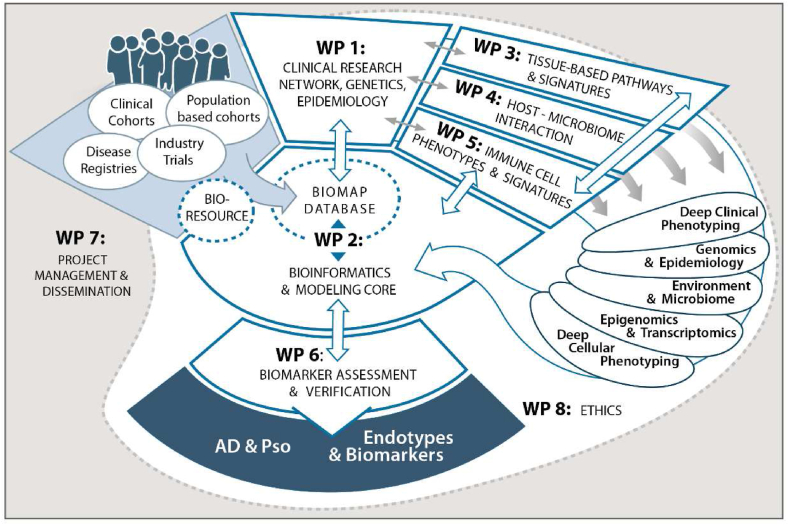
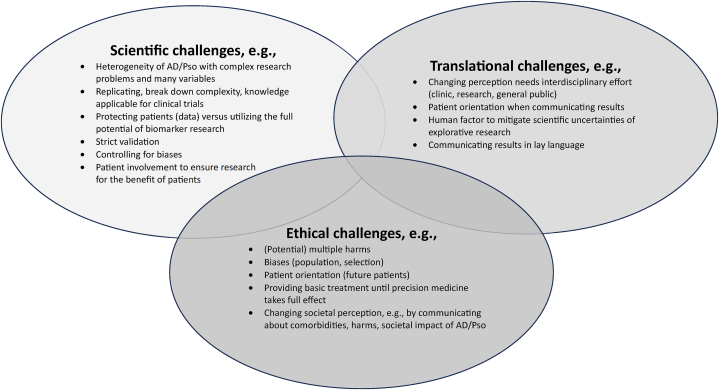
This qualitative study examines the impact of scientific, ethical, and translational challenges of precision medicine for atopic dermatitis and psoriasis. The study explores how these challenges affect biomarker research for inflammatory skin diseases as identified by stakeholders, including patient board representatives, pharmaceutical industry partners, and postdoctoral and senior researchers from multiple disciplines in biomarker research. We recruited participating experts both within and associated with the international Biomarkers in Atopic Dermatitis and Psoriasis (BIOMAP) consortium to ensure representation of the different organizational units of the consortium. For the study, we followed the COREQ checklist. The interviews were conducted using GDPR-safe online platforms and the pseudonymized transcripts were analyzed using Atlas.ti. We analyzed the interviews from participants' personal experiences, topic-oriented, and group specific to identify the main themes presented in this article. The findings were presented to peers and to the wider BIOMAP audience, discussed, and a draft was circulated within the consortium for feedback. In this study, we identify and discuss the interrelation of challenges that are relevant to improving precision medicine with multimodal biomarkers. We show how scientific challenges can interrelate with ethical and translational issues, and explain these interdependencies and articulate epistemic and social factors of interdisciplinary collaboration. Based on our findings, we suggest that including patient representatives' perspectives is crucial for highly interrelated and widely diverse research. The proposed integrative perspective is beneficial for all involved stakeholders. Effective communication of science requires reflection on the tension between scientific uncertainty and the goals of precision medicine. Furthermore, we show how changing the perception of the diseases, atopic dermatitis, and psoriasis can benefit patients beyond medical practice.
这项定性研究考察了精准医学在特应性皮炎和银屑病方面面临的科学、伦理及转化挑战所产生的影响。该研究探讨了这些挑战如何影响利益相关者所确定的炎症性皮肤病生物标志物研究,这些利益相关者包括患者委员会代表、制药行业合作伙伴以及生物标志物研究多个学科领域的博士后和资深研究人员。我们招募了国际特应性皮炎和银屑病生物标志物(BIOMAP)联盟内部及与之相关的参与专家,以确保联盟不同组织单位都有代表参与。对于这项研究,我们遵循了COREQ清单。访谈通过符合通用数据保护条例(GDPR)安全标准的在线平台进行,使用Atlas.ti软件对匿名化的访谈记录进行分析。我们从参与者的个人经历、主题导向以及特定群体等方面对访谈进行分析,以确定本文所呈现的主要主题。研究结果向同行以及更广泛的BIOMAP受众展示、讨论,并在联盟内部传阅草稿以征求反馈意见。在本研究中,我们识别并讨论了与利用多模态生物标志物改善精准医学相关的挑战之间的相互关系。我们展示了科学挑战如何与伦理和转化问题相互关联,并解释了这些相互依存关系,阐明了跨学科合作的认知和社会因素。基于我们的研究结果,我们建议纳入患者代表的观点对于高度相关且广泛多样的研究至关重要。所提出的综合观点对所有相关利益者都有益。科学的有效传播需要反思科学不确定性与精准医学目标之间的矛盾。此外,我们展示了改变对特应性皮炎和银屑病这两种疾病的认知如何能在医疗实践之外使患者受益。