St John's Institute of Dermatology, School of Basic & Medical Biosciences and Department of Medical & Molecular Genetics, School of Basic & Medical Biosciences, Faculty of Life Sciences & Medicine, King's College London, London, UK.
Centre for Reviews and Dissemination, University of York, York, UK.
Br J Dermatol. 2022 Oct;187(4):481-493. doi: 10.1111/bjd.21627. Epub 2022 Jul 11.
Identification of those at risk of more severe psoriasis and/or associated morbidities offers opportunity for early intervention, reduced disease burden and more cost-effective healthcare. Prognostic biomarkers of disease progression have thus been the focus of intense research, but none are part of routine practice.
To identify and catalogue candidate biomarkers of disease progression in psoriasis for the translational research community.
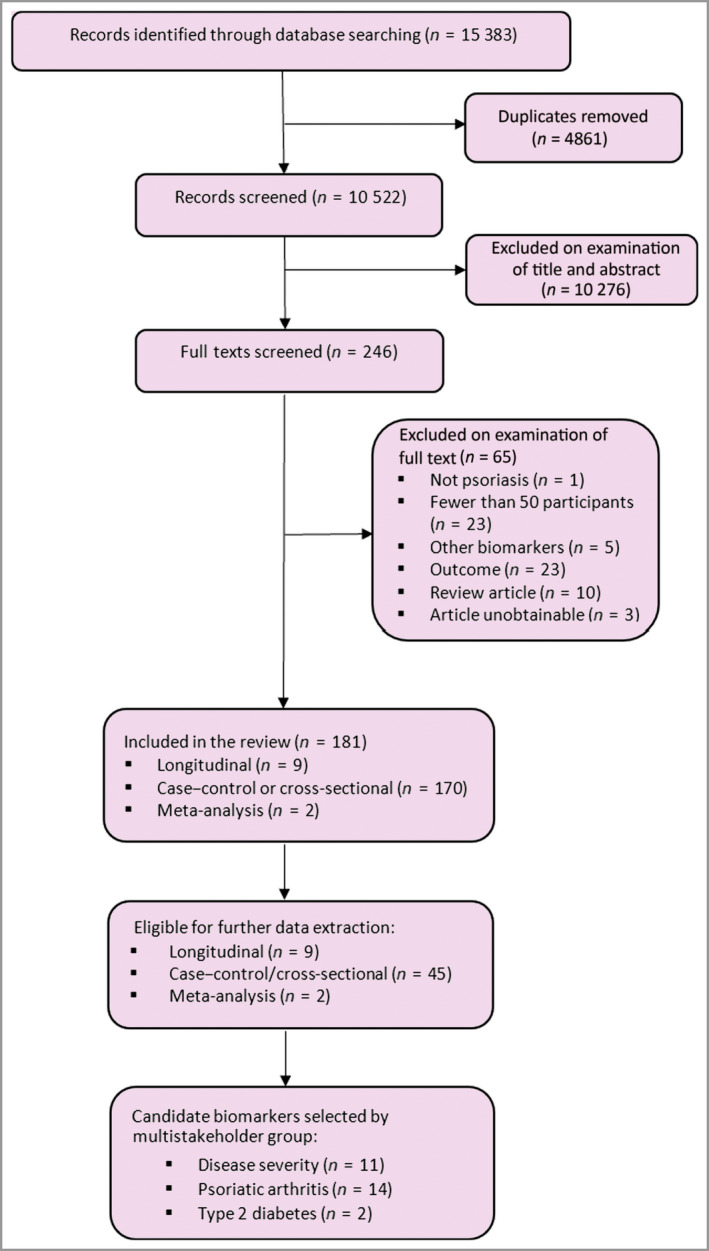
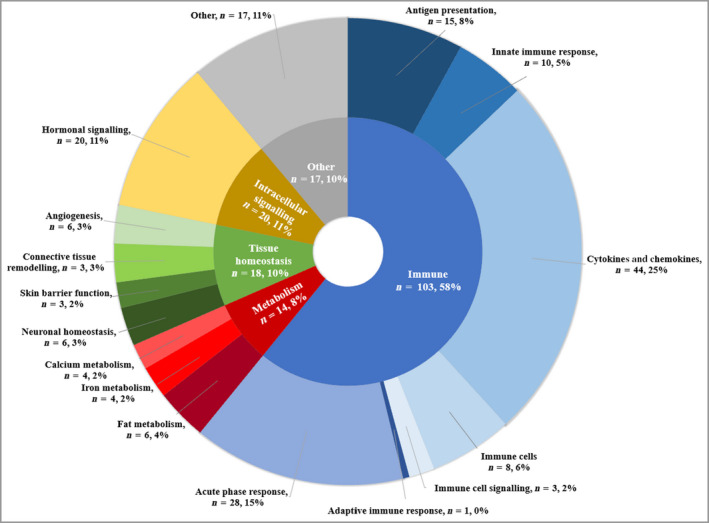
A systematic search of CENTRAL, Embase, LILACS and MEDLINE was performed for relevant articles published between 1990 and December 2021. Eligibility criteria were studies involving patients with psoriasis (any age, n ≥ 50) reporting biomarkers associated with disease progression. The main outcomes were any measure of skin severity or any prespecified psoriasis comorbidity. Data were extracted by one reviewer and checked by a second; studies meeting minimal quality criteria (longitudinal design and/or use of methods to control for confounding) were formally assessed for bias. Candidate biomarkers were identified by an expert multistakeholder group using a majority voting consensus exercise, and mapped to relevant cellular and molecular pathways.
Of 181 included studies, most investigated genomic or proteomic biomarkers associated with disease severity (n = 145) or psoriatic arthritis (n = 30). Methodological and reporting limitations compromised interpretation of findings, most notably a lack of longitudinal studies, and inadequate control for key prognostic factors. The following candidate biomarkers with future potential utility were identified for predicting disease severity: LCE3D, interleukin (IL)23R, IL23A, NFKBIL1 loci, HLA-C06:02 (genomic), IL-17A, IgG aHDL, GlycA, I-FABP and kallikrein 8 (proteomic), tyramine (metabolomic); psoriatic arthritis: HLA-C06:02, HLA-B27, HLA-B38, HLA-B*08, and variation at the IL23R and IL13 loci (genomic); IL-17A, CXCL10, Mac-2 binding protein, integrin b5, matrix metalloproteinase-3 and macrophage-colony stimulating factor (proteomic) and tyramine and mucic acid (metabolomic); and type 2 diabetes mellitus: variation in IL12B and IL23R loci (genomic). No biomarkers were supported by sufficient evidence for clinical use without further validation.
This review provides a comprehensive catalogue of investigated biomarkers of disease progression in psoriasis. Future studies must address the common methodological limitations identified herein to expedite discovery and validation of biomarkers for clinical use. What is already known about this topic? The current treatment paradigm in psoriasis is reactive. There is a need to develop effective risk-stratified management approaches that can proactively attenuate the substantial burden of disease. Prognostic biomarkers of disease progression have therefore been the focus of intense research. What does this study add? This review is the first to scope, collate and catalogue research investigating biomarkers of disease progression in psoriasis. The review identifies potentially promising candidate biomarkers for further investigation and highlights common important limitations that should be considered when designing and conducting future studies in this area.
识别那些有更严重银屑病和/或相关合并症风险的患者,为早期干预、减轻疾病负担和更具成本效益的医疗保健提供了机会。因此,疾病进展的预后生物标志物一直是研究的重点,但没有一种被纳入常规实践。
为转化研究界确定和编目银屑病疾病进展的候选生物标志物。
对 1990 年至 2021 年 12 月期间发表的相关文章进行了 CENTRAL、Embase、LILACS 和 MEDLINE 的系统搜索。纳入标准为:涉及银屑病患者(任何年龄,n≥50)的研究报告了与疾病进展相关的生物标志物。主要结局为任何皮肤严重程度的测量或任何预先指定的银屑病合并症。由一名评审员提取数据,并由第二名评审员检查;符合最低质量标准(纵向设计和/或使用方法控制混杂因素)的研究被正式评估偏倚。候选生物标志物由一个多利益相关者专家组使用多数投票共识共识程序确定,并映射到相关的细胞和分子途径。
在纳入的 181 项研究中,大多数研究了与疾病严重程度(n=145)或银屑病关节炎(n=30)相关的基因组或蛋白质组生物标志物。研究结果的解释受到方法学和报告方面的限制,最明显的是缺乏纵向研究和对关键预后因素的控制不足。确定了以下具有未来潜在应用价值的候选生物标志物,用于预测疾病严重程度:LCE3D、白细胞介素(IL)23R、IL23A、NFKBIL1 基因座、HLA-C06:02(基因组)、IL-17A、IgG aHDL、GlycA、I-FABP 和激肽释放酶 8(蛋白质组)、酪胺(代谢组学);银屑病关节炎:HLA-C06:02、HLA-B27、HLA-B38、HLA-B*08 和 IL23R 和 IL13 基因座的变异(基因组);IL-17A、CXCL10、Mac-2 结合蛋白、整合素 b5、基质金属蛋白酶-3 和巨噬细胞集落刺激因子(蛋白质组)和酪胺和粘蛋白酸(代谢组学);2 型糖尿病:IL12B 和 IL23R 基因座的变异(基因组)。没有生物标志物得到充分证据支持,无需进一步验证即可用于临床。
本综述提供了银屑病疾病进展研究中全面的生物标志物目录。未来的研究必须解决本文中确定的常见方法学限制,以加快用于临床的生物标志物的发现和验证。
关于这个话题已知的是什么?目前银屑病的治疗方法是被动的。需要开发有效的风险分层管理方法,以主动减轻疾病的沉重负担。因此,疾病进展的预后生物标志物一直是研究的重点。
本研究增加了什么?这是第一篇综述、整理和编目银屑病疾病进展研究中生物标志物的综述。该综述确定了有希望进一步研究的潜在候选生物标志物,并强调了在该领域设计和进行未来研究时应考虑的常见重要限制。