Turishcheva Polina, Fahey Paul G, Vystrčilová Michaela, Hansel Laura, Froebe Rachel, Ponder Kayla, Qiu Yongrong, Willeke Konstantin F, Bashiri Mohammad, Baikulov Ruslan, Zhu Yu, Ma Lei, Yu Shan, Huang Tiejun, Li Bryan M, Wulf Wolf De, Kudryashova Nina, Hennig Matthias H, Rochefort Nathalie L, Onken Arno, Wang Eric, Ding Zhiwei, Tolias Andreas S, Sinz Fabian H, Ecker Alexander S
Institute of Computer Science and Campus Institute Data Science, University of Göttingen, Germany.
Department of Neuroscience & Center for Neuroscience and Artificial Intelligence, Baylor College of Medicine, Houston, Texas, USA.
ArXiv. 2024 Jul 12:arXiv:2407.09100v1.
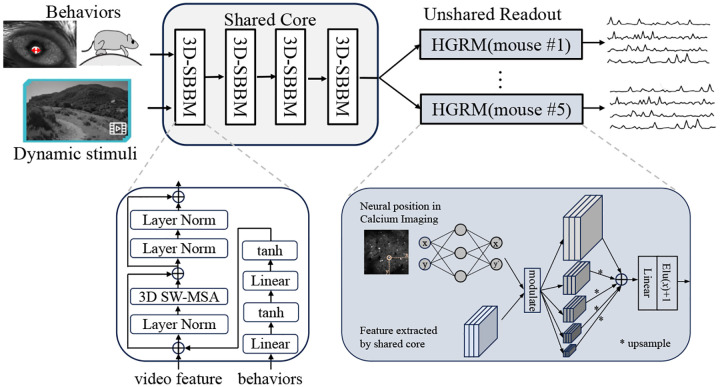
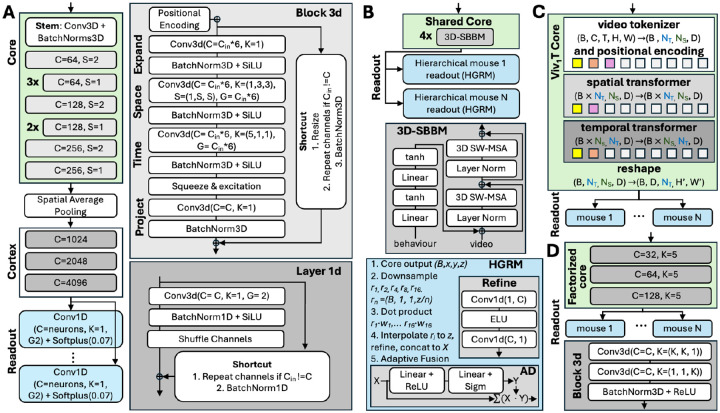
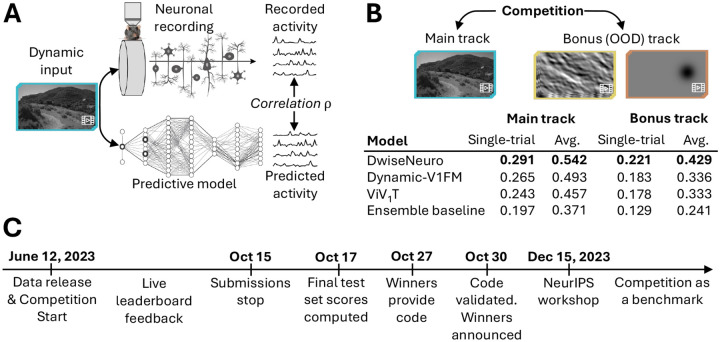
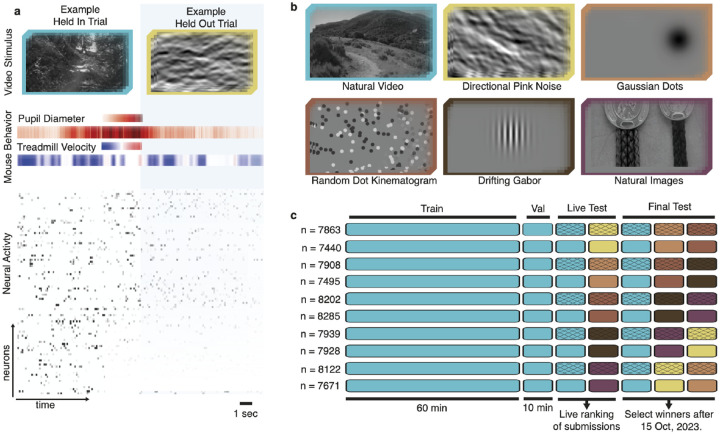
Understanding how biological visual systems process information is challenging because of the nonlinear relationship between visual input and neuronal responses. Artificial neural networks allow computational neuroscientists to create predictive models that connect biological and machine vision. Machine learning has benefited tremendously from benchmarks that compare different model on the same task under standardized conditions. However, there was no standardized benchmark to identify state-of-the-art dynamic models of the mouse visual system. To address this gap, we established the SENSORIUM 2023 Benchmark Competition with dynamic input, featuring a new large-scale dataset from the primary visual cortex of ten mice. This dataset includes responses from 78,853 neurons to 2 hours of dynamic stimuli per neuron, together with the behavioral measurements such as running speed, pupil dilation, and eye movements. The competition ranked models in two tracks based on predictive performance for neuronal responses on a held-out test set: one focusing on predicting in-domain natural stimuli and another on out-of-distribution (OOD) stimuli to assess model generalization. As part of the NeurIPS 2023 competition track, we received more than 160 model submissions from 22 teams. Several new architectures for predictive models were proposed, and the winning teams improved the previous state-of-the-art model by 50%. Access to the dataset as well as the benchmarking infrastructure will remain online at www.sensorium-competition.net.
由于视觉输入与神经元反应之间存在非线性关系,理解生物视觉系统如何处理信息具有挑战性。人工神经网络使计算神经科学家能够创建连接生物视觉和机器视觉的预测模型。机器学习从在标准化条件下对同一任务的不同模型进行比较的基准测试中受益匪浅。然而,当时没有标准化的基准来识别小鼠视觉系统的先进动态模型。为了填补这一空白,我们举办了2023年感官基准竞赛,其输入为动态输入,采用了来自十只小鼠初级视觉皮层的一个新的大规模数据集。该数据集包括78853个神经元对每个神经元两小时动态刺激的反应,以及诸如奔跑速度、瞳孔扩张和眼球运动等行为测量数据。竞赛根据在保留测试集上对神经元反应的预测性能,将模型分为两个赛道进行排名:一个赛道专注于预测域内自然刺激,另一个赛道专注于预测分布外(OOD)刺激以评估模型的泛化能力。作为2023年神经信息处理系统大会竞赛赛道的一部分,我们收到了来自22个团队的160多个模型提交。提出了几种用于预测模型的新架构,获胜团队将之前的先进模型提高了50%。数据集以及基准测试基础设施将继续在www.sensorium-competition.net上在线提供。