Lin Jia, Wang Jingrao, Feng Jiaoyang, Zhu Rui, Guo Yu, Dong Yueyan, Zhang Hong, Jin Xin
Department of Ophthalmology, The First Affiliated Hospital of Harbin Medical University, Harbin, China.
Front Microbiol. 2024 Jul 8;15:1389139. doi: 10.3389/fmicb.2024.1389139. eCollection 2024.
To elucidate the reasons behind the increased incidence of ocular disease in patients with coronavirus disease 2019 (COVID-19), this study delved deeper into the specific effects of COVID-19 on patients' ocular surface microbiome (OSM) and investigated its relationship with the increased incidence of ocular disease.
In this study, conjunctival sac swabs were collected from 43 participants for 16S rRNA amplicon sequencing. The participants were categorized into three groups based on their COVID-19 status: the control group (C group) consisted of 15 participants who showed no evidence of COVID-19, the experimental group (E group) included 15 participants who tested positive for COVID-19, and the COVID-19 recovery period group (R group) comprised 13 participants.
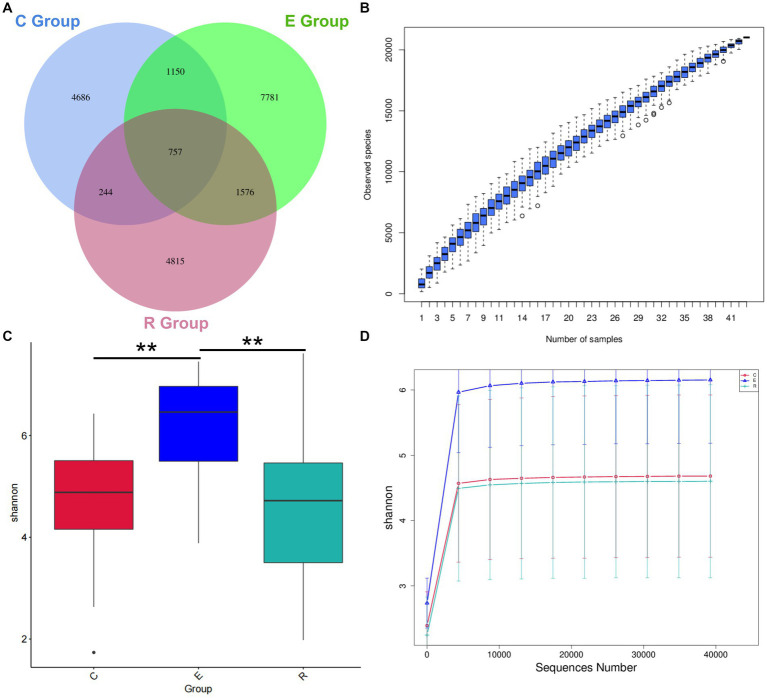
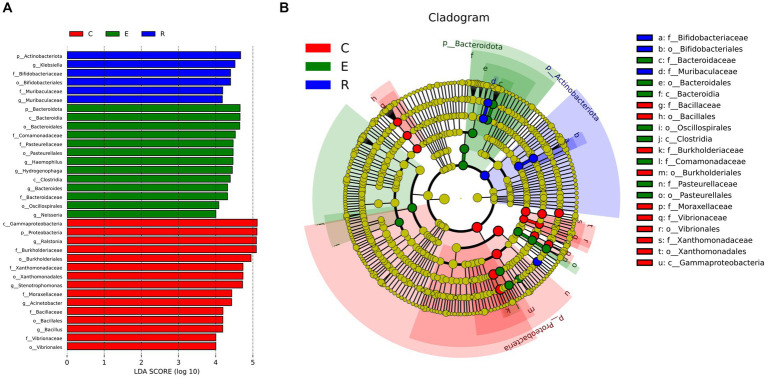
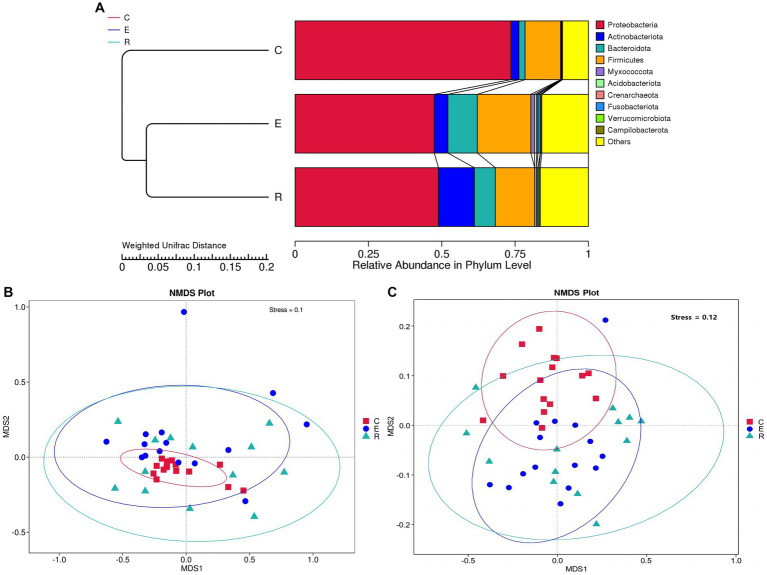
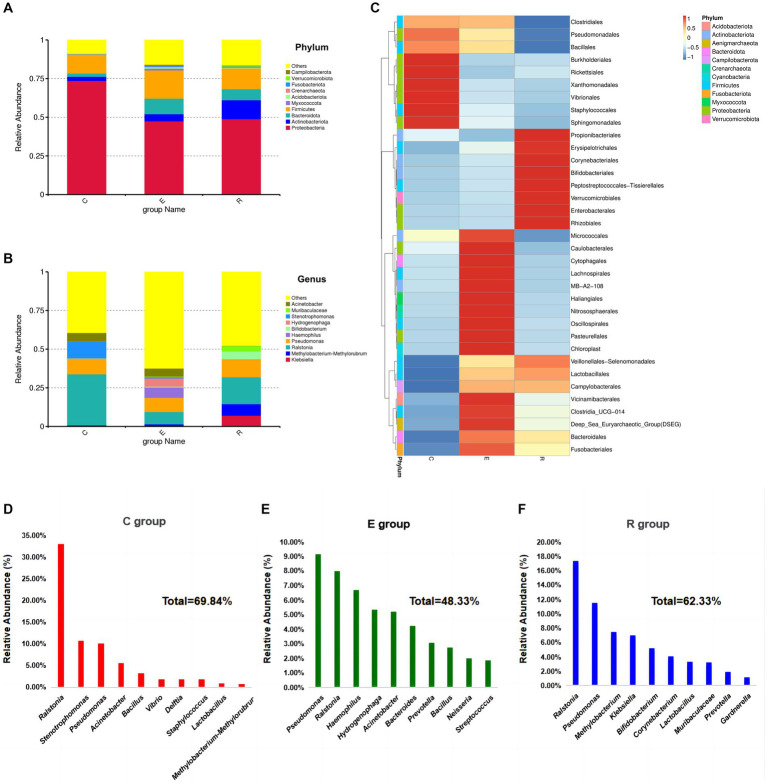
In the comparison of alpha diversity, group E had a higher Shannon, Chao1 and Goods coverage index. When comparing beta diversity, groups E and R were more similar to each other. At the phylum level, although the OSM of the three groups was dominated by , , and , the compositional proportions were significantly different. At the genus level, the dominant species in the three OSM groups were significantly different, with becoming the dominant genus in groups E and R compared to group C, and the abundance of decreasing significantly.
This study provides additional evidence supporting the association between the OSM and COVID-19, which contributes to our understanding of the potential mechanisms underlying ocular symptoms and complications associated with COVID-19 in the future.
为阐明2019冠状病毒病(COVID-19)患者眼部疾病发病率增加的原因,本研究更深入地探究了COVID-19对患者眼表微生物群(OSM)的具体影响,并研究了其与眼部疾病发病率增加之间的关系。
在本研究中,收集了43名参与者的结膜囊拭子进行16S rRNA扩增子测序。参与者根据其COVID-19状态分为三组:对照组(C组)由15名无COVID-19证据的参与者组成,实验组(E组)包括15名COVID-19检测呈阳性的参与者,COVID-19恢复期组(R组)由13名参与者组成。
在α多样性比较中,E组的香农、Chao1和古德覆盖指数更高。在比较β多样性时,E组和R组彼此更相似。在门水平上,尽管三组的OSM均以 、 、 和 为主,但组成比例存在显著差异。在属水平上,三个OSM组中的优势物种显著不同,与C组相比, 和 在E组和R组中成为优势属,而 的丰度显著降低。
本研究提供了额外的证据支持OSM与COVID-19之间的关联,这有助于我们未来理解与COVID-19相关的眼部症状和并发症的潜在机制。