Department of Cardiology and Angiology I, Medical Center, University of Freiburg, 79106 Freiburg, Germany.
Faculty of Medicine, University of Freiburg, 79106 Freiburg, Germany.
Cardiovasc Res. 2024 Nov 25;120(14):1713-1726. doi: 10.1093/cvr/cvae154.
The distinct functions of immune cells in atherosclerosis have been mostly defined by pre-clinical mouse studies. Contrastingly, the immune cell composition of human atherosclerotic plaques and their contribution to disease progression are only poorly understood. It remains uncertain whether genetic animal models allow for valuable translational approaches.
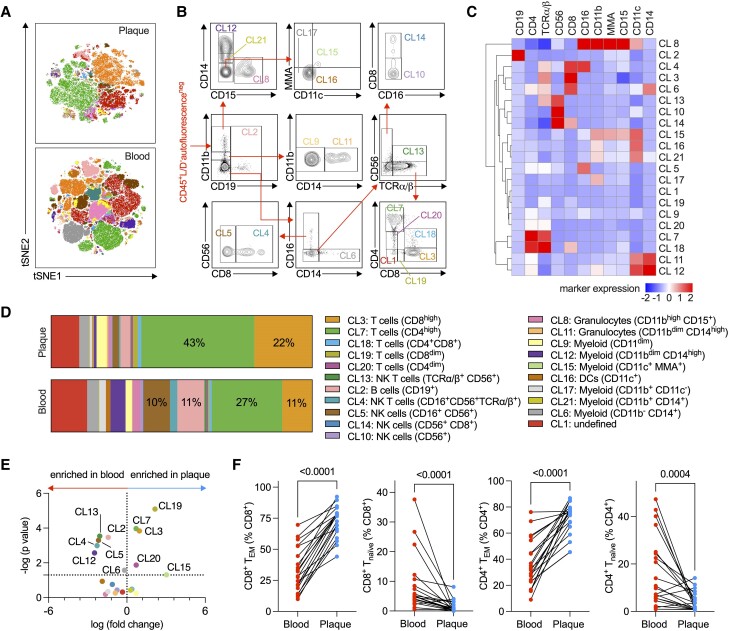
Single-cell RNA-sequencing (scRNA-seq) was performed to define the immune cell landscape in human carotid atherosclerotic plaques. The human immune cell repertoire demonstrated an unexpectedly high heterogeneity and was dominated by cells of the T-cell lineage, a finding confirmed by immunohistochemistry. Bioinformatical integration with 7 mouse scRNA-seq data sets from adventitial and atherosclerotic vascular tissue revealed a total of 51 identities of cell types and differentiation states, of which some were only poorly conserved between species and exclusively found in humans. Locations, frequencies, and transcriptional programmes of immune cells in mouse models did not resemble the immune cell landscape in human carotid atherosclerosis. In contrast to standard mouse models of atherosclerosis, human plaque leucocytes were dominated by several T-cell phenotypes with transcriptional hallmarks of T-cell activation and memory formation, T-cell receptor, and pro-inflammatory signalling. Only mice at the age of 22 months partially resembled the activated T-cell phenotype. In a validation cohort of 43 patients undergoing carotid endarterectomy, the abundance of activated immune cell subsets in the plaque defined by multi-colour flow cytometry associated with the extent of clinical atherosclerosis.
Integrative scRNA-seq reveals a substantial difference in the immune cell composition of murine and human carotid atherosclerosis-a finding that questions the translational value of standard mouse models for adaptive immune cell studies. Clinical associations suggest a specific role for T-cell driven (auto-)immunity in human plaque formation and instability.
免疫细胞在动脉粥样硬化中的独特功能主要是通过临床前小鼠研究来定义的。相比之下,人类动脉粥样硬化斑块中的免疫细胞组成及其对疾病进展的贡献知之甚少。遗传动物模型是否允许有价值的转化方法仍不确定。
进行单细胞 RNA 测序 (scRNA-seq) 以定义人类颈动脉粥样硬化斑块中的免疫细胞景观。人类免疫细胞库表现出出乎意料的高度异质性,并以 T 细胞谱系的细胞为主,这一发现通过免疫组织化学得到证实。与来自外膜和动脉粥样硬化血管组织的 7 个小鼠 scRNA-seq 数据集的生物信息学整合揭示了总共 51 种细胞类型和分化状态的身份,其中一些在物种间差异很大,仅在人类中发现。在小鼠模型中,免疫细胞的位置、频率和转录程序与人类颈动脉粥样硬化中的免疫细胞景观并不相似。与动脉粥样硬化的标准小鼠模型相反,人类斑块白细胞主要由几种 T 细胞表型组成,具有 T 细胞激活和记忆形成、T 细胞受体和促炎信号的转录特征。只有 22 个月大的小鼠部分类似于激活的 T 细胞表型。在接受颈动脉内膜切除术的 43 名患者的验证队列中,通过多色流式细胞术定义的斑块中激活免疫细胞亚群的丰度与临床动脉粥样硬化的程度相关。
整合 scRNA-seq 揭示了鼠类和人类颈动脉粥样硬化中免疫细胞组成的实质性差异——这一发现对标准小鼠模型在适应性免疫细胞研究中的转化价值提出了质疑。临床相关性表明 T 细胞驱动的(自身)免疫在人类斑块形成和不稳定性中具有特定作用。