Arrigoni Sara C, Berger Rolf M F, Ebels Tjark, Postmus Douwe, Hoendermis Elke S, Schoof Paul H, Willems Tineke P, van Melle Joost P
Department of Cardiothoracic Surgery, University of Groningen, University Medical Center Groningen, Hanzeplein 1, PO Box 30.001, Groningen 9700 RB, The Netherlands.
Department of Pediatric Cardiology, University of Groningen, University Medical Center Groningen, Groningen, The Netherlands.
Eur Heart J Imaging Methods Pract. 2023 Nov 27;1(2):qyad039. doi: 10.1093/ehjimp/qyad039. eCollection 2023 Sep.
Cardiac magnetic resonance (CMR) imaging is a main diagnostic tool in the follow-up of Fontan patients. However, the value of serial CMR for the evaluation of Fontan attrition is unknown. The aim of this prospective study of serial CMR is to describe the analysis of time-dependent evolution of blood flow distribution, ventricular volumes, and function in patients after Fontan completion.
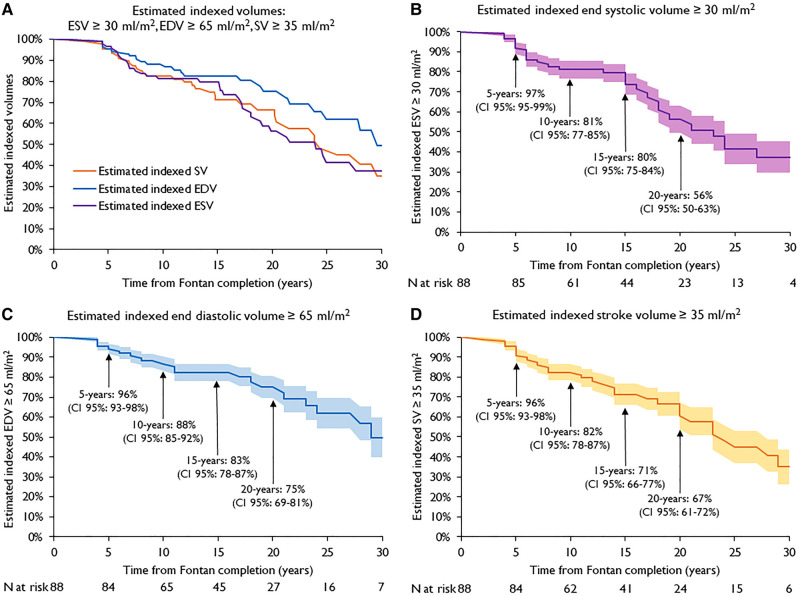
In this prospective single-centre study, between 2012 and 2022, 281 CMR examinations were performed in 88 Fontan patients with distribution of blood flows, measurements of ventricular volumes, and ejection fraction. Linear mixed model regression for repeated measurements was used to analyse changes of measurements across serial CMR examinations. During a time interval of 10 years, the median number of CMR per patient was 3 (range 1-5). Indexed flow of ascending aorta, caval veins, and pulmonary arteries decreased significantly across serial CMR examinations. Although a decrease of mean indexed aortic flow (3.03 ± 0.10 L/min/m at first CMR vs. 2.36 ± 0.14 L/min/m at fourth CMR, < 0.001) was observed, ejection fraction did not decline (50 ± 1% at first CMR vs. 54 ± 2% at fourth CMR, = 0.070). Indexed ventricular volumes did not differ significantly across serial CMR examinations.
The decrease of indexed aortic and cavopulmonary flows reflects the attrition of univentricular circulation and can be detected by means of serial CMR. Ventricular systolic dysfunction does not contribute significantly to this attrition. In order to detect significant change of indexed aortic flow, we recommend performing serial CMR as routine practice in the Fontan population.
心脏磁共振成像(CMR)是Fontan手术患者随访中的主要诊断工具。然而,连续CMR评估Fontan手术减效的价值尚不清楚。这项连续CMR的前瞻性研究旨在描述Fontan手术完成后患者血流分布、心室容积和功能随时间变化的分析。
在这项前瞻性单中心研究中,2012年至2022年间,对88例Fontan手术患者进行了281次CMR检查,包括血流分布、心室容积测量和射血分数测定。采用重复测量的线性混合模型回归分析连续CMR检查中测量值的变化。在10年的时间间隔内,每位患者CMR检查的中位数为3次(范围1 - 5次)。连续CMR检查中,升主动脉、腔静脉和肺动脉的指数化血流显著下降。虽然观察到平均指数化主动脉血流减少(首次CMR时为3.03±0.10L/min/m²,第四次CMR时为2.36±0.14L/min/m²,P<0.001),但射血分数未下降(首次CMR时为50±1%,第四次CMR时为54±2%,P = 0.070)。连续CMR检查中,指数化心室容积无显著差异。
指数化主动脉和腔肺血流的减少反映了单心室循环的减效,可通过连续CMR检测到。心室收缩功能障碍对这种减效的影响不显著。为了检测指数化主动脉血流的显著变化,我们建议在Fontan患者群体中常规进行连续CMR检查。