Morbach Caroline, Simon Isabelle, Danner Elisabeth, Gelbrich Götz, Stefenelli Ulrich, Sahiti Floran, Scholz Nina, Cejka Vladimir, Albert Judith, Ertl Georg, Angermann Christiane E, Güder Gülmisal, Frantz Stefan, Heuschmann Peter U, Maack Christoph, Störk Stefan
Department Clinical Research and Epidemiology, Comprehensive Heart Failure Center, University Hospital Würzburg, Am Schwarzenberg 15, 97078 Würzburg, Germany.
Department Medicine I, University Hospital Würzburg, Oberdürrbacherstr. 6, 97080 Würzburg, Germany.
Eur Heart J Imaging Methods Pract. 2023 Sep 12;1(2):qyad020. doi: 10.1093/ehjimp/qyad020. eCollection 2023 Sep.
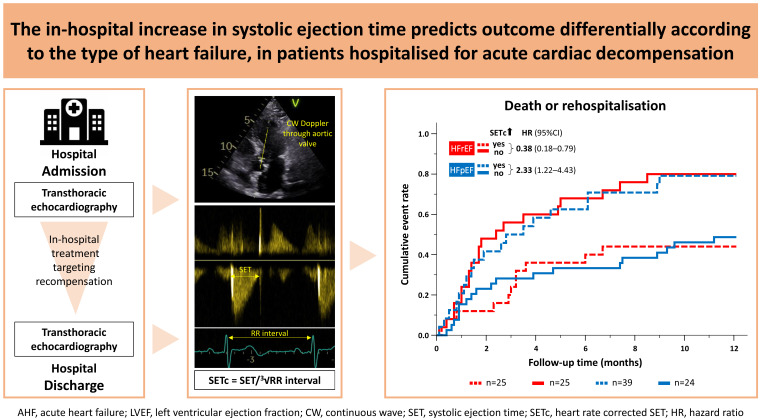
Systolic ejection time (SET) is discussed as a treatment target in patients with heart failure (HF) and a reduced left ventricular (LV) ejection fraction (EF). We derived reference values for SET correcting for its dependence on heart rate (SETc), and explored its prognostic utility in patients admitted with decompensated HF.
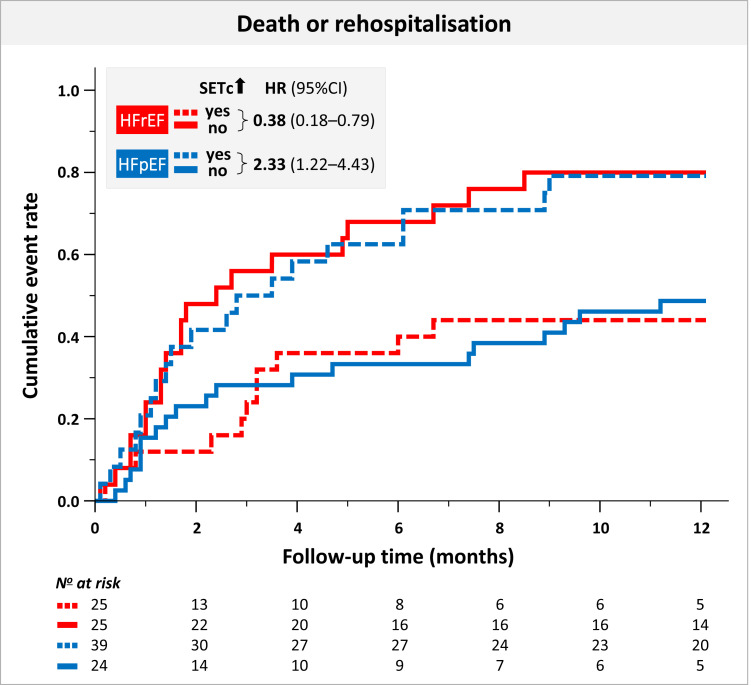
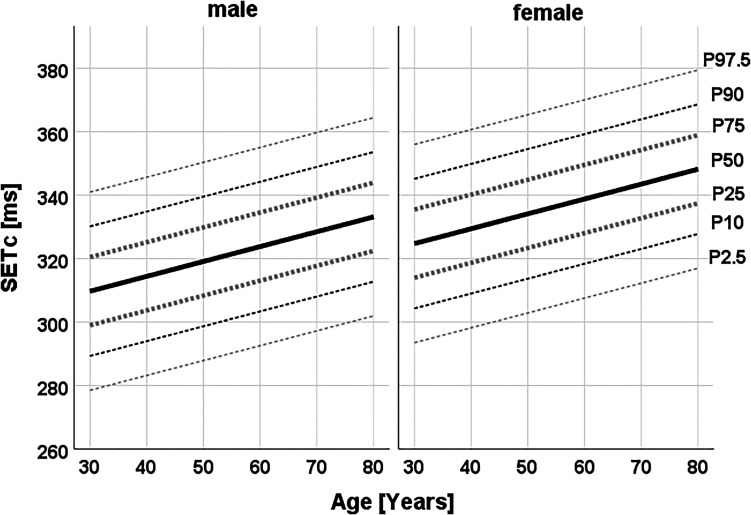
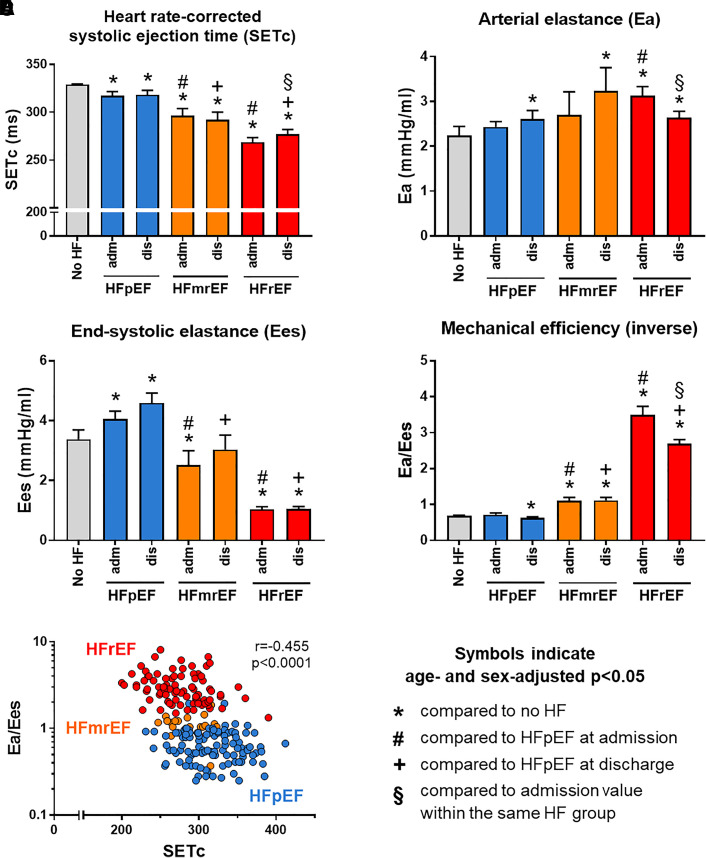
SETc was derived in 4836 participants of the population-based STAAB study (mean age 55 ± 12 years, 52% women). There, mean SETc was 328 ± 18 ms, increased with age (+4.7 ms per decade), was shorter in men than women (-14.9 ms), and correlated with arterial elastance ( = 0.30; all < 0.001). In 134 patients hospitalized with acute HF, SETc at admission was shorter when compared with the general population and differed between patients with HF with reduced EF (HFrEF; LVEF ≤40%; 269 ± 35 ms), HF with mildly reduced EF (HFmrEF; LVEF 41-49%; 294 ± 27 ms), and HF with preserved EF (HFpEF; LVEF ≥50%; 317 ± 35 ms; < 0.001). In proportional hazard regression, an in-hospital increase in SETc was associated with an age- and sex-adjusted hazard ratio of 0.38 (95% confidence interval 0.18-0.79) in patients with HFrEF, but a hazard ratio of 2.39 (95% confidence interval 1.24-4.64) in patients with HFpEF.
In the general population, SETc increased with age and an elevated afterload. SETc was mildly reduced in patients hospitalized with HFpEF, but markedly reduced in patients with HFrEF. In-hospital prolongation of SETc predicted a favourable outcome in HFrEF, but an adverse outcome in HFpEF. Our results support the concept of a U-shaped relationship between cardiac systolic function and risk, providing a rationale for a more individualized treatment approach in patients with HF.
收缩期射血时间(SET)被探讨作为心力衰竭(HF)且左心室(LV)射血分数(EF)降低患者的治疗靶点。我们得出了校正心率依赖性后的SET参考值(SETc),并探讨了其在失代偿性HF住院患者中的预后价值。
在基于人群的STAAB研究的4836名参与者中得出SETc(平均年龄55±12岁,52%为女性)。在该研究中,平均SETc为328±18毫秒,随年龄增加(每十年增加4.7毫秒),男性比女性短(-14.9毫秒),且与动脉弹性相关(r=0.30;所有P<0.001)。在134例急性HF住院患者中,入院时的SETc与一般人群相比更短,且在射血分数降低的HF(HFrEF;LVEF≤40%;269±35毫秒)、射血分数轻度降低的HF(HFmrEF;LVEF 41-49%;294±27毫秒)和射血分数保留的HF(HFpEF;LVEF≥50%;317±35毫秒)患者之间存在差异(P<0.001)。在比例风险回归分析中,HFrEF患者住院期间SETc升高与年龄和性别校正后的风险比为0.38(95%置信区间0.18-0.79)相关,但HFpEF患者的风险比为2.39(95%置信区间1.24-4.64)。
在一般人群中,SETc随年龄和后负荷升高而增加。HFpEF住院患者的SETc轻度降低,但HFrEF患者显著降低。住院期间SETc延长在HFrEF中预示良好结局,但在HFpEF中预示不良结局。我们的结果支持心脏收缩功能与风险之间呈U形关系的概念,为HF患者更个体化的治疗方法提供了理论依据。