Department of Plant and Microbial Biology, University of California, Berkeley, CA 94720, United States.
California Institute for Quantitative Biosciences (QB3), University of California, Berkeley, CA 94720, United States.
ISME J. 2024 Jan 8;18(1). doi: 10.1093/ismejo/wrae140.
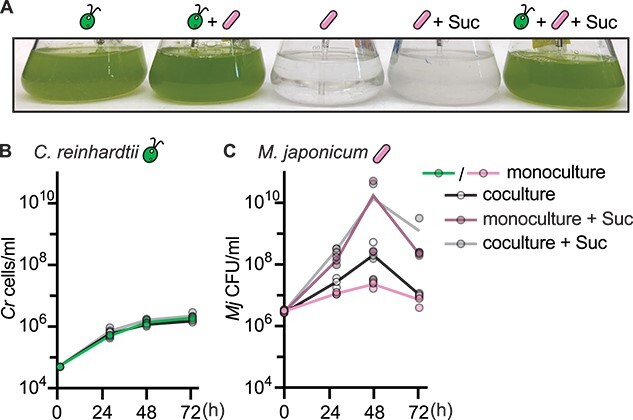
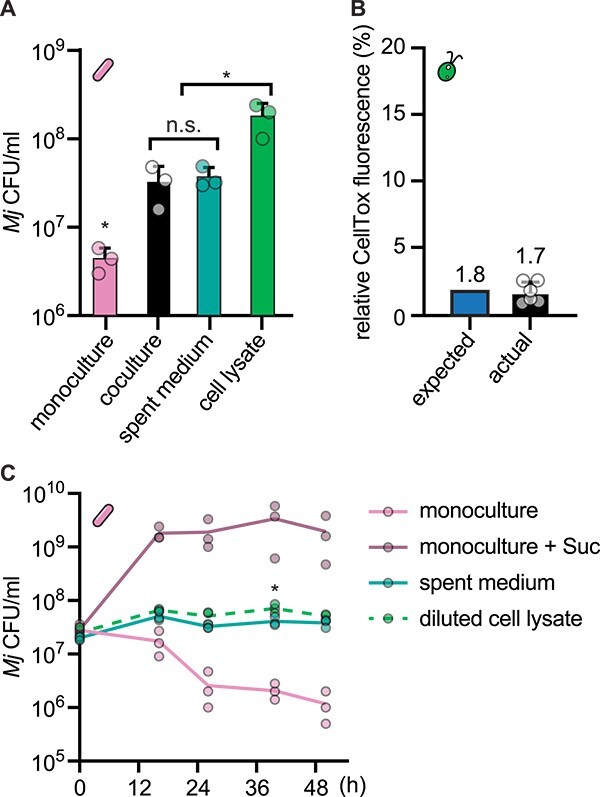
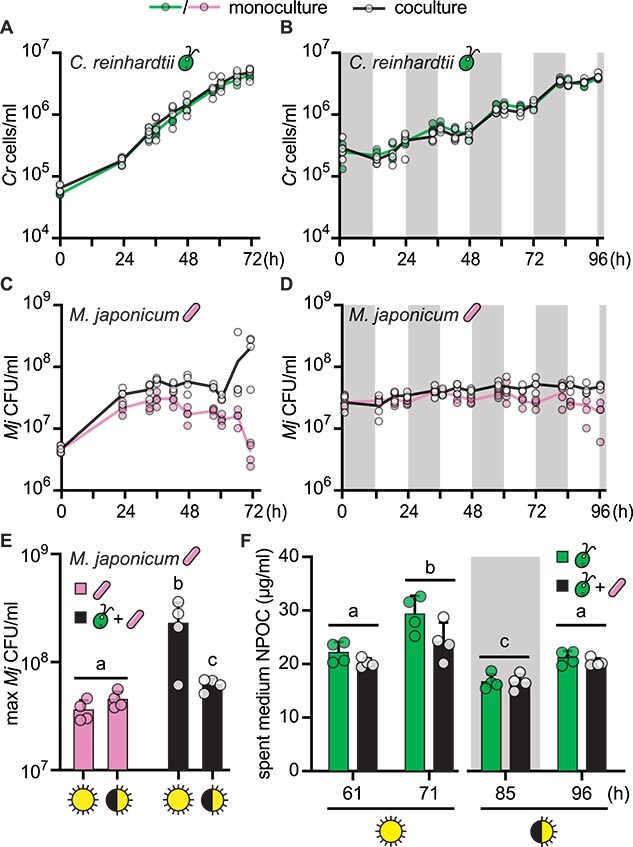
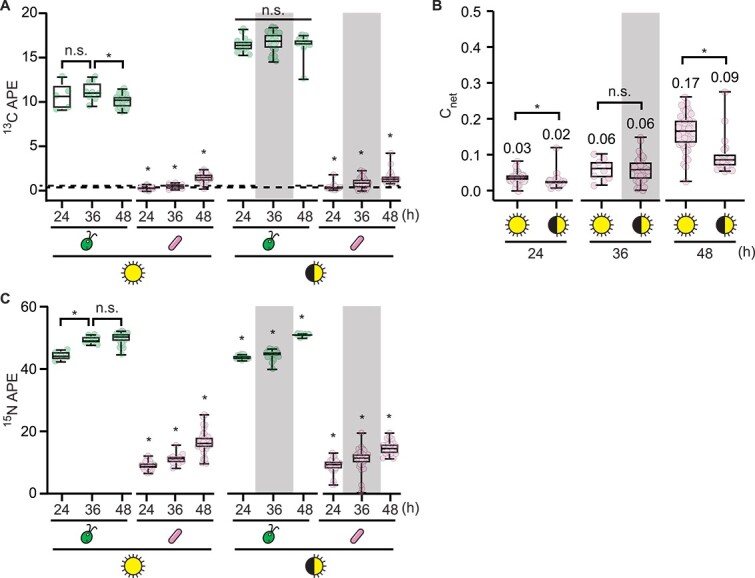
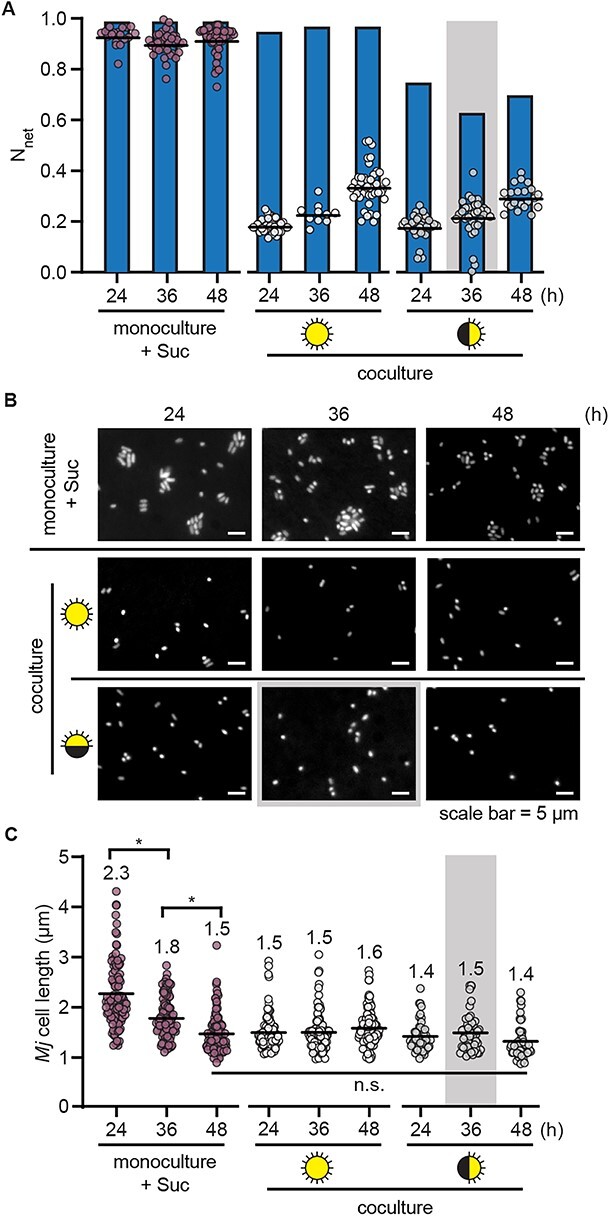
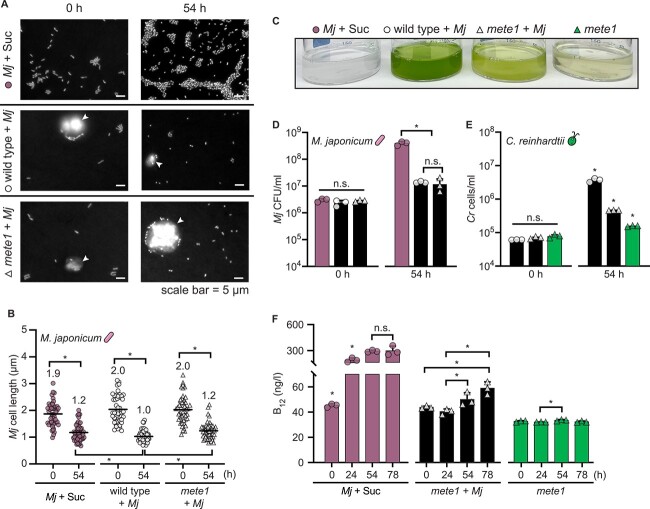
Although the green alga Chlamydomonas reinhardtii has long served as a reference organism, few studies have interrogated its role as a primary producer in microbial interactions. Here, we quantitatively investigated C. reinhardtii's capacity to support a heterotrophic microbe using the established coculture system with Mesorhizobium japonicum, a vitamin B12-producing α-proteobacterium. Using stable isotope probing and nanoscale secondary ion mass spectrometry (nanoSIMS), we tracked the flow of photosynthetic fixed carbon and consequent bacterial biomass synthesis under continuous and diurnal light with single-cell resolution. We found that more 13C fixed by the alga was taken up by bacterial cells under continuous light, invalidating the hypothesis that the alga's fermentative degradation of starch reserves during the night would boost M. japonicum heterotrophy. 15NH4 assimilation rates and changes in cell size revealed that M. japonicum cells reduced new biomass synthesis in coculture with the alga but continued to divide-a hallmark of nutrient limitation often referred to as reductive division. Despite this sign of starvation, the bacterium still synthesized vitamin B12 and supported the growth of a B12-dependent C. reinhardtii mutant. Finally, we showed that bacterial proliferation could be supported solely by the algal lysis that occurred in coculture, highlighting the role of necromass in carbon cycling. Collectively, these results reveal the scarcity of fixed carbon in this microbial trophic relationship (particularly under environmentally relevant light regimes), demonstrate B12 exchange even during bacterial starvation, and underscore the importance of quantitative approaches for assessing metabolic coupling in algal-bacterial interactions.
虽然绿藻莱茵衣藻长期以来一直被作为参考生物,但很少有研究探讨其作为微生物相互作用中的初级生产者的作用。在这里,我们使用与产维生素 B12 的α-变形菌根瘤菌建立的共培养系统,定量研究了莱茵衣藻支持异养微生物的能力。使用稳定同位素示踪和纳米二次离子质谱(nanoSIMS),我们以单细胞分辨率跟踪了在连续和昼夜光照下光合作用固定碳的流动和随后的细菌生物量合成。我们发现,在连续光照下,更多由藻类固定的 13C 被细菌细胞吸收,这否定了藻类在夜间发酵降解淀粉储备会促进根瘤菌异养的假设。15NH4 同化率和细胞大小的变化表明,根瘤菌在与藻类共培养时减少了新的生物量合成,但仍继续分裂——这是通常被称为还原分裂的营养限制的标志。尽管存在这种饥饿的迹象,细菌仍合成了维生素 B12 并支持依赖 B12 的莱茵衣藻突变体的生长。最后,我们表明,仅通过共培养中发生的细菌裂解就可以支持细菌的增殖,这突出了腐生生物量在碳循环中的作用。总之,这些结果揭示了在这种微生物营养关系中固定碳的稀缺性(特别是在环境相关的光照条件下),即使在细菌饥饿期间也证明了 B12 的交换,并强调了定量方法在评估藻类-细菌相互作用中的代谢偶联的重要性。