Ruiz Ana Corrêa, de Lara Machado Wagner, D'avila Helen Freitas, Feoli Ana Maria Pandolfo
Postgraduate Program in Psychology, Pontifícia Universidade Católica Do Rio Grande Do Sul, Av. Ipiranga, 6681-Partenon, Porto Alegre, Brazil-RS, 90619-900, Brazil.
Postgraduate Program in Health Promotion, University of Santa Cruz do Sul, Av. Independência, 2293, Santa Cruz do Sul, Brazil-RS, 96815-900, Brazil.
Psicol Reflex Crit. 2024 Jul 25;37(1):28. doi: 10.1186/s41155-024-00306-1.
The recurrence of weight gain is attributed to the homeostatic regulation of hunger and satiety signals, influenced by metabolic state, nutrient availability, and non-homeostatic mechanisms shaped by reinforced consequences from experiences. In response, Evelyn Tribole and Elyse Resch proposed Intuitive Eating (IE) in 1980, countering restrictive diets. IE, inversely correlated with Body Mass Index (BMI), binge eating, and anxiety/depression symptoms, fosters mind-body-food harmony by recognizing hunger and satiety cues. IE encourages meeting physiological, not emotional, needs, permitting unconditional eating, and relying on internal signals for food decisions. Amidst university students' stress, exacerbated during the COVID-19 pandemic, understanding their eating behavior, particularly intuitive eating levels, becomes crucial.
This study aimed to assess the IE level of Brazilian students during the COVID-19 pandemic.
This cross-sectional study, the first to analyze the Intuitive Eating of students in Brazil during the pandemic, was conducted using an online questionnaire.
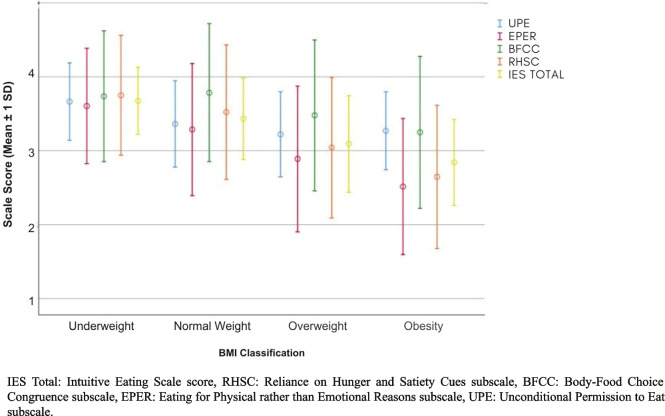
The sample comprised 1335 students, most of whom were women (82.17%), with a mean age of 26.12 ± 7.9 years, and a healthy nutritional status (57.58%). The mean IE score was 3.2 ± 0.6. A significant association was found between the confinement situation, the type of housing unit, and the IE subscale-Unconditional Permission to Eat (p = 0.043). However, there was no association between the other subscales and the total IE scale. Regarding self-reported mental and eating disorders, the most frequent were anxiety (21.2%), depression (6.5%), and binge eating disorder (BED) (4.7%). IE was negatively associated with BED (B = - 0.66; p < .001), bulimia nervosa (B = - 0.58; p < .001), body mass index (BMI) (p < .001) and self-reported anxiety (B = - .102; p = 0.16). The male sex showed a higher IE score compared with the female sex (p < .001).
While no significant association was found between IE and the confinement situation, a significant association was found between housing type and the Unconditional Permission to Eat subscale.
体重增加的复发归因于饥饿和饱腹感信号的稳态调节,这受到代谢状态、营养可利用性以及由经验强化后果所塑造的非稳态机制的影响。对此,伊芙琳·特里布尔和伊莉丝·雷施于1980年提出了直觉饮食(IE),以对抗限制性饮食。直觉饮食与体重指数(BMI)、暴饮暴食以及焦虑/抑郁症状呈负相关,它通过识别饥饿和饱腹感线索来促进身心与食物的和谐。直觉饮食鼓励满足生理需求而非情感需求,允许无条件进食,并依靠内部信号来做出食物决策。在大学生面临压力(在新冠疫情期间压力加剧)的情况下,了解他们的饮食行为,尤其是直觉饮食水平,变得至关重要。
本研究旨在评估新冠疫情期间巴西学生的直觉饮食水平。
这项横断面研究是首次分析疫情期间巴西学生的直觉饮食情况,采用在线问卷进行。
样本包括1335名学生(其中大多数为女性,占82.17%),平均年龄为26.12±7.9岁,营养状况良好(占57.58%)。直觉饮食平均得分为3.2±0.6。在隔离情况、住房类型与直觉饮食子量表——无条件进食许可之间发现了显著关联(p = 0.043)。然而,其他子量表与直觉饮食总量表之间没有关联。关于自我报告的心理和饮食障碍,最常见的是焦虑(21.2%)、抑郁(6.5%)和暴饮暴食障碍(BED,4.7%)。直觉饮食与暴饮暴食障碍(B = -0.66;p <.001)、神经性贪食症(B = -0.58;p <.001)、体重指数(BMI)(p <.001)以及自我报告的焦虑(B = -.102;p = 0.16)呈负相关。男性的直觉饮食得分高于女性(p <.001)。
虽然未发现直觉饮食与隔离情况之间存在显著关联,但在住房类型与无条件进食许可子量表之间发现了显著关联。