Department of Environmental Health Sciences, Mailman School of Public Health, Columbia University, New York, New York 10032, United States.
School of Engineering, Brown University, Providence, Rhode Island 02912, United States.
Environ Sci Technol. 2024 Aug 6;58(31):13594-13604. doi: 10.1021/acs.est.3c10314. Epub 2024 Jul 25.
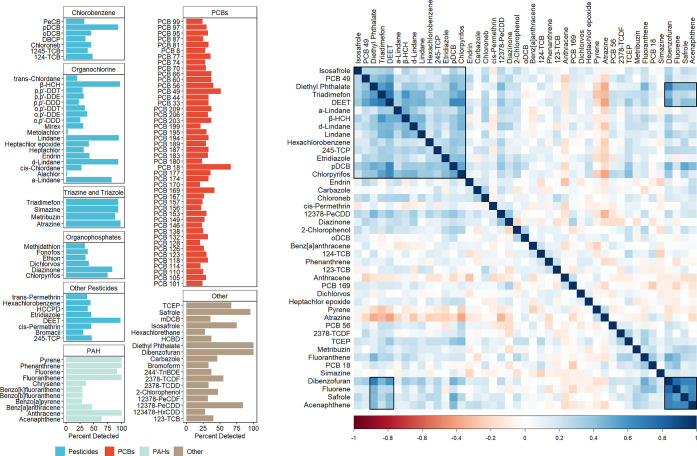
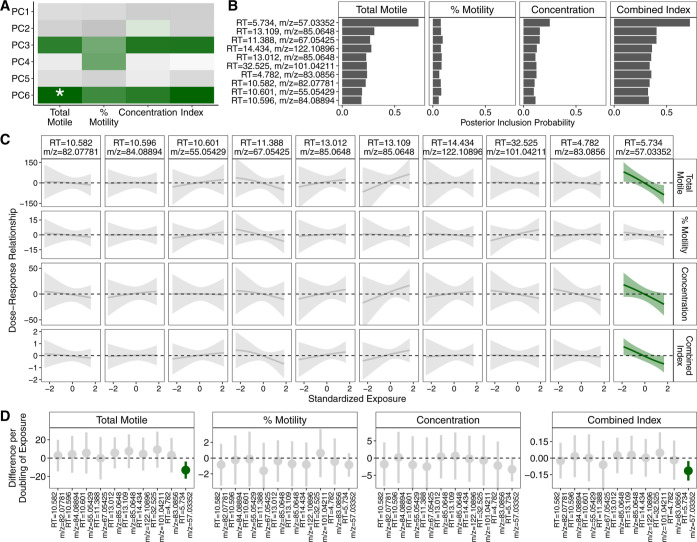
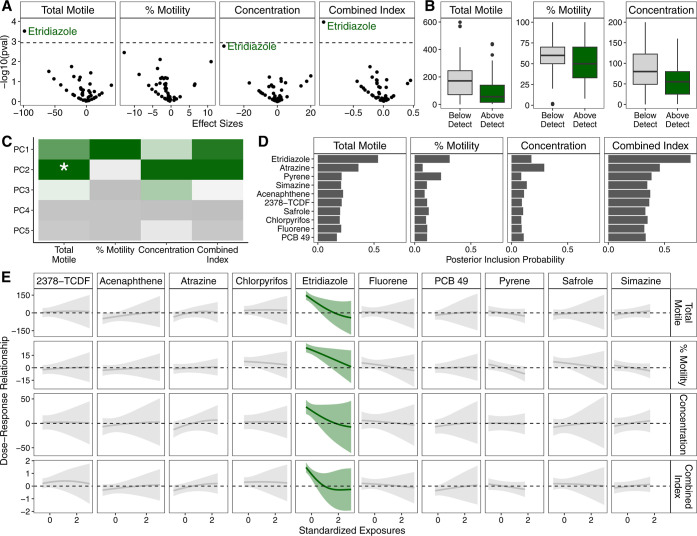
Indicators of male fertility are in decline globally, but the underlying causes, including the role of environmental exposures, are unclear. This study aimed to examine organic chemical pollutants in seminal plasma, including both known priority environmental chemicals and less studied chemicals, to identify uncharacterized male reproductive environmental toxicants. Semen samples were collected from 100 individuals and assessed for sperm concentration, percent motility, and total motile sperm. Targeted and nontargeted organic pollutant exposures were measured from seminal plasma using gas chromatography, which showed widespread detection of organic pollutants in seminal plasma across all exposure classes. We used principal component pursuit (PCP) on our targeted panel and derived one component (driven by etriadizole) associated with total motile sperm ( < 0.001) and concentration ( = 0.03). This was confirmed by the exposome-wide association models using individual chemicals, where etriadizole was negatively associated with total motile sperm (FDR = 0.01) and concentration ( = 0.07). Using PCP on 814 nontargeted spectral peaks identified a component that was associated with total motile sperm ( = 0.001). Bayesian kernel machine regression identified one principal driver of this association, which was analytically confirmed to be -nitrosodiethylamine. These findings are promising and consistent with experimental evidence showing that etridiazole and -nitrosodiethylamine may be reproductive toxicants.
全球男性生育力的指标正在下降,但潜在原因,包括环境暴露的作用,尚不清楚。本研究旨在检测精液中的有机化学污染物,包括已知的优先环境化学物质和研究较少的化学物质,以确定未被识别的男性生殖环境毒物。从 100 个人中收集精液样本,并评估精子浓度、运动百分比和总活动精子。使用气相色谱法从精液中测量目标和非目标有机污染物暴露情况,结果显示所有暴露组别的精液中都广泛检测到有机污染物。我们使用靶向面板上的主成分追踪(PCP),并得出一个与总活动精子(<0.001)和浓度(=0.03)相关的成分(由三氮唑驱动)。这通过使用个体化学物质的暴露组全关联模型得到了证实,其中三氮唑与总活动精子呈负相关(FDR=0.01)和浓度(=0.07)。使用 814 个非靶向光谱峰上的 PCP 确定了一个与总活动精子相关的成分(=0.001)。贝叶斯核机器回归确定了这一关联的一个主要驱动因素,经分析证实为 -亚硝基二乙胺。这些发现很有希望,并且与实验证据一致,表明三氮唑和 -亚硝基二乙胺可能是生殖毒物。