Zhuang Jin-Da, Shi Jin-Min, Hong Chen-Cheng, Wu Ting-Ting, Liu Li, Voglmeir Josef
Glycomics and Glycan Bioengineering Research Center (GGBRC), College of Food Science and Technology Nanjing Agricultural University, 1 Weigang, 210095 Nanjing, China.
JACS Au. 2024 Jun 20;4(7):2557-2563. doi: 10.1021/jacsau.4c00288. eCollection 2024 Jul 22.
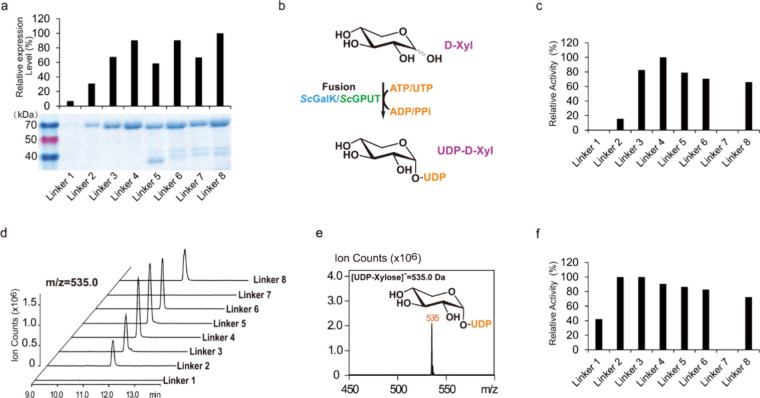
The biotechnological production of uridine diphosphate-d-xylose (UDP-d-xylose), the glycosyl donor in enzymatic for d-xylose, is an important precursor for advancing glycoengineering research on biopharmaceuticals such as heparin and glycosaminoglycans. Leveraging a recently discovered UDP-xylose salvage pathway, we have engineered a series of bifunctional chimeric biocatalysts derived from galactokinase/uridyltransferase, facilitating the conversion of d-xylose to UDP-d-xylose. This study elucidates the novel assembly of eight fusion protein constructs, differing in domain orientations and linker peptide lengths, to investigate their functional expression in , resulting in the synthesis of the first bifunctional enzyme that orchestrates a direct transformation from d-xylose to UDP-d-xylose. Fusion constructs with a NH-GSGGGSGHM-COOH peptide linker demonstrated the highest expression and catalytic tenacity. For the highest catalytic conversion from d-xylose to UDP-d-xylose, we established an optimum pH of 7.0 and a temperature optimum of 30 °C, with an optimal fusion enzyme concentration of 3.3 mg/mL for large-scale UDP-d-xylose production. Insights into ATP and ADP inhibition further helped to optimize the reaction conditions. Testing various ratios of unfused galactokinase and uridyltransferase biocatalysts for UDP-xylose synthesis from d-xylose revealed that a 1:1 ratio was optimal. The / value for the NH-GSGGGSGHM-COOH peptide linker showed a 10% improvement compared with the unfused counterparts. The strategic design of these fusion enzymes efficiently routes for the convenient and efficient biocatalytic synthesis of xylosides in biotechnological and pharmaceutical applications.
尿苷二磷酸 - D - 木糖(UDP - D - 木糖)是用于D - 木糖的酶促反应中的糖基供体,其生物技术生产是推进肝素和糖胺聚糖等生物制药的糖工程研究的重要前体。利用最近发现的UDP - 木糖补救途径,我们设计了一系列源自半乳糖激酶/尿苷基转移酶的双功能嵌合生物催化剂,促进D - 木糖向UDP - D - 木糖的转化。本研究阐明了八种融合蛋白构建体的新型组装,这些构建体在结构域方向和连接肽长度上有所不同,以研究它们在大肠杆菌中的功能表达,从而合成了第一种协调从D - 木糖直接转化为UDP - D - 木糖的双功能酶。具有NH₂ - GSGGGSGHM - COOH肽接头的融合构建体表现出最高的表达和催化活性。为了实现从D - 木糖到UDP - D - 木糖的最高催化转化率,我们确定了最佳pH值为7.0,最佳温度为30℃,大规模生产UDP - D - 木糖的最佳融合酶浓度为3.3 mg/mL。对ATP和ADP抑制作用的深入了解进一步有助于优化反应条件。测试不同比例的未融合半乳糖激酶和尿苷基转移酶生物催化剂用于从D - 木糖合成UDP - 木糖,结果表明1:1的比例是最佳的。与未融合的对应物相比,NH₂ - GSGGGSGHM - COOH肽接头的kcat/Km值提高了10%。这些融合酶的策略性设计为生物技术和制药应用中方便高效地生物催化合成木糖苷提供了有效途径。