Lin Jialing, Zeng Chuanhui, Li Xueli, Tang Qin, Liao Jing, Jiang Yan, Zeng Xianchun
Chengdu Medical College School of Laboratory Medicine Chengdu Sichuan China.
Solid-State Fermentation Resource Utilization Key Laboratory of Sichuan Province Yibin Sichuan China.
Food Sci Nutr. 2024 Mar 18;12(7):4667-4679. doi: 10.1002/fsn3.4115. eCollection 2024 Jul.
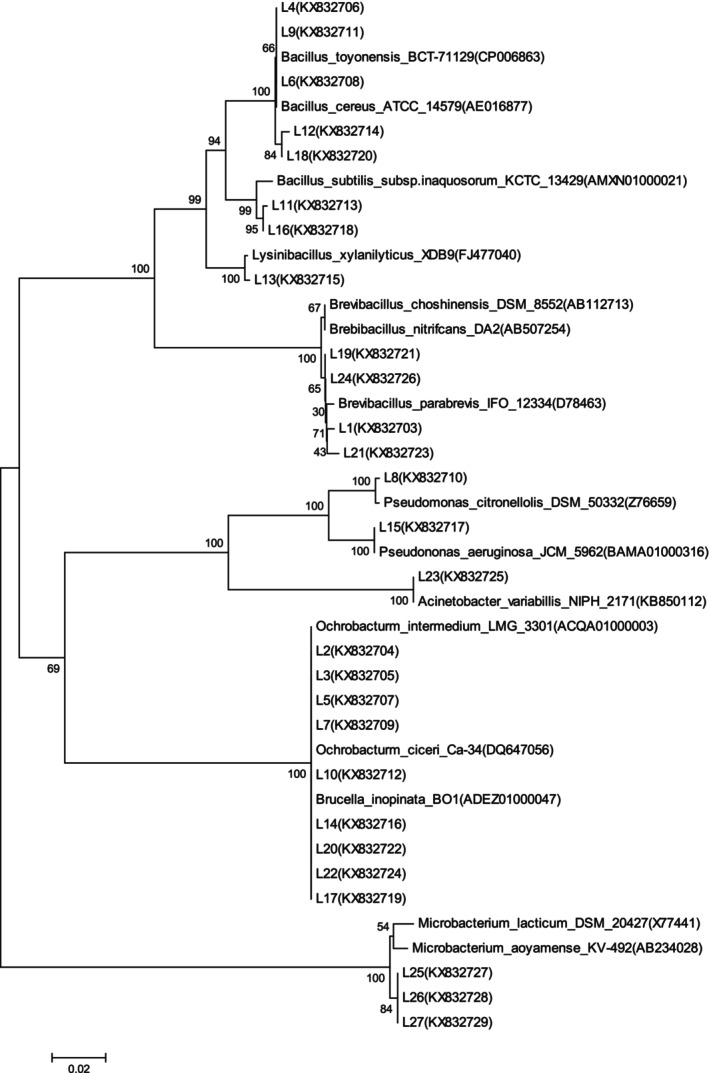
Heterocyclic amines (HAs) are a group of mutagenic and carcinogenic compounds produced from the processing of high-protein foods, which include 2-amino-3-methylimidazo[4, 5-f]quinoline (IQ) showing the strongest carcinogenic effect. Camels are able to digest HAs in foods, which provide rich microbial resources for the study. Thus, camel rumen and intestinal microbiota were used to degrade IQ, and the dominant microorganisms and their degradation characteristics were investigated. After three generations of culture with IQ as the sole carbon source, the highest abundance in rumen and intestinal microbes was found in the Proteobacteria phylum. The strains of third generation of the rumen contents were mainly attributed to the genera and , and the dominant genera in intestine were , , and . Microorganisms were further isolated and purified from the third generation cultures. These 27 strains from the rumen (L1-L27) and 23 strains from the intestine (C1-C23) were obtained. Among them, four strains with the most effective degrading abilities were as follows: L6 (28.55% of IQ degrading rate) and C1 (25.19%) belonged to the genus , L15 (23.41%) belonged to the genus , and C16 (20.89%) were of the genus . This study suggested the application of abundant microbial resources from camels' digestive tract to biodegrade foodborne toxins.
杂环胺(HAs)是一类由高蛋白食物加工过程中产生的具有致突变性和致癌性的化合物,其中2-氨基-3-甲基咪唑[4,5-f]喹啉(IQ)的致癌作用最强。骆驼能够消化食物中的杂环胺,为该研究提供了丰富的微生物资源。因此,利用骆驼瘤胃和肠道微生物群来降解IQ,并对优势微生物及其降解特性进行了研究。以IQ为唯一碳源进行三代培养后,发现瘤胃和肠道微生物中丰度最高的是变形菌门。瘤胃内容物第三代菌株主要归属于属和属,肠道中的优势属为属、属和属。从第三代培养物中进一步分离纯化微生物。获得了27株来自瘤胃的菌株(L1-L27)和23株来自肠道的菌株(C1-C23)。其中,降解能力最有效的四株菌株如下:L6(IQ降解率为28.55%)和C1(25.19%)属于属,L15(23.41%)属于属,C16(20.89%)属于属。本研究表明,可利用骆驼消化道丰富的微生物资源来生物降解食源性毒素。