Department of Biomedical Engineering, Wake Forest School of Medicine, 575 Patterson Avenue, Suite 530, Winston-Salem, NC, 27101, USA.
Virginia Tech-Wake Forest School of Biomedical Engineering and Sciences, Winston-Salem, NC, USA.
Ann Biomed Eng. 2024 Oct;52(10):2655-2665. doi: 10.1007/s10439-024-03583-0. Epub 2024 Jul 25.
Wearable sensors are used to measure head impact exposure in sports. The Head Impact Telemetry (HIT) System is a helmet-mounted system that has been commonly utilized to measure head impacts in American football. Advancements in sensor technology have fueled the development of alternative sensor methods such as instrumented mouthguards. The objective of this study was to compare peak magnitude measured from high school football athletes dually instrumented with the HIT System and a mouthpiece-based sensor system.
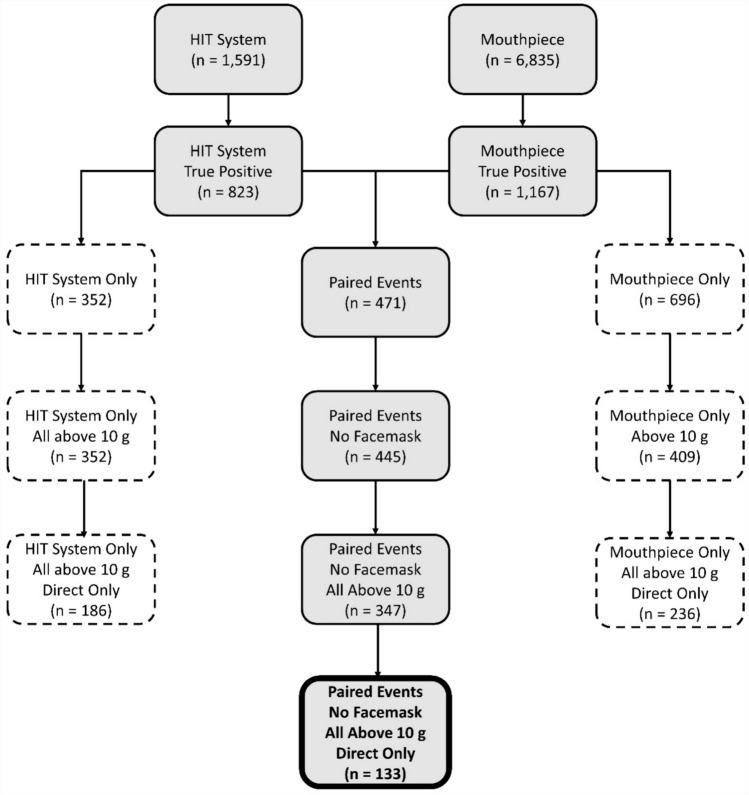
Data was collected at all contact practices and competitions over a single season of spring football. Recorded events were observed and identified on video and paired using event timestamps. Paired events were further stratified by removing mouthpiece events with peak resultant linear acceleration below 10 g and events with contact to the facemask or body of athletes.
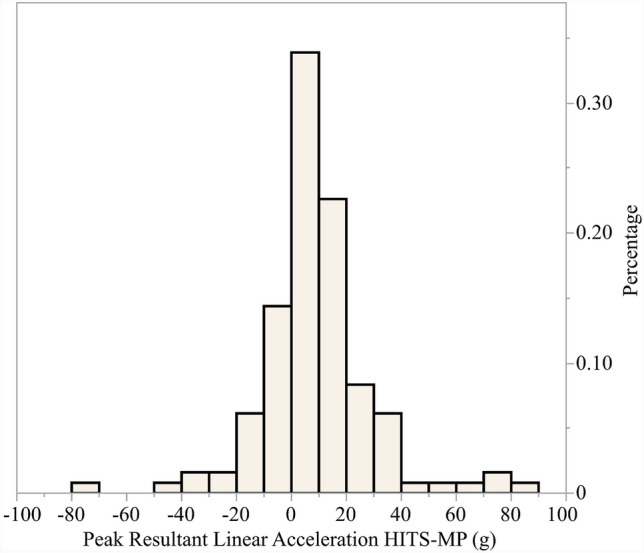
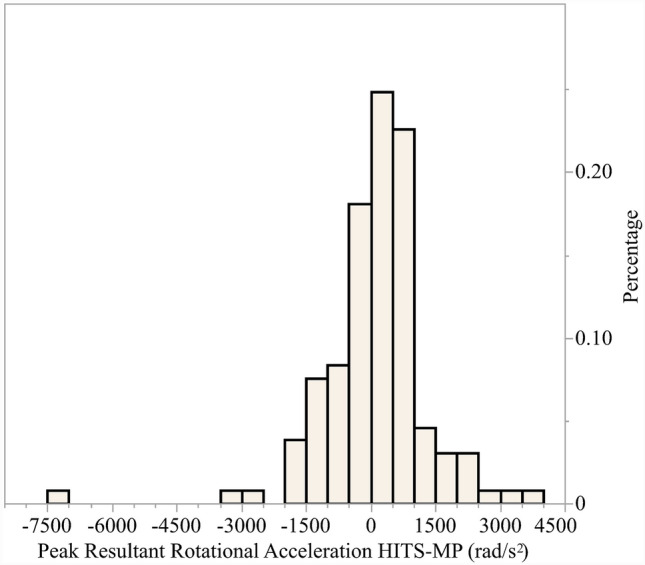
A total of 133 paired events were analyzed in the results. There was a median difference (mouthpiece subtracted from HIT System) in peak resultant linear and rotational acceleration for concurrently measured events of 7.3 g and 189 rad/s. Greater magnitude events resulted in larger kinematic differences between sensors and a Bland Altman analysis found a mean bias of 8.8 g and 104 rad/s, respectively.
If the mouthpiece-based sensor is considered close to truth, the results of this study are consistent with previous HIT System validation studies indicating low error on average but high scatter across individual events. Future researchers should be mindful of sensor limitations when comparing results collected using varying sensor technologies.
可穿戴传感器用于测量运动中的头部撞击暴露。头部撞击遥测系统(HIT)是一种头盔式系统,常用于测量美式足球中的头部撞击。传感器技术的进步推动了替代传感器方法的发展,例如带有传感器的牙套。本研究的目的是比较同时使用 HIT 系统和基于牙套的传感器系统测量的高中橄榄球队员的头部撞击峰值幅度。
在一个春季橄榄球赛季的所有接触练习和比赛中收集数据。在视频上观察和识别记录的事件,并使用事件时间戳进行配对。通过去除峰值合成线性加速度低于 10 g 的牙套事件和与运动员面罩或身体接触的事件,对配对事件进行进一步分层。
在结果中分析了总共 133 对配对事件。在同时测量的事件中,峰值合成线性和旋转加速度的中位数差异(从 HIT 系统中减去牙套)分别为 7.3 g 和 189 rad/s。更大幅度的事件导致传感器之间的运动学差异更大,Bland-Altman 分析发现平均偏差分别为 8.8 g 和 104 rad/s。
如果认为基于牙套的传感器接近真实值,那么本研究的结果与之前的 HIT 系统验证研究一致,表明平均误差较低,但单个事件的离散度较高。未来的研究人员在比较使用不同传感器技术收集的结果时,应注意传感器的局限性。