MOGAM Institute for Biomedical Research, Seoul, 06730, Republic of Korea.
CHA Vaccine Institute, Seongnamsi, Gyenggido, 13488, South Korea.
Sci Rep. 2024 Jul 26;14(1):17173. doi: 10.1038/s41598-024-67000-1.
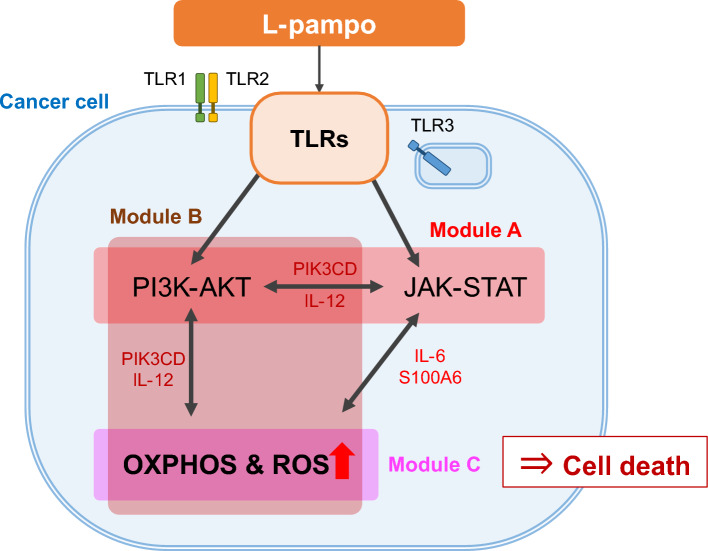
Toll-like receptors (TLRs) are critical components to stimulate immune responses against various infections. Recently, TLR agonists have emerged as a promising way to activate anti-tumor immunity. L-pampo, a TLR1/2 and TLR3 agonist, induces humoral and cellular immune responses and also causes cancer cell death. In this study, we investigated the L-pampo-induced signals and delineated their interactions with molecular signaling pathways using RNA-seq in immune cells and colon and prostate cancer cells. We first constructed a template network with differentially expressed genes and influential genes from network propagation using the weighted gene co-expression network analysis. Next, we obtained perturbed modules using the above method and extracted core submodules from them by conducting Walktrap. Finally, we reconstructed the subnetworks of major molecular signals utilizing a shortest path-finding algorithm, TOPAS. Our analysis suggests that TLR signaling activated by L-pampo is transmitted to oxidative phosphorylation (OXPHOS) with reactive oxygen species (ROS) through PI3K-AKT and JAK-STAT only in immune and prostate cancer cells that highly express TLRs. This signal flow may further sensitize prostate cancer to L-pampo due to its high basal expression level of OXPHOS and ROS. Our computational approaches can be applied for inferring underlying molecular mechanisms from complex gene expression profiles.
Toll 样受体 (TLRs) 是刺激针对各种感染的免疫反应的关键组成部分。最近,TLR 激动剂已成为激活抗肿瘤免疫的一种有前途的方法。L-pampo 是 TLR1/2 和 TLR3 的激动剂,可诱导体液和细胞免疫反应,并导致癌细胞死亡。在这项研究中,我们使用免疫细胞和结肠和前列腺癌细胞中的 RNA-seq 研究了 L-pampo 诱导的信号,并阐明了它们与分子信号通路的相互作用。我们首先使用加权基因共表达网络分析,使用网络传播中的差异表达基因和有影响力的基因构建模板网络。接下来,我们使用上述方法获得了扰动模块,并通过 Walktrap 从中提取了核心子模块。最后,我们利用最短路径查找算法 TOPAS 重建了主要分子信号的子网。我们的分析表明,只有在高表达 TLR 的免疫和前列腺癌细胞中,L-pampo 激活的 TLR 信号通过 PI3K-AKT 和 JAK-STAT 传递到活性氧 (ROS) 的氧化磷酸化 (OXPHOS)。由于 OXPHOS 和 ROS 的基础表达水平较高,这种信号流可能使前列腺癌对 L-pampo 更加敏感。我们的计算方法可用于从复杂的基因表达谱中推断潜在的分子机制。