Department of Medical Oncology, Faculty of Medicine, Ondokuz Mayıs University, Samsun, Turkey.
Department of Internal Medicine, Faculty of Medicine, Ondokuz Mayıs University, Samsun, Turkey.
BMC Neurol. 2024 Jul 26;24(1):260. doi: 10.1186/s12883-024-03639-7.
We aimed to investigate whether the HALP score was a predictor of survival in patients with Glioblastoma (GBM).
A total of 84 Glioblastoma (GBM) patients followed in our clinic were included in the study. HALP scores were calculated using the preoperative hemoglobin, albumin, lymphocyte and platelet results of the patients. For the HALP score, a cut-off value was found by examining the area below the receiver operating characteristic (ROC) curve. Patients were divided into two groups as low and high according to this cut-off value. The relationships among the clinical, dermographic and laboratory parameters of the patients were examined using these two groups.
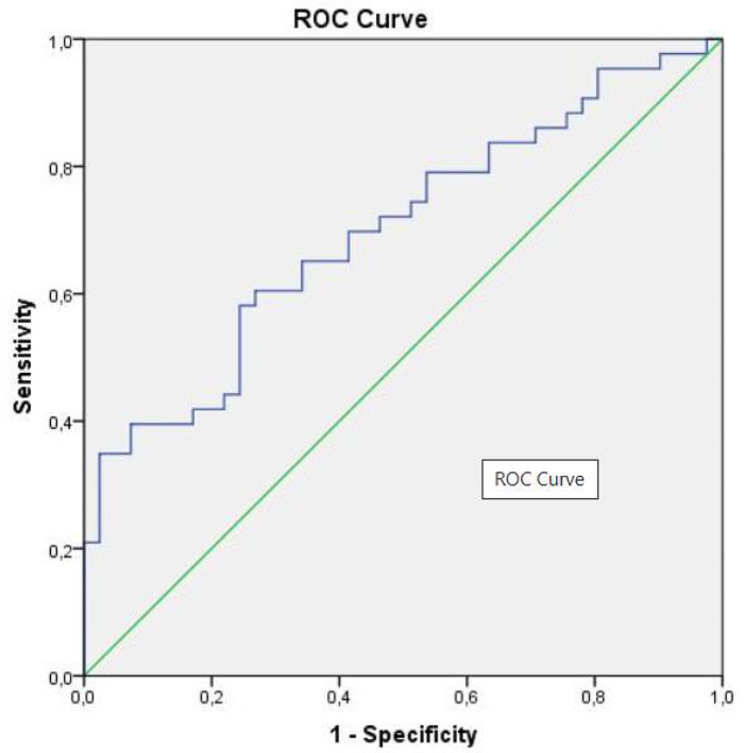
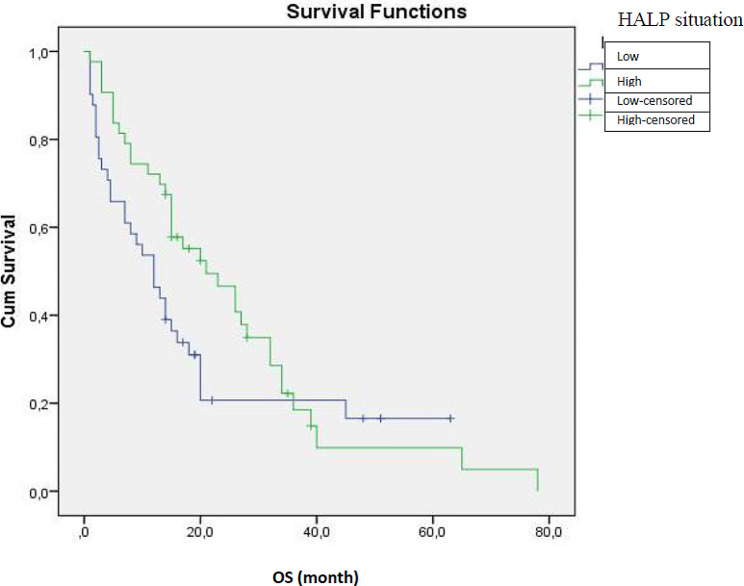
Median OS, PFS, HALP score, NLR, PLR were 15 months (1.0-78.0), 8 months (1.0-66.0), 37.39 ± 23.84 (min 6.00-max 132.31), 4.14, 145.07 respectively. A statistically significant correlation was found between HALP score and OS, PFS, NLR, PLR, ECOG-PS status using Spearman's rho test (p = 0.001, p < 0.001, p < 0.001, p < 0.001, p = 0.026 respectively). For the HALP score, a cut-off value of = 37.39 (AUC = 0.698, 95% CI, p < 0.002) was found using ROC analysis. Median OS was 12 (6.99-17.01) months in the low HALP group and 21 (11.37-30.63) months in the high HALP group (p = 0.117). NLR and PLR were significantly lower in the HALP high group (p < 0.001, p < 0.001 respectively). The ratio of receiving treatment was significantly higher in the high HALP group (p < 0.05). In Multivariate analysis, significant results were found for treatment status and ECOG-PS status (p < 0.001, p = 0.038 respectively).
The HALP score measured at the beginning of treatment seems to have predictive importance in the prognosis of GBM patients. A HALP score of > 37.39 was associated with prolonged survival in high-grade brain tumors.
本研究旨在探讨 HALP 评分是否可预测胶质母细胞瘤(GBM)患者的生存情况。
本研究共纳入 84 例在我院就诊的 GBM 患者。使用患者术前的血红蛋白、白蛋白、淋巴细胞和血小板结果计算 HALP 评分。通过检查受试者工作特征(ROC)曲线下的面积确定 HALP 评分的截断值。根据该截断值,将患者分为低和高两组。通过这两组检查患者的临床、人口统计学和实验室参数之间的关系。
中位 OS、PFS、HALP 评分、NLR、PLR 分别为 15 个月(1.0-78.0)、8 个月(1.0-66.0)、37.39±23.84(min 6.00-max 132.31)、4.14、145.07。Spearman 秩相关检验显示 HALP 评分与 OS、PFS、NLR、PLR、ECOG-PS 状态之间存在显著相关性(p=0.001、p<0.001、p<0.001、p<0.001、p=0.026)。通过 ROC 分析,HALP 评分的截断值为=37.39(AUC=0.698,95%CI,p<0.002)。低 HALP 组中位 OS 为 12(6.99-17.01)个月,高 HALP 组中位 OS 为 21(11.37-30.63)个月(p=0.117)。高 HALP 组 NLR 和 PLR 明显较低(p<0.001、p<0.001)。高 HALP 组的治疗率明显较高(p<0.05)。多变量分析显示,治疗状态和 ECOG-PS 状态具有显著意义(p<0.001、p=0.038)。
治疗开始时测量的 HALP 评分似乎对 GBM 患者的预后具有预测意义。HALP 评分>37.39 与高级别脑肿瘤患者的生存延长相关。