Albornoz Alejandro, Pardo Bibiana, Apaoblaza Sofia, Henriquez Claudio, Ojeda Javier, Uberti Benjamín, Hancke Juan, Burgos Rafael A, Moran Gabriel
Laboratory of Inflammation Pharmacology and Immunometabolism, Institute of Pharmacology and Morphophysiology, Faculty of Veterinary Sciences, Universidad Austral de Chile, Valdivia 5090000, Chile.
Graduate School, Faculty of Veterinary Sciences, Universidad Austral de Chile, Valdivia 5090000, Chile.
Animals (Basel). 2024 Jul 11;14(14):2036. doi: 10.3390/ani14142036.
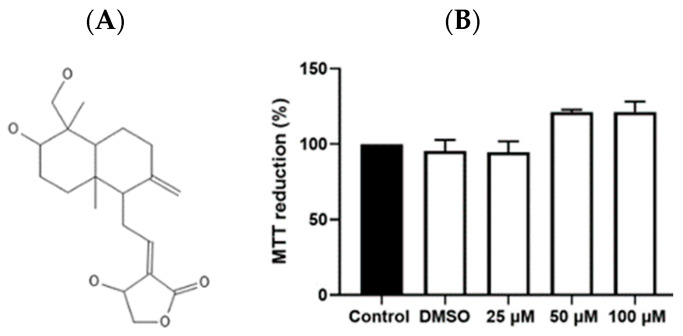
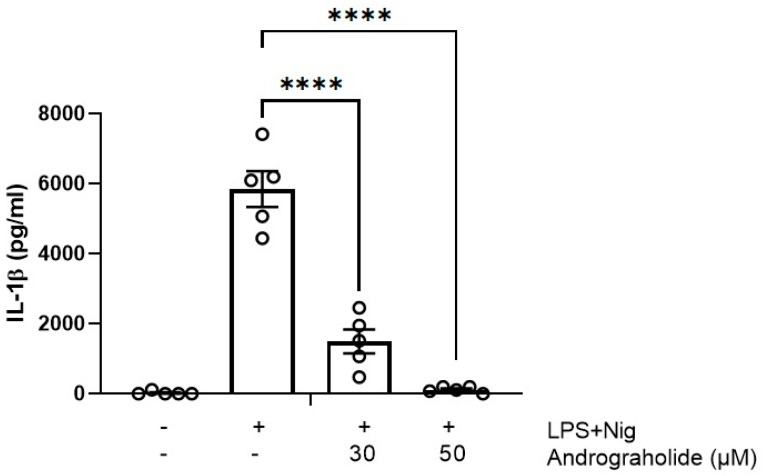
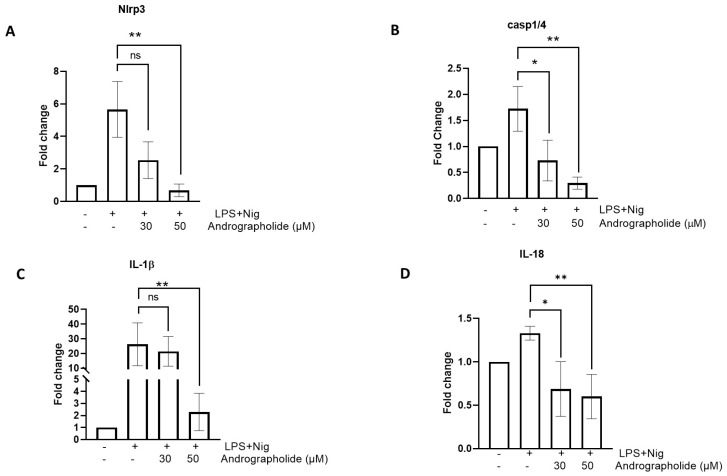
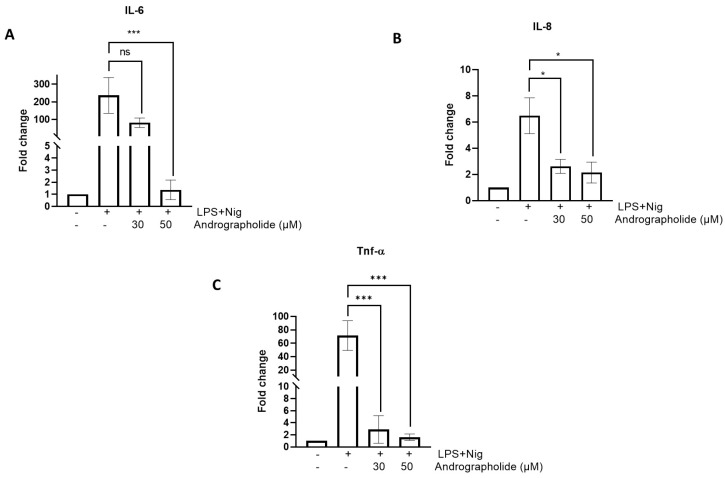
Inflammasomes are multiprotein complexes that trigger processes through caspase-1 activation, leading to the maturation of proinflammatory cytokines, such as IL-1β and IL-18. The gene encoding the inflammasome stimulatory protein NLRP3 is conserved in canines. Caspase-1/4 homologues have been identified in multiple carnivores, including canines, and caspase-1 activity has been shown in humans. The NLRP3 inflammasome has also been described in some canine inflammatory diseases. Andrographolide, a labdane diterpene, is the principal active ingredient in the herb Andrographis paniculate. The objective of this study was to determine the effect of andrographolide on the gene expression of the components of the NLRP3 inflammasome, proinflammatory cytokines, and IL-1β secretion in canine peripheral blood mononuclear cells. For this, MTT assays and real-time PCR were employed to assess the cytotoxicity and gene expression. Further, an ELISA test was performed to measure the IL-1β concentration. The findings reveal that andrographolide significantly reduces the expression of NLRP3, caspase-1/4, IL-1β, and IL-18. Additionally, it decreases the secretion of IL-1β and other proinflammatory cytokines, including IL-6, IL-8, and TNF-α. The results show that andrographolide decreases the expression of NLRP3, caspase-1/4, IL-1β, and IL-18. Andrographolide also reduces proinflammatory cytokines expression, and decreases IL-1β secretion. This indicates that andrographolide can interfere with the activation and function of the inflammasome, resulting in a decrease in the inflammatory response in canines. Research in this area is still budding, and more studies are necessary to fully understand andrographolide's mechanisms of action and its therapeutic potential in relation to the NLRP3 inflammasome in dogs.
炎性小体是通过半胱天冬酶-1激活触发一系列过程的多蛋白复合物,导致促炎细胞因子如白细胞介素-1β(IL-1β)和白细胞介素-18(IL-18)成熟。编码炎性小体刺激蛋白NLRP3的基因在犬类中是保守的。在包括犬类在内的多种食肉动物中已鉴定出半胱天冬酶-1/4同源物,并且在人类中已显示出半胱天冬酶-1活性。NLRP3炎性小体也已在一些犬类炎性疾病中被描述。穿心莲内酯是一种半日花烷二萜,是穿心莲属植物的主要活性成分。本研究的目的是确定穿心莲内酯对犬外周血单个核细胞中NLRP3炎性小体成分、促炎细胞因子的基因表达以及IL-1β分泌的影响。为此,采用MTT法和实时定量PCR评估细胞毒性和基因表达。此外,进行酶联免疫吸附测定(ELISA)来测量IL-1β浓度。研究结果表明,穿心莲内酯显著降低NLRP3、半胱天冬酶-1/4、IL-1β和IL-18的表达。此外,它还减少IL-1β和其他促炎细胞因子(包括IL-6、IL-8和肿瘤坏死因子-α(TNF-α))的分泌。结果表明,穿心莲内酯降低NLRP3、半胱天冬酶-1/4、IL-1β和IL-18的表达。穿心莲内酯还降低促炎细胞因子的表达,并减少IL-1β分泌。这表明穿心莲内酯可干扰炎性小体的激活和功能,导致犬类炎症反应减弱。该领域的研究仍处于起步阶段,需要更多研究来充分了解穿心莲内酯的作用机制及其与犬类NLRP3炎性小体相关的治疗潜力。