Cao Lin, Sun Fengxue, Ren Qifeng, Jiang Ziyi, Chen Jian, Li Yalin, Wang Lihua
College of Animal Science and Technology, Qingdao Agricultural University, Qingdao 266109, China.
Animals (Basel). 2024 Jul 20;14(14):2120. doi: 10.3390/ani14142120.
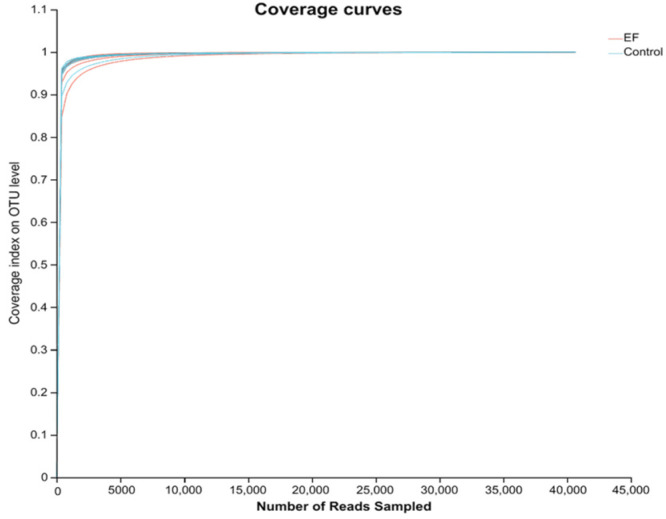
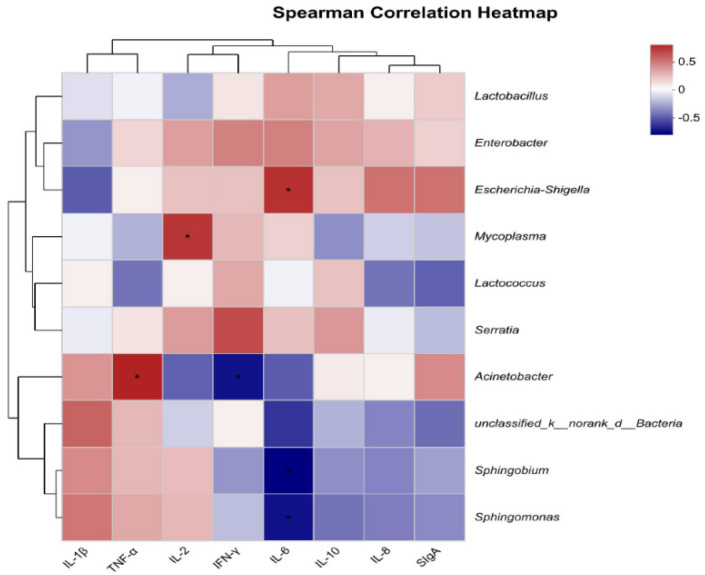
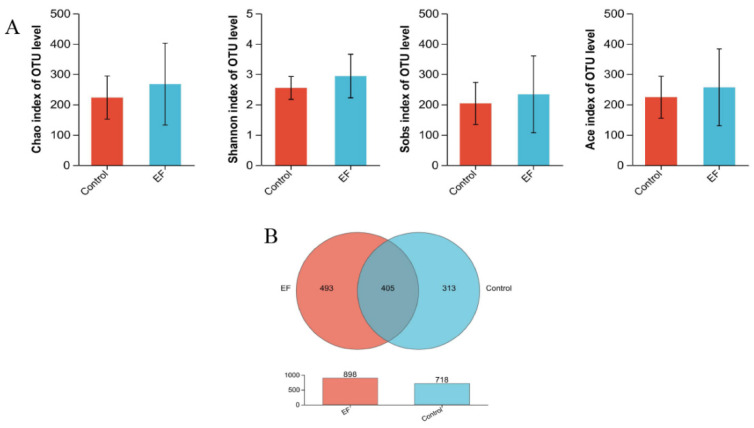
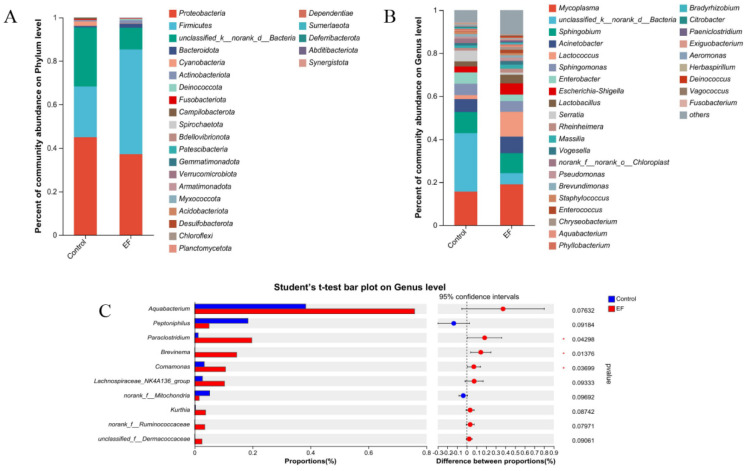
The purpose of this experiment was to explore the effects of dietary (EF) on the growth performance, antioxidant capacity, immunity, and intestinal microbiota of growing male minks. A total of 60 male Regal White minks at 12 weeks of age were randomly assigned to two groups, each with 15 replicates of two minks per replicate. The minks in two groups were fed the basal diets and the basal diets with viable (more than 10 cfu/kg of diet), respectively. Compared with the minks in control, minks had heavier body weight (BW) at week 4 and week 8 of the study ( < 0.05), greater average daily gain (ADG), and a lower feed/gain ratio (F/G) of male minks during the initial 4 weeks and the entire 8-week study period ( < 0.05). Furthermore, increased the apparent digestibility of crude protein (CP) and dry matter (DM) compared to the control ( < 0.05). Moreover, enhanced the serum superoxide dismutase (SOD) activity and decreased the malondialdehyde (MDA) contents ( < 0.05). The results also confirmed that increased the levels of serum immunoglobulin A (IgA), immunoglobulin G (IgG), and the concentrations of secretory immunoglobulin A (SIgA) in the jejunal mucosa while decreasing the interleukin-8 (IL-8) and interleukin-1β (IL-1β) levels in the jejunal mucosa ( < 0.05). Intestinal microbiota analysis revealed that increased the species numbers at the OUT level. Compared with the control, had significant effects on the relative abundance of , , and ( < 0.05). The results showed that could improve the growth performance, increase the antioxidant capacity, improve the immunity of growing male minks, and also modulate the gut microbiota.
本实验旨在探讨饲料(EF)对生长雄性水貂生长性能、抗氧化能力、免疫力和肠道微生物群的影响。选取60只12周龄的雄性帝王白貂,随机分为两组,每组15个重复,每个重复2只水貂。两组水貂分别饲喂基础日粮和添加了活性(每千克日粮超过10 cfu)的基础日粮。与对照组水貂相比,试验组水貂在研究第4周和第8周时体重(BW)更重(P<0.05),平均日增重(ADG)更高,且在最初4周和整个8周研究期内雄性水貂的料重比(F/G)更低(P<0.05)。此外,与对照组相比,试验组粗蛋白(CP)和干物质(DM)的表观消化率有所提高(P<0.05)。而且,试验组血清超氧化物歧化酶(SOD)活性增强,丙二醛(MDA)含量降低(P<0.05)。结果还证实,试验组血清免疫球蛋白A(IgA)、免疫球蛋白G(IgG)水平升高,空肠黏膜中分泌型免疫球蛋白A(SIgA)浓度增加,同时空肠黏膜中白细胞介素-8(IL-8)和白细胞介素-1β(IL-1β)水平降低(P<0.05)。肠道微生物群分析表明,试验组在OUT水平上的物种数量增加。与对照组相比,试验组对[具体菌属1]、[具体菌属2]和[具体菌属3]的相对丰度有显著影响(P<0.05)。结果表明,[饲料名称或物质名称]可改善生长雄性水貂的生长性能,提高抗氧化能力,增强免疫力,并调节肠道微生物群。