Abd El-Khalek Aya A, Balaha Hossam Magdy, Sewelam Ashraf, Ghazal Mohammed, Khalil Abeer T, Abo-Elsoud Mohy Eldin A, El-Baz Ayman
Communications and Electronics Engineering Department, Nile Higher Institute for Engineering and Technology, Mansoura 35511, Egypt.
Department of Bioengineering, J.B. Speed School of Engineering, University of Louisville, Louisville, KY 40292, USA.
Bioengineering (Basel). 2024 Jul 13;11(7):711. doi: 10.3390/bioengineering11070711.
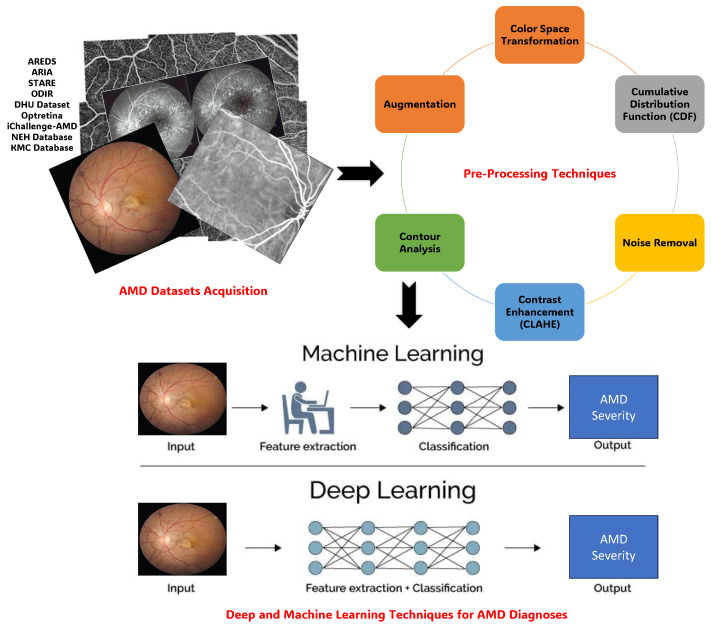
The rapid advancement of computational infrastructure has led to unprecedented growth in machine learning, deep learning, and computer vision, fundamentally transforming the analysis of retinal images. By utilizing a wide array of visual cues extracted from retinal fundus images, sophisticated artificial intelligence models have been developed to diagnose various retinal disorders. This paper concentrates on the detection of Age-Related Macular Degeneration (AMD), a significant retinal condition, by offering an exhaustive examination of recent machine learning and deep learning methodologies. Additionally, it discusses potential obstacles and constraints associated with implementing this technology in the field of ophthalmology. Through a systematic review, this research aims to assess the efficacy of machine learning and deep learning techniques in discerning AMD from different modalities as they have shown promise in the field of AMD and retinal disorders diagnosis. Organized around prevalent datasets and imaging techniques, the paper initially outlines assessment criteria, image preprocessing methodologies, and learning frameworks before conducting a thorough investigation of diverse approaches for AMD detection. Drawing insights from the analysis of more than 30 selected studies, the conclusion underscores current research trajectories, major challenges, and future prospects in AMD diagnosis, providing a valuable resource for both scholars and practitioners in the domain.
计算基础设施的快速发展推动了机器学习、深度学习和计算机视觉的空前增长,从根本上改变了视网膜图像的分析方式。通过利用从眼底视网膜图像中提取的大量视觉线索,已经开发出复杂的人工智能模型来诊断各种视网膜疾病。本文通过全面考察最近的机器学习和深度学习方法,专注于检测年龄相关性黄斑变性(AMD)这一重要的视网膜疾病。此外,本文还讨论了在眼科领域应用这项技术时可能遇到的障碍和限制。通过系统综述,本研究旨在评估机器学习和深度学习技术在从不同模态识别AMD方面的有效性,因为它们在AMD和视网膜疾病诊断领域已显示出前景。围绕流行的数据集和成像技术进行组织,本文首先概述评估标准、图像预处理方法和学习框架,然后对检测AMD的各种方法进行深入研究。通过对30多项选定研究的分析得出见解,结论强调了AMD诊断中的当前研究轨迹、主要挑战和未来前景,为该领域的学者和从业者提供了宝贵资源。