Camera Francesca, Merla Caterina, De Santis Valerio
Division of Biotechnologies, Italian National Agency for Energy, New Technologies and Sustainable Economic Development (ENEA), 00123 Rome, Italy.
Department of Industrial and Information Engineering and Economics, University of L'Aquila, 67100 L'Aquila, Italy.
Bioengineering (Basel). 2024 Jul 13;11(7):712. doi: 10.3390/bioengineering11070712.
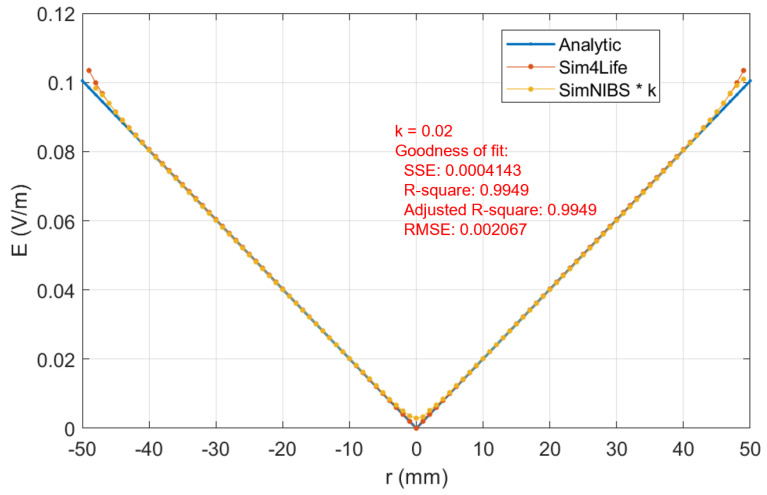
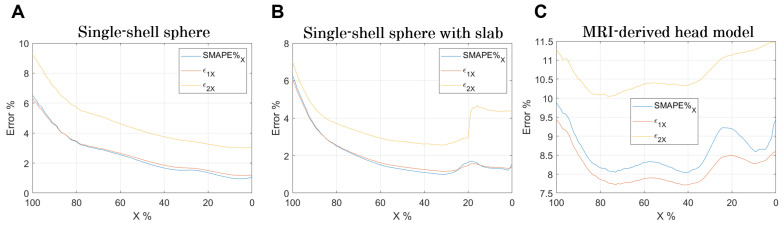
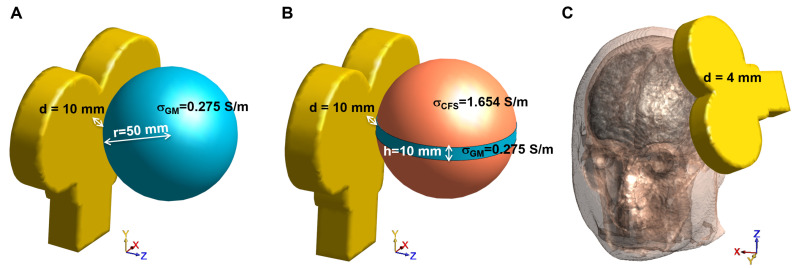
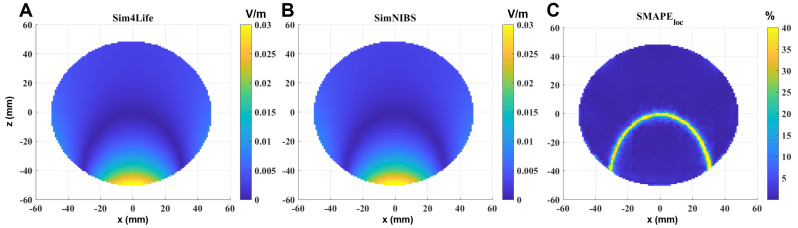
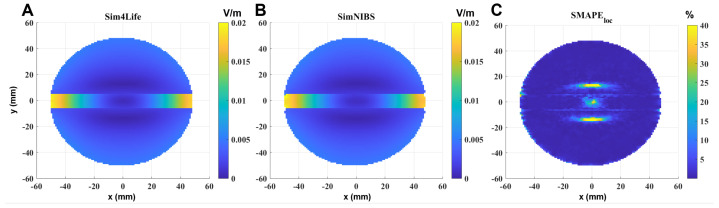
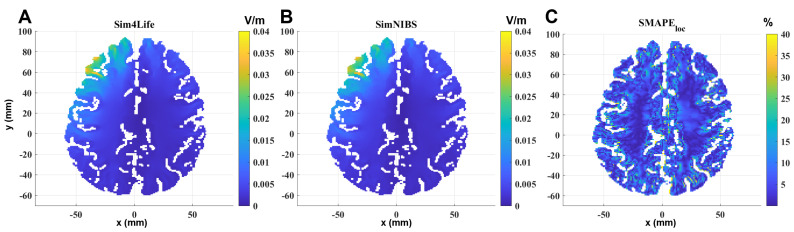
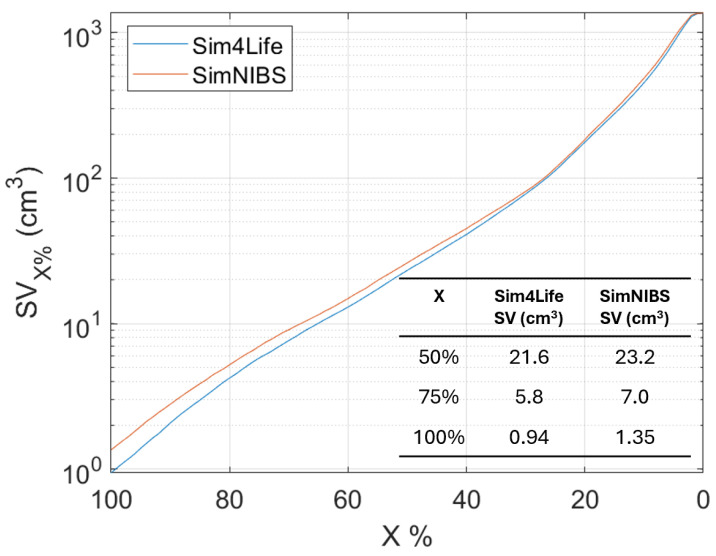
In recent years, the interest in transcranial magnetic stimulation (TMS) has surged, necessitating deeper understanding, development, and use of low-frequency (LF) numerical dosimetry for TMS studies. While various ad hoc dosimetric models exist, commercial software tools like SimNIBS v4.0 and Sim4Life v7.2.4 are preferred for their user-friendliness and versatility. SimNIBS utilizes unstructured tetrahedral mesh models, while Sim4Life employs voxel-based models on a structured grid, both evaluating induced electric fields using the finite element method (FEM) with different numerical solvers. Past studies primarily focused on uniform exposures and voxelized models, lacking realism. Our study compares these LF solvers across simplified and realistic anatomical models to assess their accuracy in evaluating induced electric fields. We examined three scenarios: a single-shell sphere, a sphere with an orthogonal slab, and a MRI-derived head model. The comparison revealed small discrepancies in induced electric fields, mainly in regions of low field intensity. Overall, the differences were contained (below 2% for spherical models and below 12% for the head model), showcasing the potential of computational tools in advancing exposure assessment required for TMS protocols in different bio-medical applications.
近年来,对经颅磁刺激(TMS)的兴趣激增,这就需要对TMS研究中的低频(LF)数值剂量学有更深入的理解、开发和应用。虽然存在各种临时剂量学模型,但像SimNIBS v4.0和Sim4Life v7.2.4这样的商业软件工具因其用户友好性和多功能性而更受青睐。SimNIBS使用非结构化四面体网格模型,而Sim4Life在结构化网格上采用基于体素的模型,两者都使用有限元方法(FEM)和不同的数值求解器来评估感应电场。过去研究主要集中在均匀暴露和体素化模型上,缺乏现实性。我们的研究在简化和现实解剖模型中比较了这些低频求解器,以评估它们在评估感应电场方面的准确性。我们研究了三种情况:单壳球体、带有正交平板的球体和MRI衍生的头部模型。比较结果显示感应电场存在小差异,主要在低场强区域。总体而言,差异在可控范围内(球形模型低于2%,头部模型低于12%),这展示了计算工具在推进不同生物医学应用中TMS方案所需的暴露评估方面的潜力。