Shemyakin-Ovchinnikov Institute of Bioorganic Chemistry, Russian Academy of Sciences, Moscow 117997, Russia.
Institute of Biochemical Technology and Nanotechnology, Peoples' Friendship University of Russia Named after Patrice Lumumba, Miklukho-Maklaya St. 6, Moscow 117198, Russia.
Biomolecules. 2024 Jul 4;14(7):798. doi: 10.3390/biom14070798.
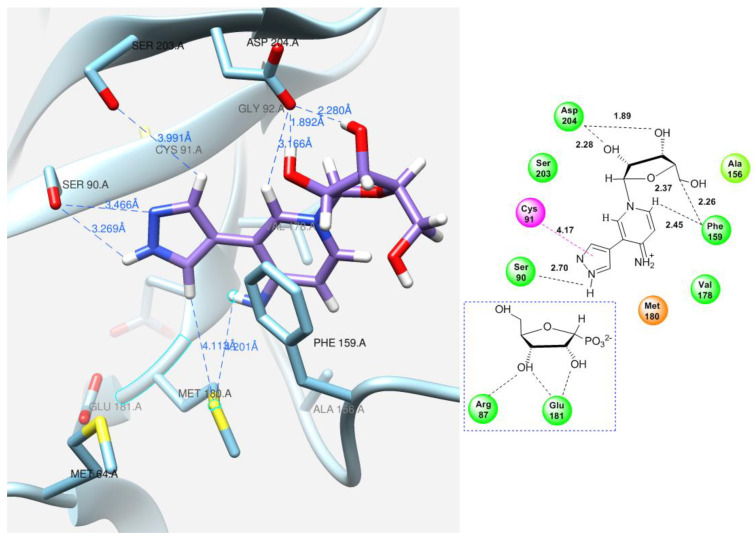
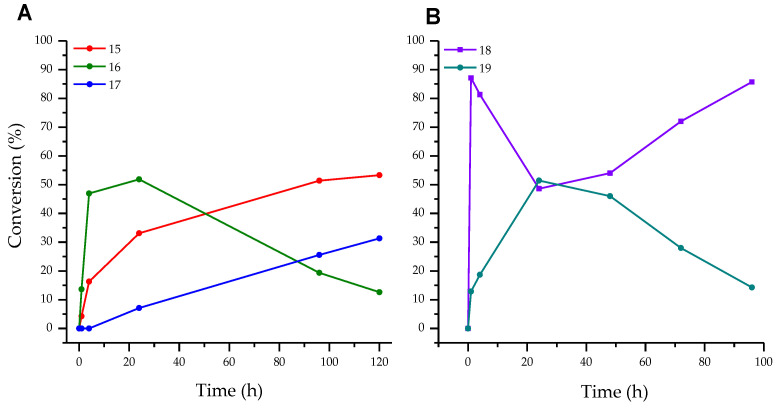
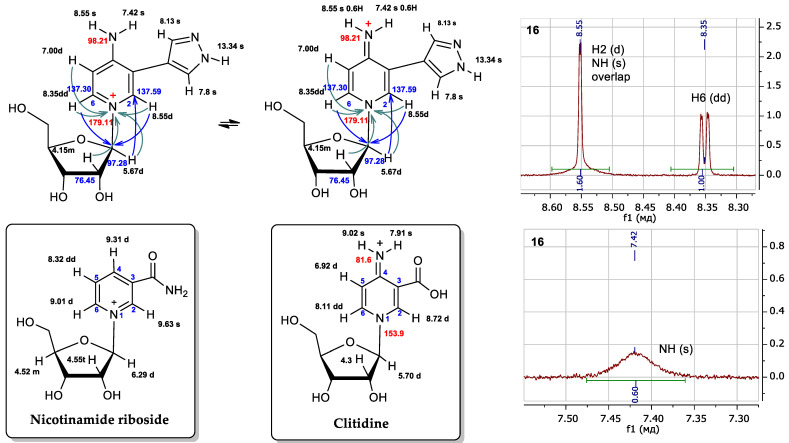
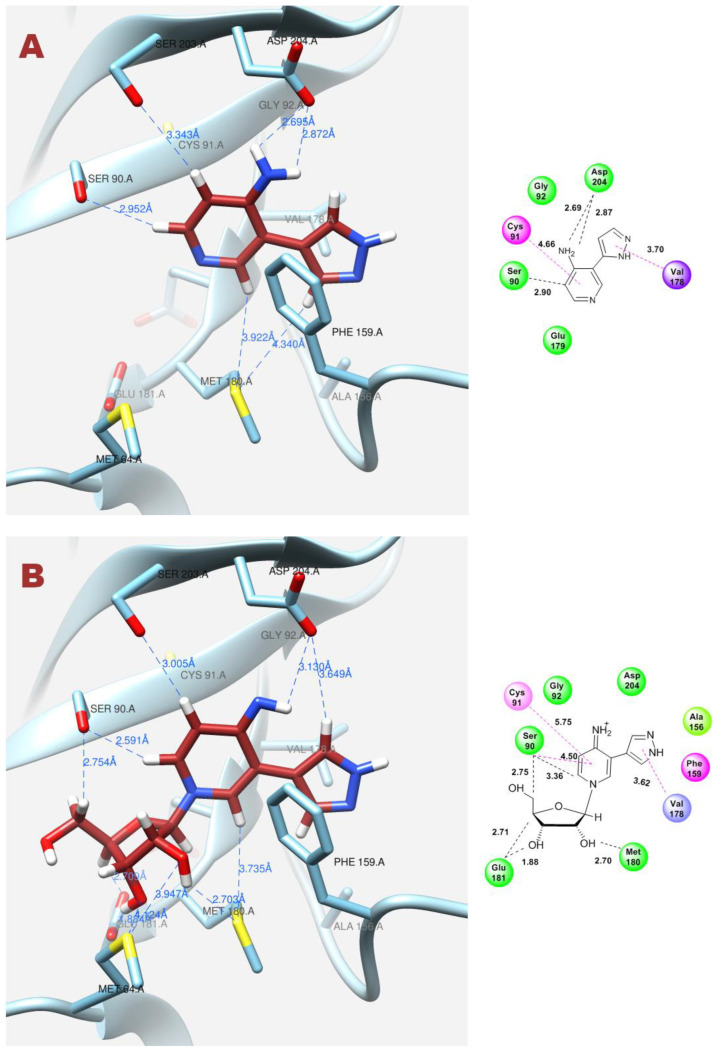
Enzymatic transglycosylation of the fleximer base 4-(4-aminopyridine-3-yl)-1H-pyrazole using recombinant purine nucleoside phosphorylase (PNP) resulted in the formation of "non-typical" minor products of the reaction. In addition to "typical" N1-pyrazole nucleosides, a 4-imino-pyridinium riboside and a N1-pyridinium-N1-pyrazole bis-ribose derivative were formed. N1-Pyrazole 2'-deoxyribonucleosides and a N1-pyridinium-N1-pyrazole bis-2'-deoxyriboside were formed. But 4-imino-pyridinium deoxyriboside was not formed in the reaction mixture. The role of thermodynamic parameters of key intermediates in the formation of reaction products was elucidated. To determine the mechanism of binding and activation of heterocyclic substrates in the PNP active site, molecular modeling of the fleximer base and reaction products in the enzyme active site was carried out. As for N1-pyridinium riboside, there are two possible locations for it in the PNP active site. The presence of a relatively large space in the area of amino acid residues Phe159, Val178, and Asp204 allows the ribose residue to fit into that space, and the heterocyclic base can occupy a position that is suitable for subsequent glycosylation. Perhaps it is this "upside down" arrangement that promotes secondary glycosylation and the formation of minor bis-riboside products.
使用重组嘌呤核苷磷酸化酶(PNP)对 fleximer 碱基 4-(4-氨基吡啶-3-基)-1H-吡唑进行酶促转糖基化反应,导致形成反应的“非典型”次要产物。除了“典型”的 N1-吡唑核苷外,还形成了 4-亚氨基-吡啶核苷和 N1-吡啶-N1-吡唑双核糖衍生物。N1-吡唑 2'-脱氧核苷和 N1-吡啶-N1-吡唑双 2'-脱氧核苷形成。但在反应混合物中未形成 4-亚氨基-吡啶脱氧核苷。阐明了关键中间体热力学参数在反应产物形成中的作用。为了确定 PNP 活性位点中杂环底物结合和激活的机制,在酶活性位点中对 fleximer 碱基和反应产物进行了分子建模。对于 N1-吡啶核苷,它在 PNP 活性位点中有两个可能的位置。残基 Phe159、Val178 和 Asp204 区域中存在相对较大的空间,允许核糖残基适合于后续糖基化反应。也许正是这种“颠倒”排列促进了二级糖基化和次要双核糖产物的形成。