Diaz-Martinez Janet, Kotzker Wayne, Mendoza-Hernandez Martha A, Gadh Rajdeep S, Hernandez-Fuentes Gustavo A, Bañuelos Andrew, Guzmán-Esquivel José, Hong Angelina, Delgado-Enciso Osiris G, Geyer-Roberts Elizabeth, Martinez-Fierro Margarita L, Rodriguez-Sanchez Iram P, Garza-Veloz Idalia, Canseco-Ávila Luis M, Delgado-Enciso Ivan
Research Center in Minority Institutions, Robert Stempel College of Public Health, Florida International University, Miami, FL 33199, USA.
Florida Kidney Physicians, Panoramic Health Practice, Boca Raton, FL 33431, USA.
Pharmaceutics. 2024 Jul 10;16(7):920. doi: 10.3390/pharmaceutics16070920.
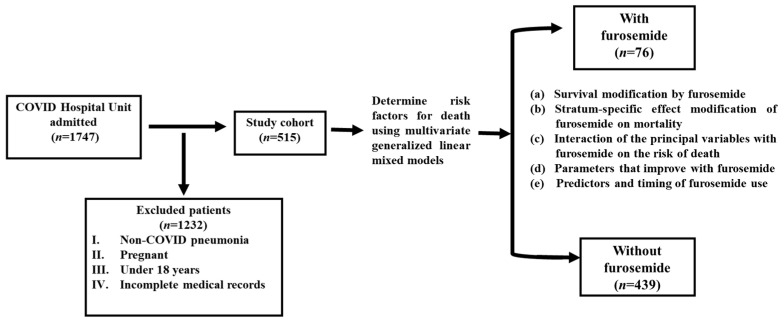
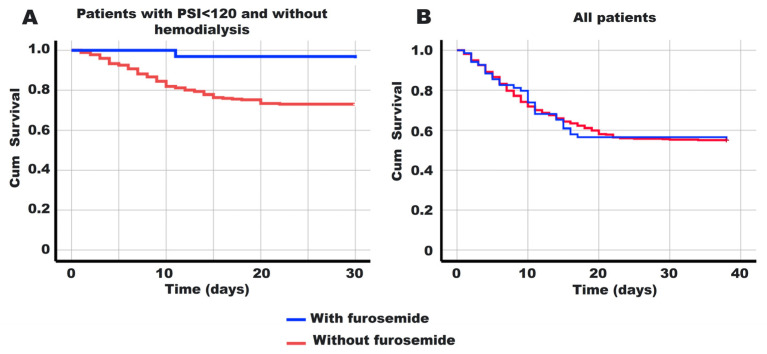
In the ongoing fight against Coronavirus Disease 2019 (COVID-19), researchers are exploring potential treatments to improve outcomes, especially in severe cases. This includes investigating the repurposing of existing medications, such as furosemide, which is widely available. This study aimed to evaluate the impact of furosemide on mortality rates among COVID-19 patients with severe or critical illness. We assessed a cohort of 515 hospitalized adults who experienced a high mortality rate of 43.9%. Using a multivariate analysis with adjusted risk ratios (AdRRs), factors like smoking (AdRR 2.48, 95% CI 1.53-4.01, < 0.001), a high Pneumonia Severity Index (PSI) score (AdRR 7.89, 95% CI 5.82-10.70, < 0.001), mechanical ventilation (AdRR 23.12, 95% CI 17.28-30.92, < 0.001), neutrophilia (AdRR 2.12, 95% CI 1.52-2.95, < 0.001), and an elevated neutrophil-to-lymphocyte ratio (NLR) (AdRR 2.39, 95% CI 1.72-3.32, < 0.001) were found to increase mortality risk. In contrast, vaccination and furosemide use were associated with reduced mortality risk (AdRR 0.58, = 0.001 and 0.60, = 0.008; respectively). Furosemide showed a pronounced survival benefit in patients with less severe disease (PSI < 120) and those not on hemodialysis, with mortality rates significantly lower in furosemide users (3.7% vs. 25.7%). A Kaplan-Meier analysis confirmed longer survival and better oxygenation levels in patients treated with furosemide. Furthermore, a Structure-Activity Relationship analysis revealed that furosemide's sulfonamide groups may interact with cytokine sites such as tumor necrosis factor-alpha (TNF-α) and interleukin-6 (IL-6), potentially explaining its beneficial effects in COVID-19 management. These findings suggest that furosemide could be a beneficial treatment option in certain COVID-19 patient groups, enhancing survival and improving oxygenation.
在当前抗击2019冠状病毒病(COVID-19)的斗争中,研究人员正在探索潜在的治疗方法以改善治疗结果,尤其是在重症病例中。这包括研究现有药物的重新用途,比如广泛可得的呋塞米。本研究旨在评估呋塞米对重症或危重症COVID-19患者死亡率的影响。我们评估了一组515名住院成人,其死亡率高达43.9%。通过使用调整风险比(AdRRs)的多变量分析,发现吸烟(AdRR 2.48,95%置信区间1.53 - 4.01,< 0.001)、高肺炎严重指数(PSI)评分(AdRR 7.89,95%置信区间5.82 - 10.70,< 0.001)、机械通气(AdRR 23.12,95%置信区间17.28 - 30.92,< 0.001)、中性粒细胞增多(AdRR 2.12,95%置信区间1.52 - 2.95,< 0.001)以及升高的中性粒细胞与淋巴细胞比值(NLR)(AdRR 2.39,95%置信区间1.72 - 3.32,< 0.001)等因素会增加死亡风险。相比之下,接种疫苗和使用呋塞米与降低死亡风险相关(AdRR分别为0.58,= 0.001和0.60,= 0.008)。呋塞米在病情较轻(PSI < 120)且未进行血液透析的患者中显示出显著的生存获益,使用呋塞米的患者死亡率显著更低(3.7%对25.7%)。 Kaplan-Meier分析证实接受呋塞米治疗的患者生存时间更长且氧合水平更好。此外,构效关系分析表明呋塞米的磺酰胺基团可能与细胞因子位点如肿瘤坏死因子-α(TNF-α)和白细胞介素-6(IL-6)相互作用,这可能解释了其在COVID-19治疗中的有益作用。这些发现表明呋塞米在某些COVID-19患者群体中可能是一种有益的治疗选择,可提高生存率并改善氧合。