Faculty of Medicine and Health, School of Public Health, The University of Sydney, Sydney, NSW, Australia.
Faculty of Health, Medicine and Life Sciences, School of Public Health and Primary Care, Maastricht University, Maastricht, The Netherlands.
Hum Reprod. 2024 Sep 1;39(9):2010-2020. doi: 10.1093/humrep/deae147.
What is the impact of co-designed, evidence-based information regarding the anti-Mullerian hormone (AMH) test on women's interest in having the test?
Women who viewed the evidence-based information about the AMH test had lower interest in having an AMH test than women who viewed information produced by an online company selling the test direct-to-consumers.
Online information about AMH testing often has unfounded claims about its ability to predict fertility and conception, and evidence suggests that women seek out and are recommended the AMH test as a measure of their fertility potential.
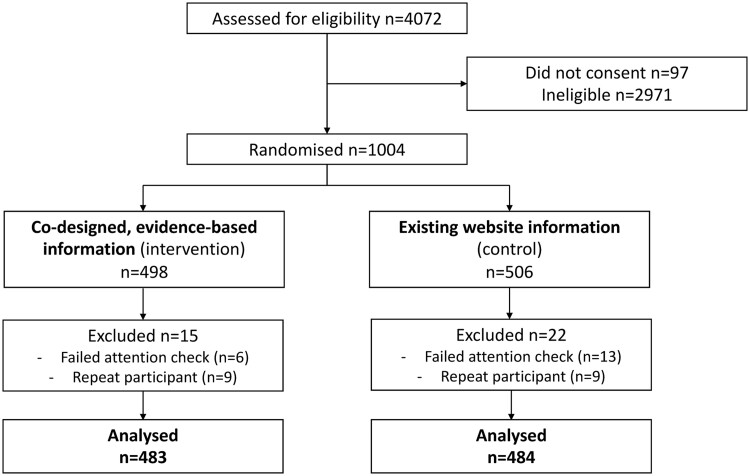
STUDY DESIGN, SIZE, DURATION: An online randomized trial was conducted from November to December 2022. Women were randomized (double-blind, equal allocation) to view one of two types of information: co-designed, evidence-based information about the AMH test (intervention), or existing information about the AMH test from a website which markets the test direct-to-consumers (control). A total of 967 women were included in the final analysis.
PARTICIPANTS/MATERIALS, SETTING, METHODS: Participants were women recruited through an online panel, who were aged 25-40 years, living in Australia or The Netherlands, had never given birth, were not currently pregnant but would like to have a child now or in the future, and had never had an AMH test. The primary outcome was interest in having an AMH test (seven-point scale; 1 = definitely NOT interested to 7 = definitely interested). Secondary outcomes included attitudes, knowledge, and psychosocial and behavioural outcomes relating to AMH testing.
Women who viewed the evidence-based information about the AMH test had lower interest in having an AMH test (MD = 1.05, 95% CI = 0.83-1.30), less positive attitudes towards (MD = 1.29, 95% CI = 4.57-5.70), and higher knowledge about the test than women who viewed the control information (MD = 0.75, 95% CI = 0.71-0.82).
LIMITATIONS, REASONS FOR CAUTION: The sample was more highly educated than the broader Australian and Dutch populations and some measures (e.g. influence on family planning) were hypothetical in nature.
Women have higher knowledge of and lower interest in having the AMH test when given evidence-based information about the test and its limitations. Despite previous studies suggesting women are enthusiastic about AMH testing to learn about their fertility potential, we demonstrate that this enthusiasm does not hold when they are informed about the test's limitations.
STUDY FUNDING/COMPETING INTEREST(S): This project was supported by an NHMRC Emerging Leader Research Fellowship (2009419) and the Australian Health Research Alliance's Women's Health Research, Translation and Impact Network EMCR award. B.W.M. reports consultancy for ObsEva and Merck and travel support from Merck. D.L. is the Medical Director of, and holds stock in, City Fertility NSW and reports consultancy for Organon and honoraria from Ferring, Besins, and Merck. K.H. reports consultancy and travel support from Merck and Organon. K.M. is a director of Health Literacy Solutions that owns a licence of the Sydney Health Literacy Lab Health Literacy Editor. No other relevant disclosures exist.
ACTRN12622001136796.
17 August 2022.
DATE OF FIRST PATIENT’S ENROLMENT: 21 November 2022.
关于抗苗勒氏管激素(AMH)测试的循证信息对女性进行该测试的意愿有何影响?
与观看由在线公司直接向消费者销售该测试的信息相比,观看关于 AMH 测试的循证信息的女性对进行 AMH 测试的兴趣较低。
关于 AMH 测试的在线信息通常对其预测生育能力和受孕能力的能力有毫无根据的说法,并且有证据表明,女性寻求并被推荐 AMH 测试作为其生育能力的衡量标准。
研究设计、规模、持续时间:2022 年 11 月至 12 月进行了一项在线随机试验。女性随机(双盲、均衡分配)观看两种类型的信息之一:关于 AMH 测试的循证信息(干预),或来自一个直接向消费者销售该测试的网站的关于 AMH 测试的现有信息(对照)。共有 967 名女性纳入最终分析。
参与者/材料、设置、方法:参与者是通过在线小组招募的年龄在 25-40 岁之间的女性,居住在澳大利亚或荷兰,从未生育过,目前未怀孕,但希望现在或将来要孩子,并且从未进行过 AMH 测试。主要结果是对进行 AMH 测试的兴趣(七点量表;1=绝对不感兴趣,7=绝对感兴趣)。次要结果包括与 AMH 测试相关的态度、知识以及心理社会和行为结果。
与观看对照信息的女性相比,观看关于 AMH 测试的循证信息的女性对进行 AMH 测试的兴趣较低(MD=1.05,95%CI=0.83-1.30),对测试的态度较不积极(MD=1.29,95%CI=4.57-5.70),对测试的了解程度更高(MD=0.75,95%CI=0.71-0.82)。
局限性、谨慎的原因:该样本比澳大利亚和荷兰更广泛的人群受教育程度更高,并且一些措施(例如对计划生育的影响)具有假设性。
当女性获得关于 AMH 测试及其局限性的循证信息时,她们对 AMH 测试的了解程度更高,对进行 AMH 测试的兴趣较低。尽管之前的研究表明女性热衷于通过 AMH 测试来了解她们的生育能力,但我们证明,当她们了解到测试的局限性时,这种热情就不复存在了。
研究资金/竞争利益:该项目得到了 NHMRC 新兴领导者研究奖学金(2009419)和澳大利亚健康研究联盟妇女健康研究、转化和影响网络 EMCR 奖的支持。B.W.M. 报告了对 ObsEva 和 Merck 的咨询以及 Merck 的旅行支持。D.L. 是 City Fertility NSW 的医疗主任,拥有股份,并报告了对 Organon 和 Ferring、Besins 和 Merck 的咨询以及对 Merck 和 Organon 的酬金。K.H. 报告了 Merck 和 Organon 的咨询和旅行支持。K.M. 是 Health Literacy Solutions 的董事,该公司拥有 Sydney Health Literacy Lab Health Literacy Editor 的许可。没有其他相关披露。
ACTRN12622001136796。
2022 年 8 月 17 日。
2022 年 11 月 21 日。