Seth G.S. Medical College and K.E.M Hospital, Mumbai, Maharashtra, India.
J Postgrad Med. 2024 Jul 1;70(3):135-142. doi: 10.4103/jpgm.jpgm_925_23. Epub 2024 Jul 26.
The primary objective of the study was to assess the factors that influenced the increased failure rate among first-year Indian medical students who appeared for the Maharashtra University of Health Science (MUHS) summative university examination, having experienced the competency-based medical education (CBME) curriculum for the first time amid the coronavirus disease (COVID-19) pandemic.
A retrospective cross-sectional online questionnaire-based study was undertaken between July 2021 and November 2021, in which first-year Indian medical students who were enrolled in the Bachelor of Medicine, Bachelor of Surgery (MBBS) program in the year 2019 and appeared for the MUHS summative university examination in February 2021 were invited to participate. Analysis was done using JASP (v0.16.0.0), and the odds ratio for failure was calculated at a significance level of P < 0.05.
Responses were obtained from 360 individuals, of whom 74.5% had passed and 25.5% had failed (n = 360). The odds of failure in first-year MBBS summative university examination was higher in students with irregular Internet access, irregular device access, an unsupportive peer environment in college, a National Entrance cum Eligibility Test score below 500, an unsupportive family environment during the lockdown, severe stress, severe depression, testing positive for COVID-19 before the exam, death in the family during the exam, and failing in terms and prelims and students of male gender ( P < 0.01).
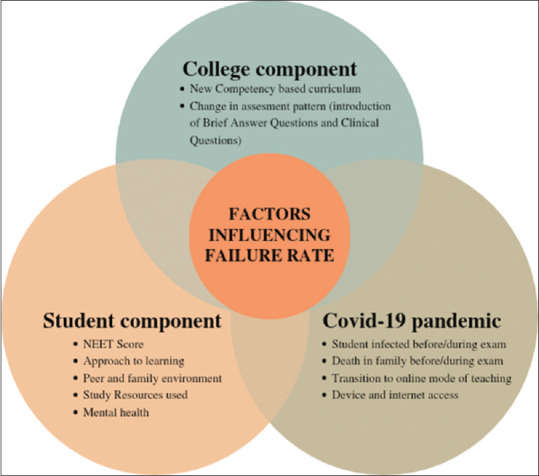
The total failure rate of 27% in the MUHS examination was mainly attributed to interplay between the student's mental health, lack of devices or Internet, and the changed assessment part of the CBME curriculum. Surprisingly, lecture frequencies, teaching patterns, and study resources did not influence the failure rate. These results can be used to formulate interventions that will help to improve academic performance and mental health students and thus help them adapt to the new curriculum.
本研究的主要目的是评估首次经历冠状病毒病(COVID-19)大流行期间以能力为基础的医学教育(CBME)课程的印度医学生在马哈拉施特拉邦大学健康科学(MUHS)总结性大学考试中首次通过率增加的因素。
2021 年 7 月至 2021 年 11 月期间进行了一项回顾性横断面在线问卷调查研究,邀请了 2019 年入读医学学士、外科学士(MBBS)课程并于 2021 年 2 月参加 MUHS 总结性大学考试的一年级印度医学生参加。使用 JASP(v0.16.0.0)进行分析,并在 P < 0.05 的显著性水平计算失败的优势比。
共收到 360 人的回复,其中 74.5%通过,25.5%失败(n = 360)。在 MUHS 第一年 MBBS 总结性大学考试中失败的可能性更高的学生包括:上网不规律、设备使用不规律、大学时同伴环境不支持、全国入学和资格考试分数低于 500、封锁期间家庭环境不支持、严重压力、严重抑郁、考试前 COVID-19 检测呈阳性、考试期间家中有人去世以及期末考试和预试不及格的学生,以及男生(P < 0.01)。
MUHS 考试的总失败率为 27%,主要归因于学生心理健康、缺乏设备或互联网以及 CBME 课程评估部分的变化之间的相互作用。令人惊讶的是,讲座频率、教学模式和学习资源并没有影响失败率。这些结果可用于制定干预措施,以帮助提高学生的学业成绩和心理健康,从而帮助他们适应新课程。