Jiao Jian-Yu, Abdugheni Rashidin, Zhang Dao-Feng, Ahmed Iftikhar, Ali Mukhtiar, Chuvochina Maria, Dedysh Svetlana N, Dong Xiuzhu, Göker Markus, Hedlund Brian P, Hugenholtz Philip, Jangid Kamlesh, Liu Shuang-Jiang, Moore Edward R B, Narsing Rao Manik Prabhu, Oren Aharon, Rossello-Mora Ramon, Rekadwad Bhagwan Narayan, Salam Nimaichand, Shu Wensheng, Sutcliffe Iain C, Teo Wee Fei Aaron, Trujillo Martha E, Venter Stephanus N, Whitman William B, Zhao Guoping, Li Wen-Jun
State Key Laboratory of Biocontrol, Guangdong Provincial Key Laboratory of Plant Resources and Southern Marine Science and Engineering Guangdong Laboratory (Zhuhai), School of Life Sciences, Sun Yat-Sen University, Guangzhou 510275, China.
State Key Laboratory of Desert and Oasis Ecology, Key Laboratory of Ecological Safety and Sustainable Development in Arid Lands, Xinjiang Institute of Ecology and Geography, Chinese Academy of Sciences, Urumqi 830011, China.
Natl Sci Rev. 2024 May 13;11(7):nwae168. doi: 10.1093/nsr/nwae168. eCollection 2024 Jul.
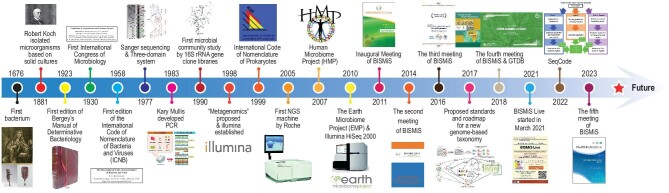
Prokaryotes are ubiquitous in the biosphere, important for human health and drive diverse biological and environmental processes. Systematics of prokaryotes, whose origins can be traced to the discovery of microorganisms in the 17th century, has transitioned from a phenotype-based classification to a more comprehensive polyphasic taxonomy and eventually to the current genome-based taxonomic approach. This transition aligns with a foundational shift from studies focused on phenotypic traits that have limited comparative value to those using genome sequences. In this context, (BMSAB) and Bergey's International Society for Microbial Systematics (BISMiS) play a pivotal role in guiding prokaryotic systematics. This review focuses on the historical development of prokaryotic systematics with a focus on the roles of BMSAB and BISMiS. We also explore significant contributions and achievements by microbiologists, highlight the latest progress in the field and anticipate challenges and opportunities within prokaryotic systematics. Additionally, we outline five focal points of BISMiS that are aimed at addressing these challenges. In conclusion, our collaborative effort seeks to enhance ongoing advancements in prokaryotic systematics, ensuring its continued relevance and innovative characters in the contemporary landscape of genomics and bioinformatics.
原核生物在生物圈中无处不在,对人类健康至关重要,并推动着各种生物和环境过程。原核生物的系统分类学起源可追溯到17世纪微生物的发现,已从基于表型的分类转变为更全面的多相分类法,并最终发展为当前基于基因组的分类方法。这种转变与研究重点从关注比较价值有限的表型特征转向使用基因组序列的研究的根本性转变相一致。在此背景下,细菌系统分类学国际委员会(BMSAB)和伯杰氏微生物系统学国际协会(BISMiS)在指导原核生物系统分类学方面发挥着关键作用。本综述重点关注原核生物系统分类学的历史发展,着重介绍BMSAB和BISMiS的作用。我们还探讨了微生物学家的重大贡献和成就,突出该领域的最新进展,并预测原核生物系统分类学面临的挑战和机遇。此外,我们概述了BISMiS旨在应对这些挑战的五个重点。总之,我们的共同努力旨在加强原核生物系统分类学的持续进展,确保其在当代基因组学和生物信息学领域的持续相关性和创新性。