Cui Jiaming, Heavey Jack, Klein Eili, Madden Gregory R, Sifri Costi D, Vullikanti Anil, Prakash B Aditya
College of Computing, Georgia Institute of Technology, Atlanta, GA 30332, US.
Department of Computer Science, Virginia Tech, Blacksburg, VA 24060, US.
medRxiv. 2025 Feb 19:2024.07.14.24310393. doi: 10.1101/2024.07.14.24310393.
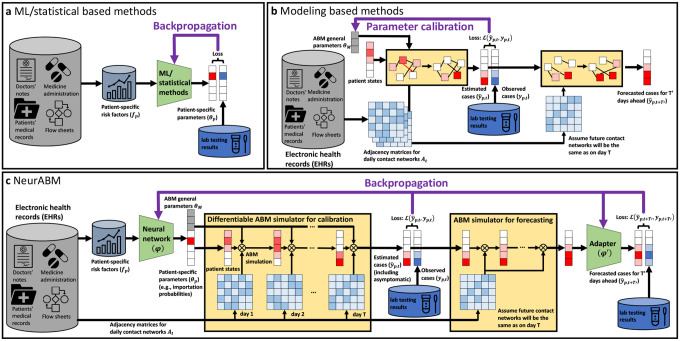
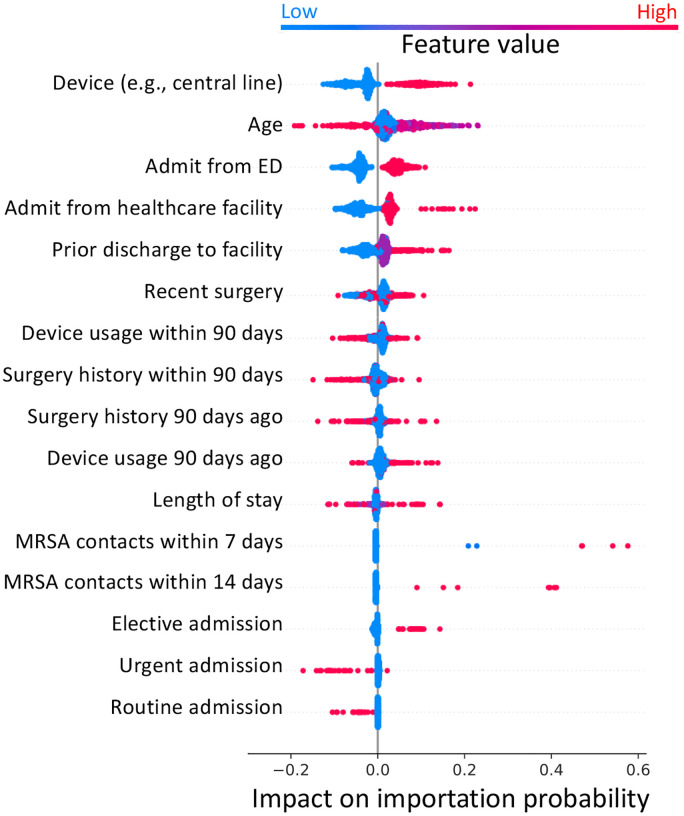
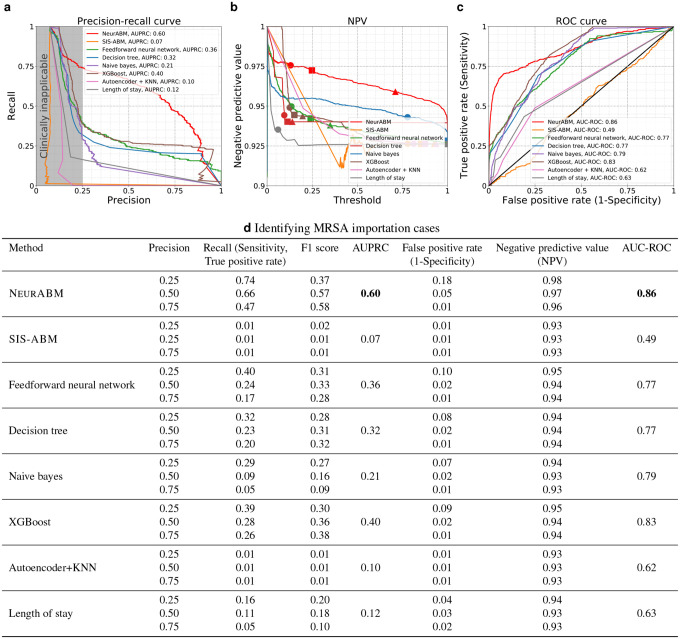
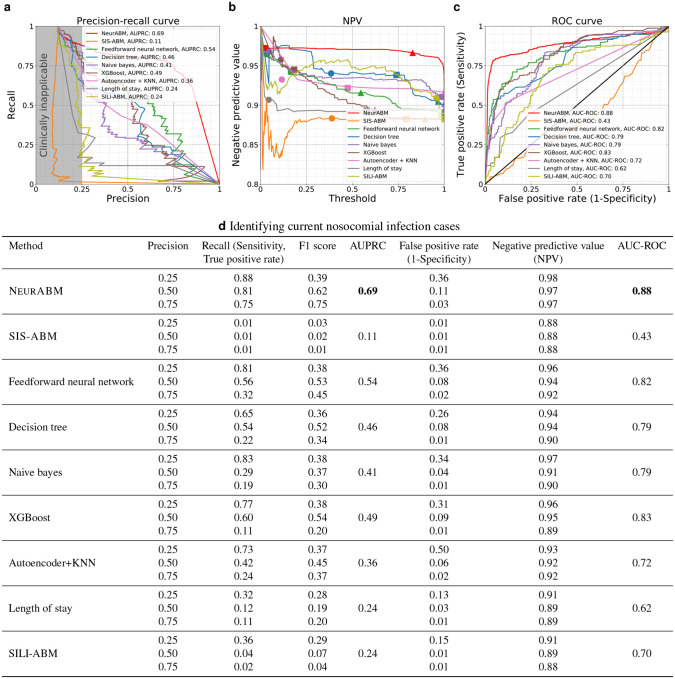
Healthcare-associated infections (HAIs) from multi-drug resistant organisms (MDROs) pose a significant challenge for healthcare systems. Patients can arrive at hospitals already infected ("importation") or acquire infections during their stay ("nosocomial infection"). Many cases, often asymptomatic, complicate rapid identification due to testing limitations and delays. Although recent advancements in mathematical modeling and machine learning have aimed to identify at-risk patients, these methods face challenges: transmission models often overlook valuable electronic health record (EHR) data, while machine learning approaches typically lack mechanistic insights into underlying processes. To address these issues, we propose NeurABM, a novel framework that integrates neural networks and agent-based models (ABM) to leverage the strengths of both methods. NeurABM simultaneously learns a neural network for patient-level importation predictions and an ABM for infection identification. Our findings show that NeurABM significantly outperforms existing methods, marking a breakthrough in accurately identifying importation cases and forecasting future nosocomial infections in clinical practice.
多重耐药菌引起的医疗保健相关感染(HAIs)对医疗系统构成了重大挑战。患者可能在入院时就已被感染(“输入性感染”),或者在住院期间获得感染(“医院感染”)。由于检测限制和延迟,许多病例(通常无症状)使得快速识别变得复杂。尽管数学建模和机器学习方面的最新进展旨在识别高危患者,但这些方法面临挑战:传播模型往往忽略了有价值的电子健康记录(EHR)数据,而机器学习方法通常缺乏对潜在过程的机理洞察。为了解决这些问题,我们提出了NeurABM,这是一个新颖的框架,它整合了神经网络和基于主体的模型(ABM),以利用这两种方法的优势。NeurABM同时学习用于患者层面输入性感染预测的神经网络和用于感染识别的ABM。我们的研究结果表明,NeurABM显著优于现有方法,标志着在临床实践中准确识别输入性病例和预测未来医院感染方面取得了突破。