Sasaki Makiko, Shimura Takaya, Nishie Hirotada, Kuroyanagi Keita, Kanno Takuya, Fukusada Shigeki, Sugimura Naomi, Mizuno Yusuke, Nukui Takayuki, Uno Konomu, Kojima Yuki, Nishigaki Ruriko, Tanaka Mamoru, Ozeki Keiji, Kubota Eiji, Kataoka Hiromi
Department of Gastroenterology and Metabolism, Nagoya City University Graduate School of Medical Science, Nagoya 467-8601, Japan.
World J Gastrointest Oncol. 2024 Jul 15;16(7):3357-3363. doi: 10.4251/wjgo.v16.i7.3357.
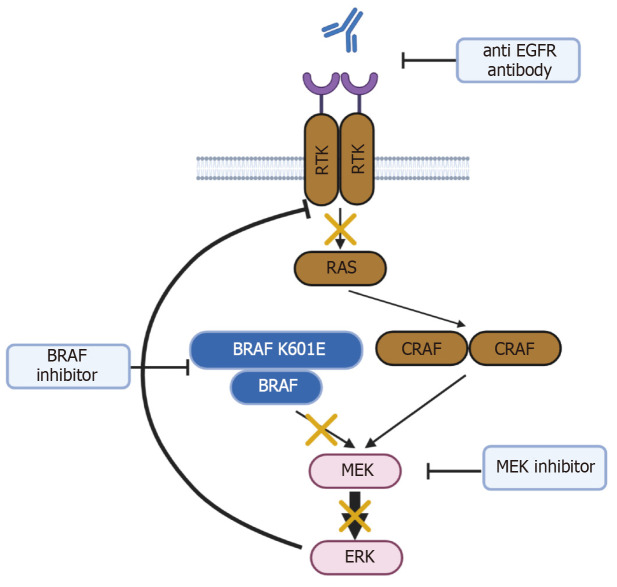
BRAF mutation has been recognized as a negative prognostic marker for metastatic colorectal cancer (mCRC), but these data are from common BRAF V600E-mutated mCRC. Combination therapy of BRAF inhibitor and anti-epidermal growth factor receptor (EGFR) antibody has been approved for BRAF V600E-mutated mCRC. However, BRAF non-V600 mutations are rare mutations, and their clinical behavior is not understood. Moreover, the BRAF K601E mutation is extremely rare in mCRC, and there have been no reports on its specific treatment.
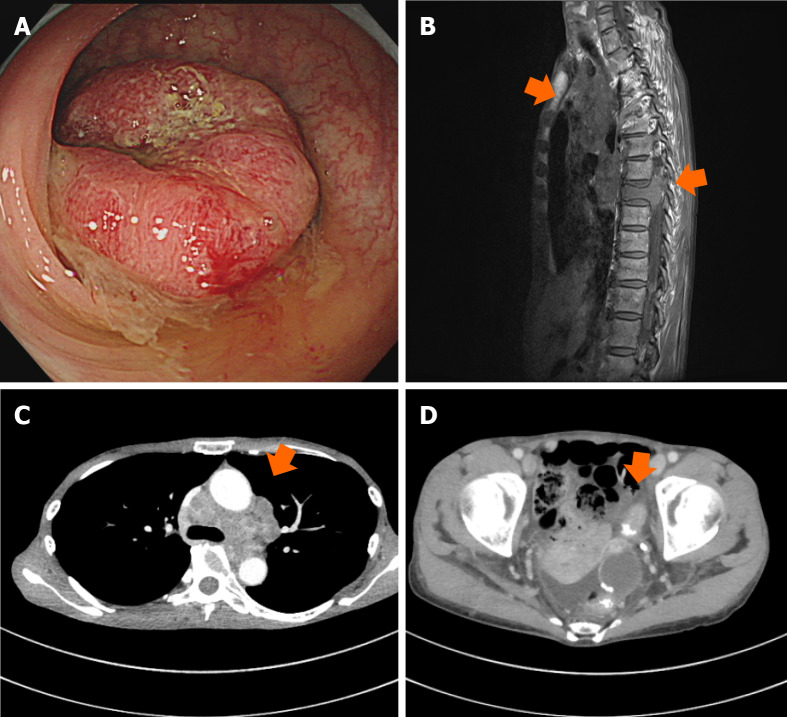
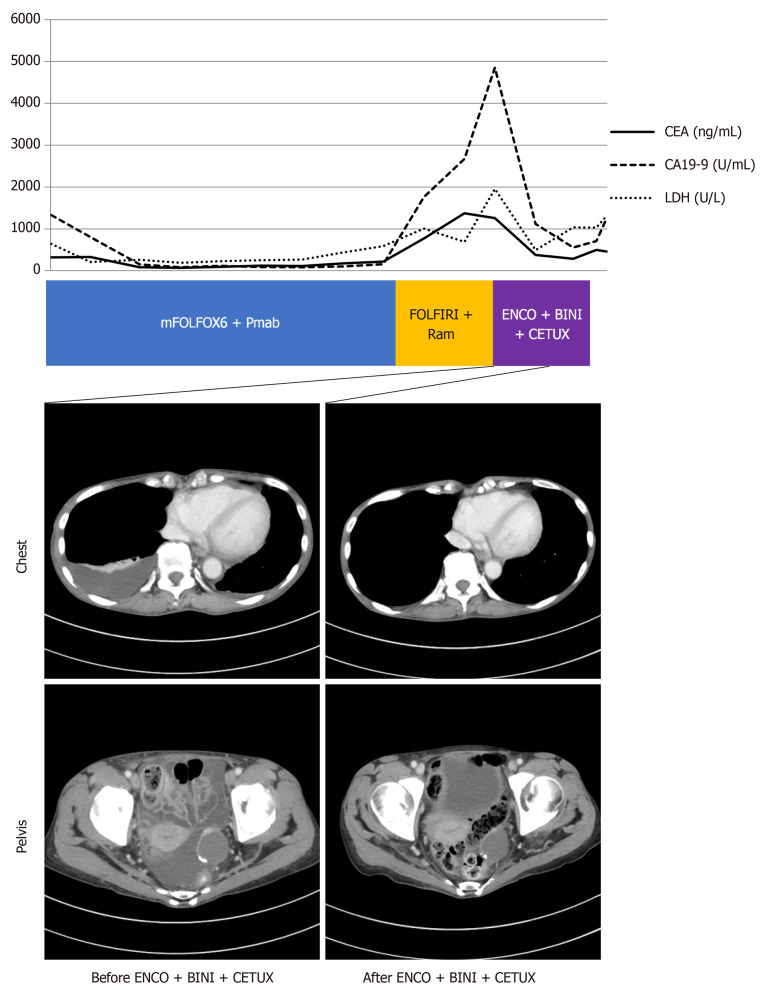
Herein, we report the case of a 59-year-old female with super aggressive mCRC with multiple metastases, which extended to whole body including mediastinal to abdominal lymph nodes, bones, pleura, and peritoneum. The companion diagnostics of tumor tissues showed RAS/BRAF wild-type without microsatellite instability. She received chemotherapy with mFOLFOX6 (oxaliplatin plus infusional 5-fluorouracil [5-FU] and leucovorin) plus panitumumab, following FOLFIRI (irinotecan plus infusional 5-FU and leucovorin) plus ramucirumab. For the next regimen selection, a comprehensive genomic profiling panel was performed and revealed a BRAF K601E mutation, which was not covered in the initial companion diagnostics. After disease progression, a combination of encorafenib, binimetinib, and cetuximab was selected as third-line chemotherapy. The serum levels of tumor markers were immediately decreased accompanied by improvements in pleural effusion and ascites. However, the disease progressed again, and best supportive care was done instead.
This case offers novel insights into the clinical behaviors of BRAF non-V600E-mCRC, potentially advancing personalized therapy for rare and aggressive cases.
BRAF 突变已被认为是转移性结直肠癌(mCRC)的不良预后标志物,但这些数据来自常见的 BRAF V600E 突变型 mCRC。BRAF 抑制剂与抗表皮生长因子受体(EGFR)抗体的联合疗法已被批准用于 BRAF V600E 突变型 mCRC。然而,BRAF 非 V600 突变是罕见突变,其临床行为尚不清楚。此外,BRAF K601E 突变在 mCRC 中极为罕见,尚无关于其特异性治疗的报道。
在此,我们报告一例 59 岁女性的超侵袭性 mCRC 伴多发转移病例,转移累及全身,包括纵隔至腹部淋巴结、骨骼、胸膜和腹膜。肿瘤组织的伴随诊断显示 RAS/BRAF 野生型且无微卫星不稳定性。她先接受了 mFOLFOX6(奥沙利铂加静脉输注 5-氟尿嘧啶[5-FU]和亚叶酸钙)加帕尼单抗化疗,之后接受 FOLFIRI(伊立替康加静脉输注 5-FU 和亚叶酸钙)加拉穆西单抗化疗。对于下一治疗方案的选择,进行了全面的基因组分析,结果显示存在 BRAF K601E 突变,这在最初的伴随诊断中未被检测到。疾病进展后,选择恩考芬尼、比美替尼和西妥昔单抗联合作为三线化疗方案。肿瘤标志物的血清水平立即下降,同时胸腔积液和腹水有所改善。然而,疾病再次进展,改为最佳支持治疗。
该病例为 BRAF 非 V600E 突变型 mCRC 的临床行为提供了新见解,可能推动针对罕见且侵袭性病例的个性化治疗。