Department of Emergency Medicine, Perelman School of Medicine, University of Pennsylvania, Philadelphia, PA 19104.
Penn Medicine Nudge Unit, University of Pennsylvania, Philadelphia, PA 19104.
Proc Natl Acad Sci U S A. 2024 Aug 6;121(32):e2320603121. doi: 10.1073/pnas.2320603121. Epub 2024 Jul 29.
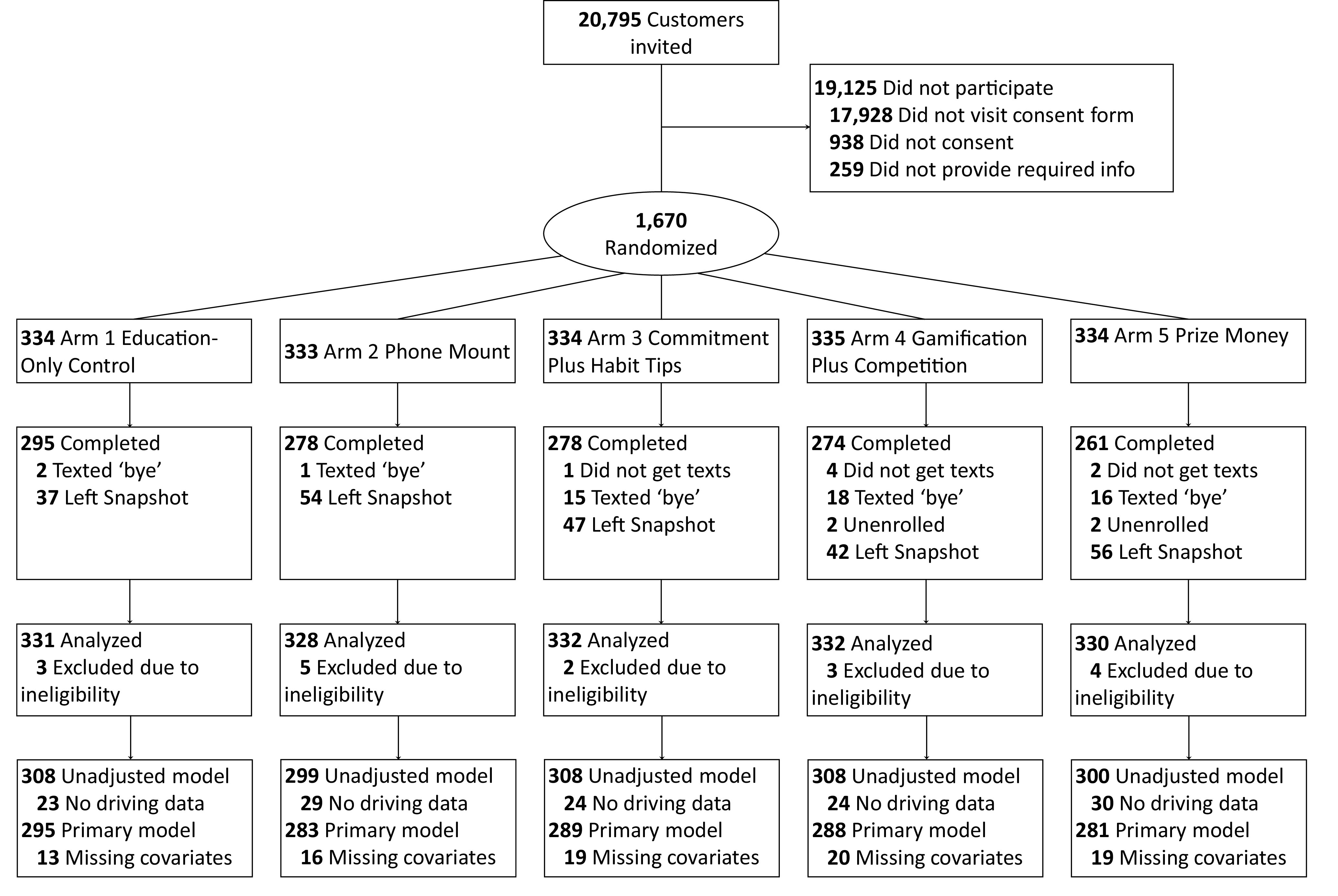
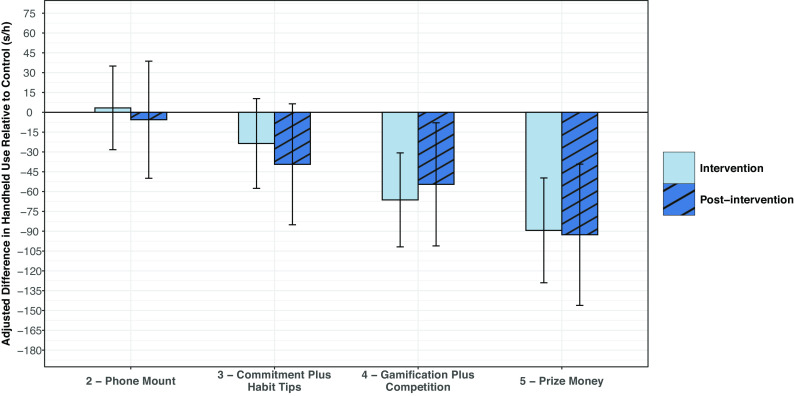
Distracted driving is responsible for nearly 1 million crashes each year in the United States alone, and a major source of driver distraction is handheld phone use. We conducted a randomized, controlled trial to compare the effectiveness of interventions designed to create sustained reductions in handheld use while driving (NCT04587609). Participants were 1,653 consenting Progressive® Snapshot® usage-based auto insurance customers ages 18 to 77 who averaged at least 2 min/h of handheld use while driving in the month prior to study invitation. They were randomly assigned to one of five arms for a 10-wk intervention period. Arm 1 (control) got education about the risks of handheld phone use, as did the other arms. Arm 2 got a free phone mount to facilitate hands-free use. Arm 3 got the mount a commitment exercise and tips for hands-free use. Arm 4 got the mount, commitment, and tips weekly goal gamification and social competition. Arm 5 was the same as Arm 4, offered behaviorally designed financial incentives. Postintervention, participants were monitored until the end of their insurance rating period, 25 to 65 d more. Outcome differences were measured using fractional logistic regression. Arm 4 participants, who received gamification and competition, reduced their handheld use by 20.5% relative to control ( < 0.001); Arm 5 participants, who additionally received financial incentives, reduced their use by 27.6% ( < 0.001). Both groups sustained these reductions through the end of their insurance rating period.
分心驾驶是导致美国每年近 100 万起车祸的原因之一,而手持电话的使用是造成驾驶员分心的主要原因之一。我们进行了一项随机对照试验,以比较旨在持续减少驾驶时手持电话使用的干预措施的有效性(NCT04587609)。参与者为 1653 名同意参加的 Progressive®Snapshot®基于使用的汽车保险客户,年龄在 18 至 77 岁之间,在研究邀请前一个月内平均至少有 2 分钟/小时的手持电话使用时间。他们被随机分配到五个干预组中的一个,为期 10 周。第 1 组(对照组)接受了关于手持电话使用风险的教育,其他组也是如此。第 2 组获得了一个免费的手机支架,以方便免提使用。第 3 组获得了支架、承诺和免提使用提示。第 4 组获得了支架、承诺、提示、每周目标游戏化和社交竞争。第 5 组与第 4 组相同,提供行为设计的财务激励。干预后,参与者被监测到他们的保险评级期结束,再延长 25 至 65 天。使用分数逻辑回归测量结果差异。第 4 组参与者接受了游戏化和竞争,他们的手持电话使用量相对对照组减少了 20.5%(<0.001);第 5 组参与者另外收到了财务激励,他们的使用量减少了 27.6%(<0.001)。两组参与者在保险评级期结束前都保持了这些减少。