Morris Roger, Wang Shiyong
Massey University EpiCentre and EpiSoft International Ltd, 76/100 Titoki Street, Masterton 5810, New Zealand.
Health, Nutrition and Population, World Bank Group, Washington, DC, USA.
Sci One Health. 2024 Apr 2;3:100067. doi: 10.1016/j.soh.2024.100067. eCollection 2024.
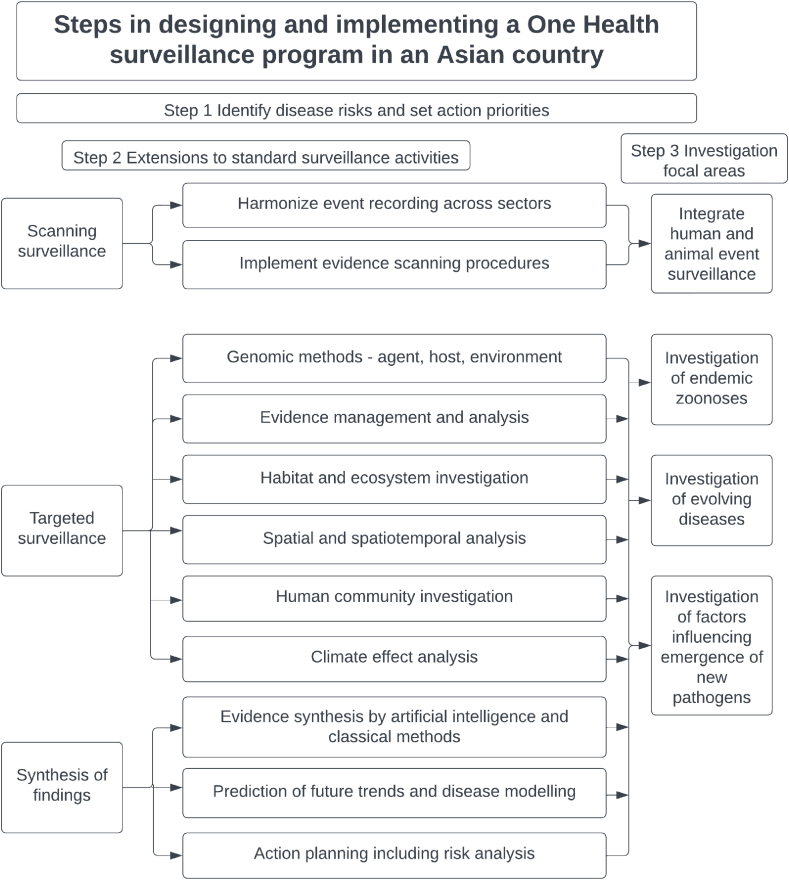
To detect and respond to emerging diseases more effectively, an integrated surveillance strategy needs to be applied to both human and animal health. Current programs in Asian countries operate separately for the two sectors and are principally concerned with detection of events that represent a short-term disease threat. It is not realistic to either invest only in efforts to detect emerging diseases, or to rely solely on event-based surveillance. A comprehensive strategy is needed, concurrently investigating and managing endemic zoonoses, studying evolving diseases which change their character and importance due to influences such as demographic and climatic change, and enhancing understanding of factors which are likely to influence the emergence of new pathogens. This requires utilisation of additional investigation tools that have become available in recent years but are not yet being used to full effect. As yet there is no fully formed blueprint that can be applied in Asian countries. Hence a three-step pathway is proposed to move towards the goal of comprehensive One Health disease surveillance and response.
为了更有效地检测和应对新出现的疾病,需要对人类和动物健康应用综合监测策略。亚洲国家目前的项目在这两个领域分别开展,主要关注检测那些构成短期疾病威胁的事件。仅仅投资于检测新出现疾病的工作,或者仅仅依靠基于事件的监测,都是不现实的。需要一个全面的策略,同时调查和管理地方性人畜共患病,研究因人口和气候变化等影响而改变其特征和重要性的不断演变的疾病,并加强对可能影响新病原体出现的因素的理解。这需要利用近年来出现但尚未得到充分利用的额外调查工具。目前还没有一个可以应用于亚洲国家的完整蓝图。因此,提出了一个三步走的途径,以实现全面的“同一健康”疾病监测和应对目标。