Eyre Katerina, Rafiee Moezedin Javad, Leo Margherita, Ma Junjie, Hillier Elizabeth, Amini Negin, Pressacco Josephine, Janich Martin A, Zhu Xucheng, Friedrich Matthias G, Chetrit Michael
Research Institute, McGill University Health Centre, Montreal, Quebec, Canada.
Research Institute, McGill University Health Centre, Montreal, Quebec, Canada.
J Cardiovasc Magn Reson. 2024;26(2):101069. doi: 10.1016/j.jocmr.2024.101069. Epub 2024 Jul 28.
Cardiovascular magnetic resonance (CMR) cine imaging is still limited by long acquisition times. This study evaluated the clinical utility of an accelerated two-dimensional (2D) cine sequence with deep learning reconstruction (Sonic DL) to decrease acquisition time without compromising quantitative volumetry or image quality.
A sub-study using 16 participants was performed using Sonic DL at two different acceleration factors (8× and 12×). Quantitative left-ventricular volumetry, function, and mass measurements were compared between the two acceleration factors against a standard cine method. Following this sub-study, 108 participants were prospectively recruited and imaged using a standard cine method and the Sonic DL method with the acceleration factor that more closely matched the reference method. Two experienced clinical readers rated images based on their diagnostic utility and performed all image contouring. Quantitative contrast difference and endocardial border sharpness were also assessed. Left- and right-ventricular volumetry, left-ventricular mass, and myocardial strain measurements were compared between cine methods using Bland-Altman plots, Pearson's correlation, and paired t-tests. Comparative analysis of image quality was measured using Wilcoxon-signed-rank tests and visualized using bar graphs.
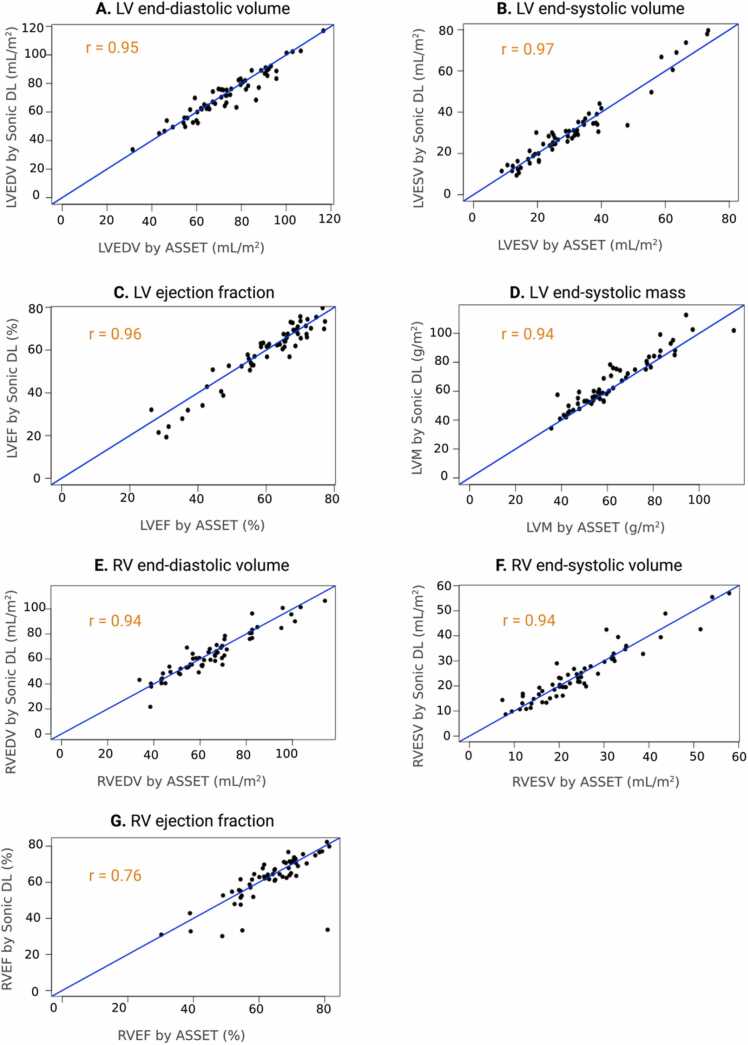
Sonic DL at an acceleration factor of 8 more closely matched the reference cine method. There were no significant differences found across left ventricular volumetry, function, or mass measurements. In contrast, an acceleration factor of 12 resulted in a 6% (5.51/90.16) reduction of measured ejection fraction when compared to the standard cine method and a 4% (4.32/88.98) reduction of measured ejection fraction when compared to Sonic DL at an acceleration factor of 8. Thus, Sonic DL at an acceleration factor of 8 was chosen for downstream analysis. In the larger cohort, this accelerated cine sequence was successfully performed in all participants and significantly reduced the acquisition time of cine images compared to the standard 2D method (reduction of 37% (5.98/16) p < 0.0001). Diagnostic image quality ratings and quantitative image quality evaluations were statistically not different between the two methods (p > 0.05). Left- and right-ventricular volumetry and circumferential and radial strain were also similar between methods (p > 0.05) but left-ventricular mass and longitudinal strain were over-estimated using the proposed accelerated cine method (mass over-estimated by 3.36 g/m, p < 0.0001; longitudinal strain over-estimated by 1.97%, p = 0.001).
This study found that an accelerated 2D cine method with DL reconstruction at an acceleration factor of 8 can reduce CMR cine acquisition time by 37% (5.98/16) without significantly affecting volumetry or image quality. Given the increase of scan time efficiency, this undersampled acquisition method using deep learning reconstruction should be considered for routine clinical CMR.
心血管磁共振(CMR)电影成像仍受长采集时间的限制。本研究评估了一种采用深度学习重建的加速二维(2D)电影序列(Sonic DL)在不影响定量容积测量或图像质量的情况下减少采集时间的临床效用。
使用16名参与者进行一项子研究,采用Sonic DL在两个不同的加速因子(8倍和12倍)下进行。将两个加速因子下的左心室定量容积、功能和质量测量结果与标准电影方法进行比较。在该子研究之后,前瞻性招募了108名参与者,并使用标准电影方法和加速因子与参考方法更匹配的Sonic DL方法进行成像。两名经验丰富的临床阅片者根据图像的诊断效用对图像进行评分,并进行所有图像轮廓描绘。还评估了定量对比度差异和心内膜边界清晰度。使用Bland-Altman图、Pearson相关性和配对t检验比较电影方法之间的左、右心室容积、左心室质量和心肌应变测量结果。使用Wilcoxon符号秩检验测量图像质量的比较分析,并使用条形图进行可视化。
加速因子为8的Sonic DL与参考电影方法更接近匹配。在左心室容积、功能或质量测量中未发现显著差异。相比之下,加速因子为12时,与标准电影方法相比,测得的射血分数降低了6%(5.51/90.16),与加速因子为8的Sonic DL相比,测得的射血分数降低了4%(4.32/88.98)。因此,选择加速因子为8的Sonic DL进行下游分析。在更大的队列中,这种加速电影序列在所有参与者中均成功完成,与标准2D方法相比,显著减少了电影图像的采集时间(减少37%(5.98/16),p<0.0001)。两种方法之间的诊断图像质量评分和定量图像质量评估在统计学上无差异(p>0.05)。两种方法之间的左、右心室容积以及圆周和径向应变也相似(p>0.05),但使用所提出的加速电影方法时,左心室质量和纵向应变被高估(质量高估3.36 g/m,p<0.0001;纵向应变高估1.97%,p = 0.001)。
本研究发现,加速因子为8的采用深度学习重建的2D电影方法可将CMR电影采集时间减少37%(5.98/16),而不会显著影响容积测量或图像质量。鉴于扫描时间效率的提高,这种使用深度学习重建的欠采样采集方法应考虑用于常规临床CMR检查。