Sacher Paul M, Fulton Emily, Rogers Victoria, Wilson Julia, Gramatica Marco, Dent Jennifer E, Aarts Edo O, Eccleston David, Greve Jan Willem, Palm-Meinders Inge, Chuttani Ram
Allurion Technologies Inc, Natick, MA, United States.
Allurion Kliniek, Hilversum, Netherlands.
JMIR Form Res. 2024 Jul 31;8:e54723. doi: 10.2196/54723.
Digital health interventions show promise for weight management. However, few text-based behavior change interventions have been designed to support patients receiving intragastric balloons, and none have simultaneously evaluated weight loss, psychological well-being, and behavior change despite the crucial interplay of these factors in weight management.
This study aims to assess whether a health coach-led, asynchronous, text-based digital behavior change coaching intervention (DBCCI) delivered to participants receiving an intragastric balloon and its aftercare program was feasible and acceptable to participants and supported improved outcomes, including weight loss, psychological well-being, and lifestyle behavior change conducive to weight loss maintenance.
This 12-month, single-arm prospective study enrolled adults aged 21 to 65 years with BMI ≥27 kg/m receiving a procedureless intragastric balloon (PIGB) at 5 bariatric clinics in the United Kingdom and the Netherlands. Participants received the DBCCI and the clinic-led PIGB aftercare program (remotely delivered) for 6 months after PIGB placement and then no intervention for an additional 6 months. The DBCCI was an evidence-based, personalized intervention wherein health coaches supported participants via exchanged asynchronous in-app text-based messages. Over the 12-month study, we assessed percentage of total body weight loss and psychological well-being via self-administered validated questionnaires (Warwick-Edinburgh Mental Wellbeing Scale, Generalized Anxiety Disorder Scale, Impact of Weight on Quality of Life-Lite-Clinical Trials Version, Loss of Control Over Eating Scale-Brief, Weight Efficacy Lifestyle Questionnaire-Short Form, and Barriers to Being Active Quiz). Participant engagement with and acceptability of the intervention were assessed via self-reported surveys.
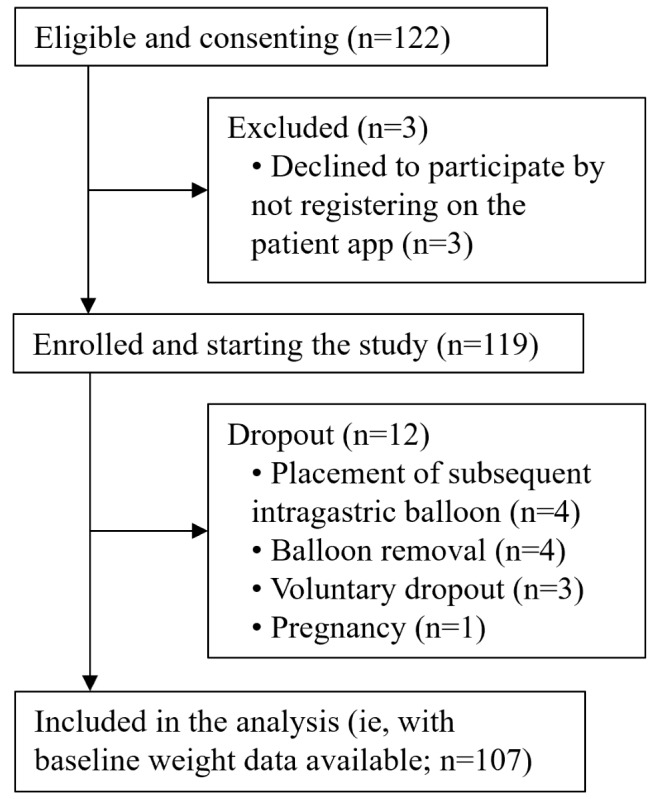
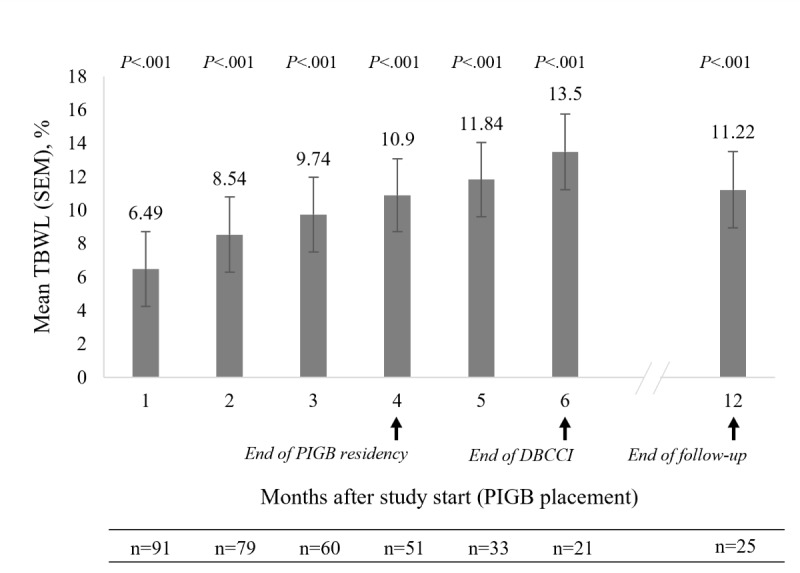
Overall, 107 participants (n=96, 89.7% female; mean baseline BMI 35.4, SD 5.4 kg/m) were included in the analysis. Mean total body weight loss was 13.5% (SEM 2.3%) at the end of the DBCCI and 11.22% (SEM 2.3%) at the 12-month follow-up (P<.001). Improvements were observed for all psychological well-being measures throughout the 12 months except for the Generalized Anxiety Disorder Scale (improvement at month 1) and Barriers to Being Active Quiz (improvements at months 3 and 6). Surveys showed high levels of engagement with and acceptability of the DBCCI.
This study provides evidence that the health coach-led, asynchronous, text-based DBCCI was engaging and acceptable to participants with overweight and obesity. The DBCCI, delivered alongside the PIGB and its aftercare program, supported improved weight loss outcomes and psychological well-being versus baseline and was associated with lifestyle behavior changes known to help achieve and maintain long-term weight loss and improved health outcomes. Follow-up findings suggest a potential need for longer-term, more intense coaching to focus on weight loss maintenance and support ongoing self-coaching. This could be achieved by leveraging generative artificial intelligence to provide ongoing automated behavior change coaching support to augment human-led care.
ClinicalTrials.gov NCT05884606; https://clinicaltrials.gov/study/NCT05884606.
数字健康干预在体重管理方面显示出前景。然而,很少有基于文本的行为改变干预措施是为支持接受胃内球囊治疗的患者而设计的,而且尽管这些因素在体重管理中存在关键的相互作用,但没有一项干预措施同时评估体重减轻、心理健康和行为改变情况。
本研究旨在评估一种由健康教练主导、异步、基于文本的数字行为改变辅导干预措施(DBCCI),该措施应用于接受胃内球囊治疗及其后续护理计划的参与者,是否对参与者可行且可接受,并能支持改善结果,包括体重减轻、心理健康以及有助于维持体重减轻的生活方式行为改变。
这项为期12个月的单臂前瞻性研究招募了年龄在21至65岁、BMI≥27kg/m²的成年人,他们在英国和荷兰的5家减肥诊所接受了无需手术的胃内球囊(PIGB)治疗。参与者在放置PIGB后接受DBCCI和诊所主导的PIGB后续护理计划(远程提供),为期6个月,之后再无干预措施,持续6个月。DBCCI是一种基于证据的个性化干预措施,健康教练通过在应用程序内以文本形式异步交流为参与者提供支持。在为期12个月的研究中,我们通过自我管理的有效问卷(沃里克-爱丁堡心理健康量表、广泛性焦虑障碍量表、体重对生活质量的影响-简化版-临床试验版、饮食失控量表-简短版、体重效能生活方式问卷-简表以及身体活动障碍问卷)评估总体重减轻百分比和心理健康状况。通过自我报告调查评估参与者对干预措施的参与度和接受度。
总体而言,107名参与者(n = 96,89.7%为女性;平均基线BMI为35.4,标准差为5.4kg/m²)纳入分析。在DBCCI结束时,平均总体重减轻为13.5%(标准误2.3%),在12个月随访时为11.22%(标准误2.3%)(P <.001)。在整个12个月中,除广泛性焦虑障碍量表(第1个月有改善)和身体活动障碍问卷(第3个月和第6个月有改善)外,所有心理健康指标均有改善。调查显示参与者对DBCCI的参与度和接受度较高。
本研究提供了证据,表明由健康教练主导、异步、基于文本的DBCCI对超重和肥胖参与者具有吸引力且可接受。与PIGB及其后续护理计划一起实施的DBCCI,与基线相比,支持改善体重减轻结果和心理健康,并与已知有助于实现和维持长期体重减轻及改善健康结果的生活方式行为改变相关。随访结果表明可能需要更长期、更强化的辅导,以专注于维持体重减轻并支持持续的自我辅导。这可以通过利用生成式人工智能提供持续的自动化行为改变辅导支持来增强以人为导向的护理来实现。
ClinicalTrials.gov NCT05884606;https://clinicaltrials.gov/study/NCT05884606