
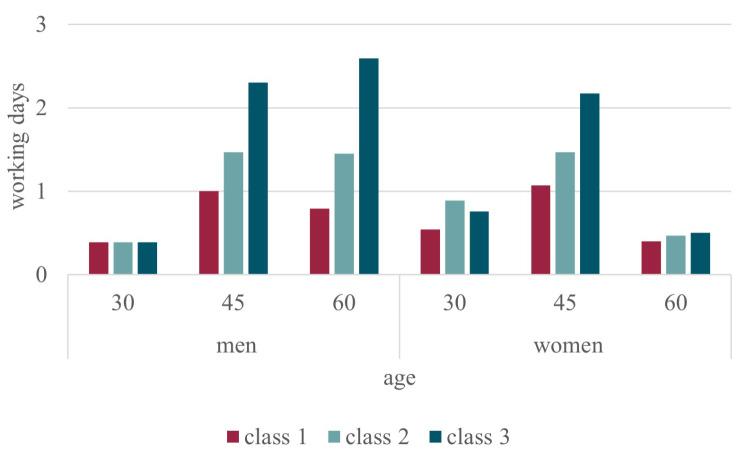
低风险、中风险和高风险肥胖与成本驱动因素、生命周期成本及预期寿命的关系。
Low-, moderate-, and high-risk obesity in association with cost drivers, costs over the lifecycle, and life expectancy.
作者信息
Reitzinger Stephanie, Czypionka Thomas
机构信息
Institute for Advanced Studies, Josefstaedter Strasse 39, Vienna, 1080, Austria.
London School of Economics and Political Science, London, UK.
出版信息
BMC Public Health. 2024 Jul 31;24(1):2069. doi: 10.1186/s12889-024-19574-8.
BACKGROUND
The prevalence of low-, moderate-, and high-risk obesity has been increasing globally. Our aim was to estimate the societal burden of these three obesity classes in the Austrian population by taking a societal-annual perspective and an individual-life-cycle perspective. Secondly, we sought to identify the respective cost drivers and the effects on life expectancy.
METHODS
We used population-weighted survey data on the distribution of body mass index (BMI) and data on relative risks regarding 83 diseases. Using fractional polynomial regressions, we estimated relative risks per BMI unit for about 30 cost-intensive diseases up to BMI values of 50. The approach for the cost analysis was based on the use of population-attributable fractions applied to direct medical and indirect cost data. Macro-disease-specific data regarding cost factors came from cost-of-illness statistics and administrative sources.
RESULTS
About 8.2% of deaths and 4.6% of health expenditure are attributable to obesity in Austria in 2019, causing 0.61% of GDP loss. A third of annual direct and indirect costs came from class 2 and class 3 obesity. From an individual perspective, life-cycle costs of class 2 and class 3 obesity were 1.9 and 3.6 times the costs of class 1 obesity, respectively. At the age of 45, people with high-risk obesity are about to lose approximately 4.9 life years and 9.7 quality-adjusted life years.
CONCLUSIONS
We have extended the method of population-attributable fractions, allowing us to estimate differences in the life-cycle direct medical and indirect costs between low-, moderate-, and high-risk obesity. We found that the lifetime costs of obesity are strikingly different between obesity classes, which has been veiled in the societal-annual perspective. Our findings provide a foundation for evaluating public health interventions aimed at combating obesity in order to mitigate the escalating individual and societal burden resulting from obesity prevalence and complications in the future.
背景
全球范围内,低风险、中风险和高风险肥胖症的患病率一直在上升。我们的目标是从社会年度视角和个人生命周期视角评估这三类肥胖症给奥地利人口带来的社会负担。其次,我们试图确定各自的成本驱动因素以及对预期寿命的影响。
方法
我们使用了关于体重指数(BMI)分布的人口加权调查数据以及83种疾病的相对风险数据。通过分数多项式回归,我们估计了BMI值达到50时约30种高成本疾病每单位BMI的相对风险。成本分析方法基于将人群归因分数应用于直接医疗和间接成本数据。关于成本因素的宏观疾病特定数据来自疾病成本统计和行政来源。
结果
2019年在奥地利,约8.2%的死亡和4.6%的医疗支出可归因于肥胖症,导致国内生产总值损失0.61%。每年三分之一的直接和间接成本来自2类和3类肥胖症。从个人角度来看,2类和3类肥胖症的生命周期成本分别是1类肥胖症成本的1.9倍和3.6倍。在45岁时,高风险肥胖者预计将损失约4.9个生命年和9.7个质量调整生命年。
结论
我们扩展了人群归因分数方法,使我们能够估计低风险、中风险和高风险肥胖症在生命周期直接医疗和间接成本方面的差异。我们发现,肥胖症类别之间的终身成本存在显著差异,这在社会年度视角中被掩盖了。我们的研究结果为评估旨在对抗肥胖症的公共卫生干预措施提供了基础,以便减轻未来因肥胖症患病率和并发症导致的个人和社会负担不断升级的情况。




 Zotero 插件