Dorman Michael F, Natale Sarah C, Stohl Joshua S, Felder Jenna
College of Health Solutions, Speech and Hearing Science, Arizona State University, Tempe, AZ, United States.
North American Research Laboratory, MED-EL, Durham, NC, United States.
Front Hum Neurosci. 2024 Jul 17;18:1434786. doi: 10.3389/fnhum.2024.1434786. eCollection 2024.
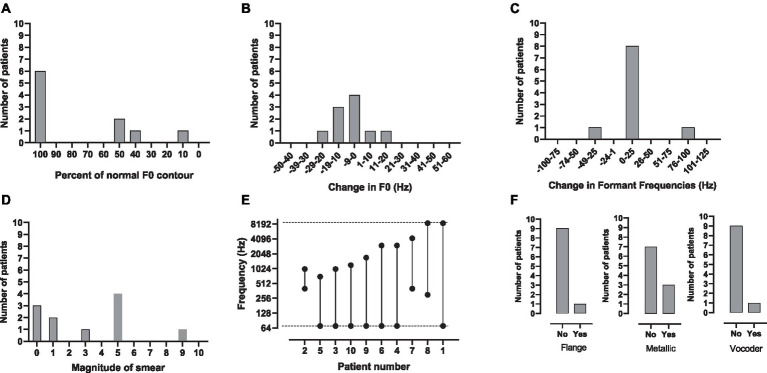
Cochlear implant (CI) systems differ in terms of electrode design and signal processing. It is likely that patients fit with different implant systems will experience different percepts when presented speech via their implant. The sound quality of speech can be evaluated by asking single-sided-deaf (SSD) listeners fit with a cochlear implant (CI) to modify clean signals presented to their typically hearing ear to match the sound quality of signals presented to their CI ear. In this paper, we describe very close matches to CI sound quality, i.e., similarity ratings of 9.5 to 10 on a 10-point scale, by ten patients fit with a 28 mm electrode array and MED EL signal processing. The modifications required to make close approximations to CI sound quality fell into two groups: One consisted of a restricted frequency bandwidth and spectral smearing while a second was characterized by a wide bandwidth and no spectral smearing. Both sets of modifications were different from those found for patients with shorter electrode arrays who chose upshifts in voice pitch and formant frequencies to match CI sound quality. The data from matching-based metrics of CI sound quality document that speech sound-quality differs for patients fit with different CIs and among patients fit with the same CI.
人工耳蜗(CI)系统在电极设计和信号处理方面存在差异。当通过人工耳蜗向植入不同系统的患者呈现语音时,他们可能会有不同的感知。可以通过让佩戴人工耳蜗(CI)的单侧聋(SSD)听众修改呈现给其正常听力耳朵的纯净信号,以使其与呈现给其人工耳蜗耳朵的信号音质相匹配,来评估语音的音质。在本文中,我们描述了10名佩戴28毫米电极阵列和MED-EL信号处理设备的患者对人工耳蜗音质的非常接近的匹配情况,即在10分制量表上相似度评分为9.5至10分。为使音质接近人工耳蜗音质所需的修改分为两组:一组包括受限的频率带宽和频谱模糊,而另一组的特点是带宽宽且无频谱模糊。这两组修改都与那些佩戴较短电极阵列的患者不同,后者会选择提高音高和共振峰频率来匹配人工耳蜗的音质。基于人工耳蜗音质匹配指标的数据表明,佩戴不同人工耳蜗的患者以及佩戴相同人工耳蜗的患者之间,语音音质存在差异。