Hatter Cardiovascular Institute, Institute for Cardiovascular Science, University College London, 67 Chenies Mews, London, WC1E 6HX, UK.
Developmental Biology and Cancer Programme, UCL Great Ormond Street Institute of Child Health, London, UK.
Basic Res Cardiol. 2024 Oct;119(5):733-749. doi: 10.1007/s00395-024-01071-z. Epub 2024 Aug 1.
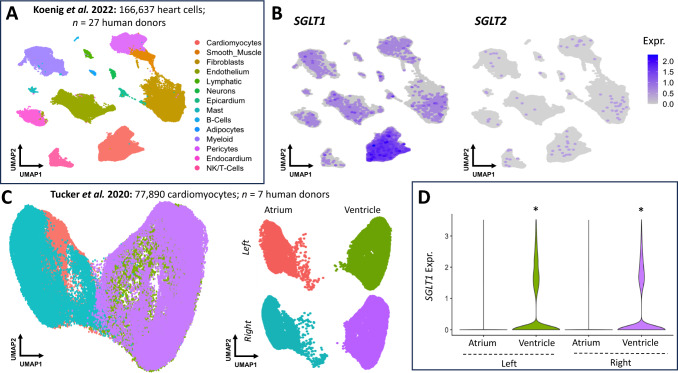
Hyperglycaemia is common during acute coronary syndromes (ACS) irrespective of diabetic status and portends excess infarct size and mortality, but the mechanisms underlying this effect are poorly understood. We hypothesized that sodium/glucose linked transporter-1 (SGLT1) might contribute to the effect of high-glucose during ACS and examined this using an ex-vivo rodent heart model of ischaemia-reperfusion injury. Langendorff-perfused rat hearts were subjected to 35 min ischemia and 2 h reperfusion, with variable glucose and reciprocal mannitol given during reperfusion in the presence of pharmacological inhibitors of SGLT1. Myocardial SGLT1 expression was determined in rat by rtPCR, RNAscope and immunohistochemistry, as well as in human by single-cell transcriptomic analysis. High glucose in non-diabetic rat heart exacerbated reperfusion injury, significantly increasing infarct size from 45 ± 3 to 65 ± 4% at 11-22 mmol/L glucose, respectively (p < 0.01), an association absent in diabetic heart (32 ± 1-37 ± 5%, p = NS). Rat heart expressed SGLT1 RNA and protein in vascular endothelium and cardiomyocytes, with similar expression found in human myocardium by single-nucleus RNA-sequencing. Rat SGLT1 expression was significantly reduced in diabetic versus non-diabetic heart (0.608 ± 0.08 compared with 1.116 ± 0.13 probe/nuclei, p < 0.01). Pharmacological inhibitors phlorizin, canagliflozin or mizagliflozoin in non-diabetic heart revealed that blockade of SGLT1 but not SGLT2, abrogated glucose-mediated excess reperfusion injury. Elevated glucose is injurious to the rat heart during reperfusion, exacerbating myocardial infarction in non-diabetic heart, whereas the diabetic heart is resistant to raised glucose, a finding which may be explained by lower myocardial SGLT1 expression. SGLT1 is expressed in vascular endothelium and cardiomyocytes and inhibiting SGLT1 abrogates excess glucose-mediated infarction. These data highlight SGLT1 as a potential clinical translational target to improve morbidity/mortality outcomes in hyperglycemic ACS patients.
高血糖在急性冠状动脉综合征(ACS)期间很常见,无论糖尿病状态如何,都预示着梗死面积增加和死亡率增加,但这种效应的机制尚不清楚。我们假设钠/葡萄糖协同转运蛋白-1(SGLT1)可能在 ACS 期间的高血糖效应中起作用,并使用缺血再灌注损伤的离体啮齿动物心脏模型对此进行了研究。Langendorff 灌注的大鼠心脏经历 35 分钟缺血和 2 小时再灌注,再灌注期间给予不同浓度的葡萄糖和等渗甘露醇,并使用 SGLT1 的药理学抑制剂。通过 rtPCR、RNAscope 和免疫组织化学测定大鼠心肌 SGLT1 表达,并通过单细胞转录组分析测定人心肌 SGLT1 表达。非糖尿病大鼠心脏中的高葡萄糖加重了再灌注损伤,使 11-22mmol/L 葡萄糖时的梗死面积分别显著增加到 65±4%(p<0.01),而在糖尿病心脏中则没有这种关联(32±1-37±5%,p=NS)。大鼠心脏的血管内皮细胞和心肌细胞中均表达 SGLT1 RNA 和蛋白,单细胞 RNA 测序显示人类心肌中也存在类似的表达。糖尿病大鼠心脏中的 SGLT1 表达明显低于非糖尿病大鼠心脏(0.608±0.08 与 1.116±0.13 探针/核,p<0.01)。非糖尿病大鼠心脏中,SGLT1 的药理学抑制剂根皮苷、卡格列净或米格列净,阻断 SGLT1 而非 SGLT2,可消除葡萄糖介导的再灌注损伤。高葡萄糖在再灌注期间对大鼠心脏有害,加重非糖尿病心脏的心肌梗死,而糖尿病心脏对高葡萄糖具有抗性,这一发现可能是由于心肌 SGLT1 表达降低所致。SGLT1 在血管内皮细胞和心肌细胞中表达,抑制 SGLT1 可消除过量葡萄糖介导的梗死。这些数据突出了 SGLT1 作为一个潜在的临床转化靶点,以改善高血糖 ACS 患者的发病率/死亡率。