Center for Brain Imaging, School of Life Science and Technology, Xidian University and Engineering Research Center of Molecular and Neuroimaging, Ministry of Education, Xi'an, Shaanxi, China.
International Joint Research Center for Advanced Medical Imaging and Intelligent Diagnosis and Treatment and Xi'an Key Laboratory of Intelligent Sensing and Regulation of Trans-Scale Life Information, School of Life Science and Technology, Xidian University, Xi'an, Shaanxi, China.
JCI Insight. 2024 Aug 1;9(17):e175967. doi: 10.1172/jci.insight.175967.
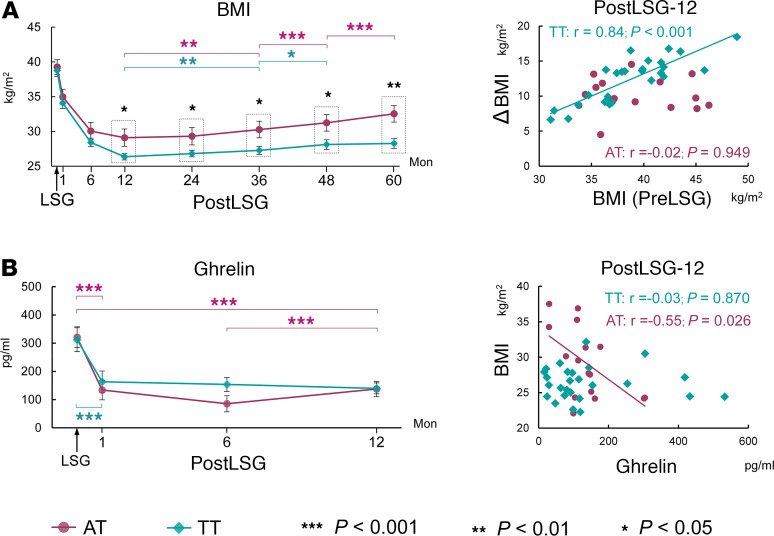
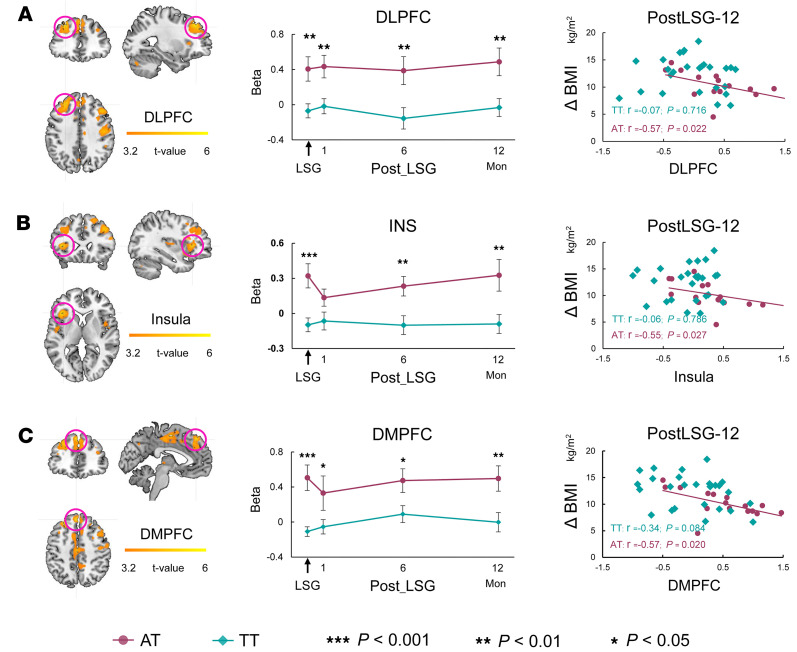
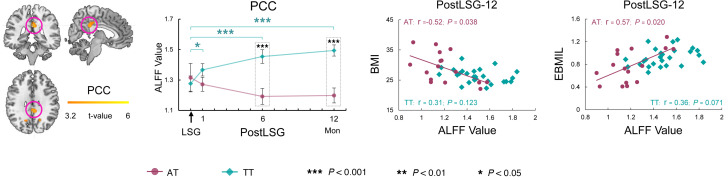
BACKGROUNDA polymorphism in the fat mass and obesity-associated gene (FTO) is linked to enhanced neural sensitivity to food cues and attenuated ghrelin suppression. Risk allele carriers regain more weight than noncarriers after bariatric surgery. It remains unclear how FTO variation affects brain function and ghrelin following surgery.METHODSResting-state functional magnetic resonance imaging and cue-reactivity functional magnetic resonance imaging with high-/low-caloric food cues were performed before surgery and at 1, 6, and 12 months after surgery to examine brain function in 16 carriers with 1 copy of the rs9939609 A allele (AT) and 26 noncarriers (TT). Behavioral assessments up to 5 years after surgery were also conducted.RESULTSThe AT group relative to the TT group had smaller BMI loss at 12-60 months after surgery and lower resting-state activity in posterior cingulate cortex following laparoscopic sleeve gastrectomy (group-by-time interaction effects). Meanwhile, the AT group relative to the TT group showed greater food cue responses in dorsolateral prefrontal cortex (DLPFC), dorsomedial prefrontal cortex (DMPFC), and insula (group effects). There were negative associations of weight loss with ghrelin and greater activation in DLPFC, DMPFC and insula in the AT but not the TT group.CONCLUSIONThese findings indicate that FTO variation is associated with the evolution of ghrelin signaling and brain function after bariatric surgery, which might hinder weight loss.TRIAL REGISTRATIONChinese Clinical Trial Registry Center, ChiCTR-OOB-15006346.FUNDINGThis work was supported by the National Natural Science Foundation of China (grant nos. 82172023, 82202252, 82302292); National Key R&D Program of China (no. 2022YFC3500603); Natural Science Basic Research Program of Shaanxi (grant nos. 2022JC-44, 2022JQ-622, 2023-JC-QN-0922, 2023-ZDLSF-07); Fundamental Research Funds for the Central Universities (grant nos. ZYTS23188, XJSJ23190, XJS221201, QTZX23093); and the Intramural Research Program of the National Institute on Alcoholism and Alcohol Abuse (grant no. Y1AA3009).
肥胖相关基因(FTO)的多态性与增强对食物线索的神经敏感性和减弱生长激素释放肽的抑制有关。风险等位基因携带者在减肥手术后比非携带者更容易增加体重。目前尚不清楚 FTO 变异如何影响手术后的大脑功能和生长激素释放肽。
在手术前、手术后 1、6 和 12 个月,使用高热量/低热量食物线索进行静息态功能磁共振成像和线索反应功能磁共振成像,以检查 16 名携带 1 份 rs9939609A 等位基因(AT)和 26 名非携带者(TT)的 FTO 变异对大脑功能的影响。手术后 5 年内还进行了行为评估。
与 TT 组相比,AT 组在手术后 12-60 个月时 BMI 下降幅度较小,腹腔镜袖状胃切除术(分组-时间交互效应)后后扣带回皮质的静息状态活动较低。同时,与 TT 组相比,AT 组在背外侧前额叶皮质(DLPFC)、背内侧前额叶皮质(DMPFC)和岛叶的食物线索反应更大(组效应)。在 AT 组而非 TT 组中,体重减轻与生长激素释放肽呈负相关,DLPFC、DMPFC 和岛叶的激活程度更大。
这些发现表明,FTO 变异与减肥手术后生长激素释放肽信号和大脑功能的演变有关,这可能会阻碍体重减轻。
中国临床试验注册中心,ChiCTR-OOB-15006346。
本工作得到国家自然科学基金(批准号:82172023、82202252、82302292);国家重点研发计划(编号:2022YFC3500603);陕西省自然科学基础研究计划(批准号:2022JC-44、2022JQ-622、2023-JC-QN-0922、2023-ZDLSF-07);中央高校基本科研业务费(批准号:ZYTS23188、XJSJ23190、XJS221201、QTZX23093);国家酒精滥用与酒精中毒研究所内部研究计划(批准号:Y1AA3009)。