Hunan Key Laboratory of Economic Crops Genetic Improvement and Integrated Utilization, School of Life and Health Science, Hunan University of Science and Technology, Xiangtan, 411201, China.
Yuelushan Laboratory, Changsha, 410128, China.
BMC Plant Biol. 2024 Aug 2;24(1):735. doi: 10.1186/s12870-024-05418-5.
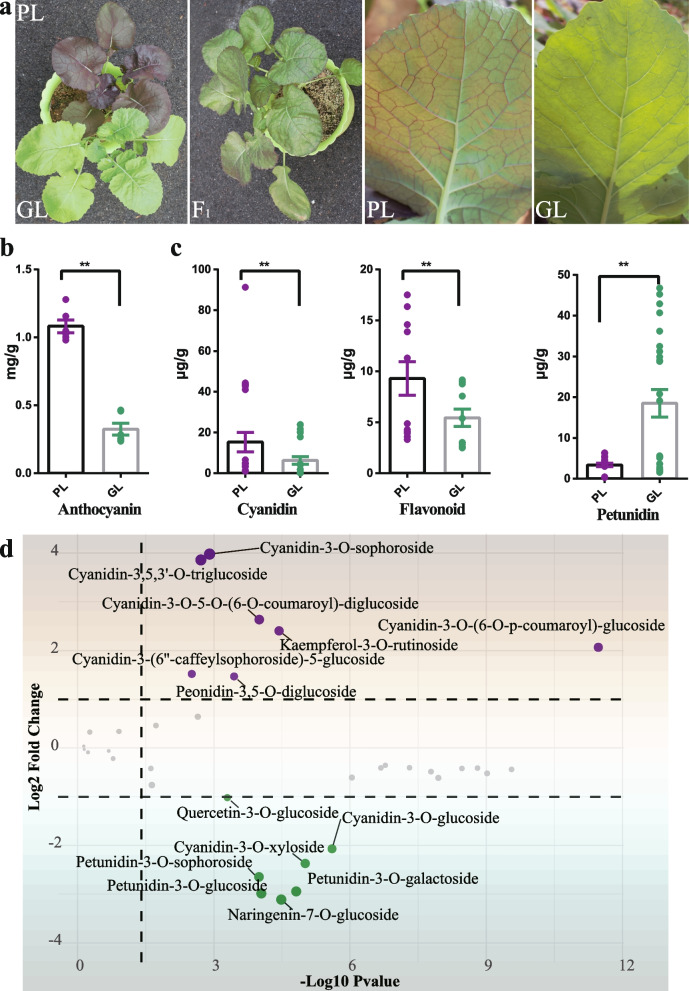
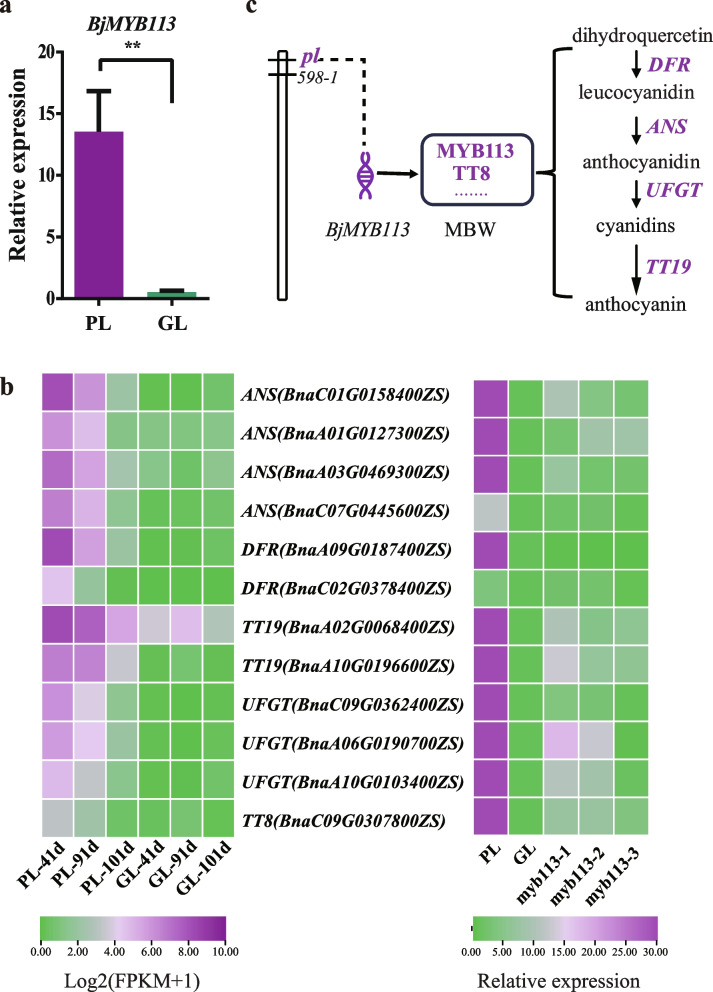
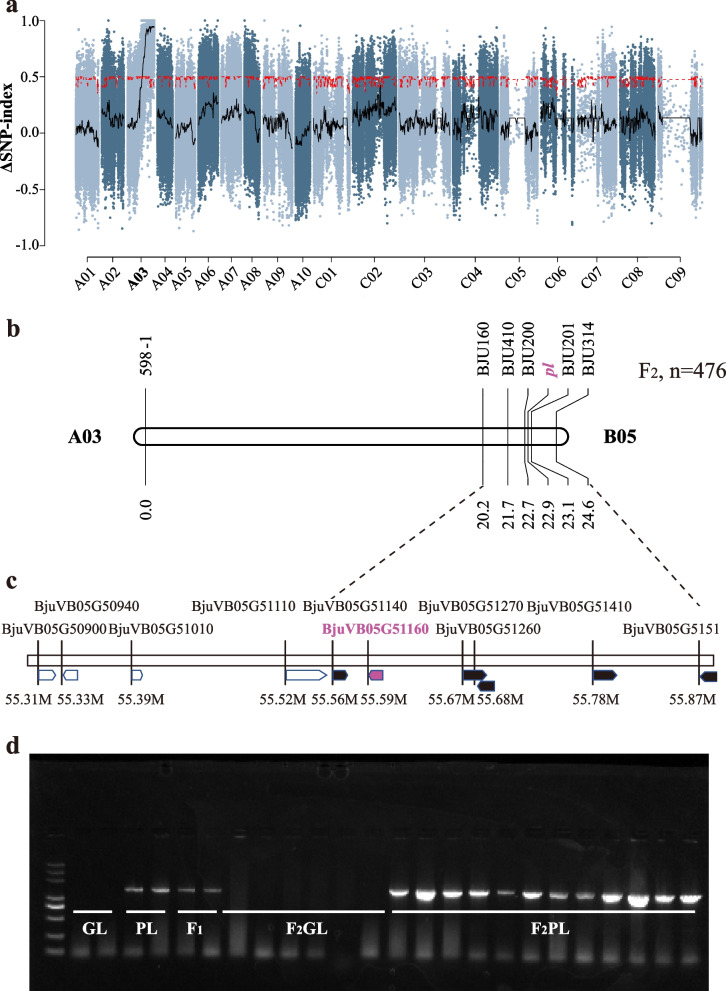
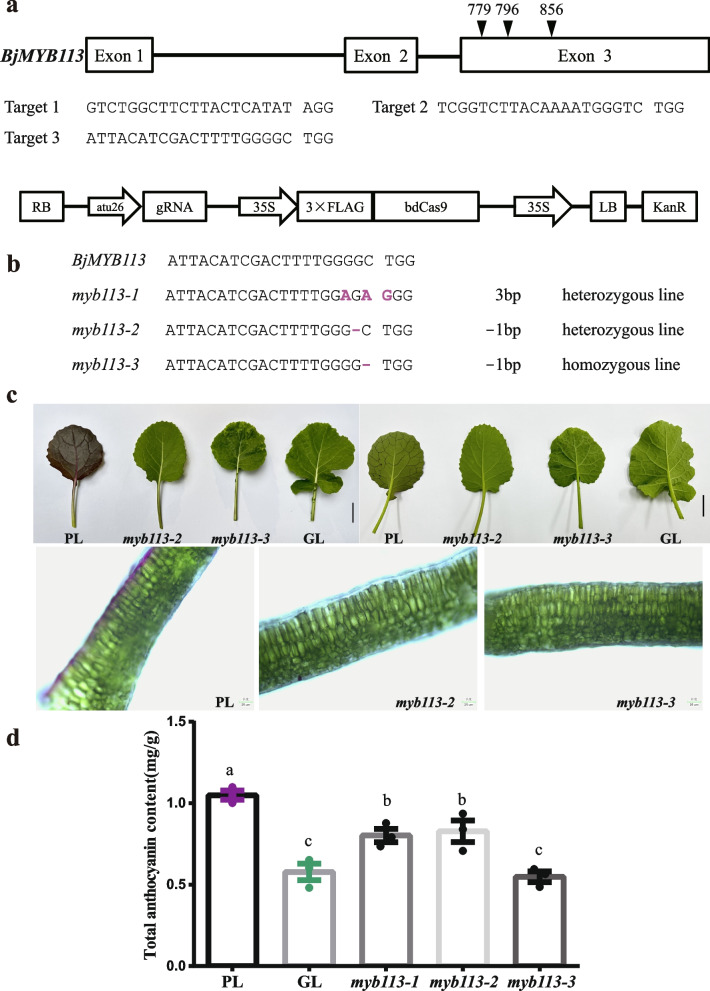
The purple leaves of Brassica napus are abundant in anthocyanins, which are renowned for their role in conferring distinct colors, stress tolerance, and health benefits, however the genetic basis of this trait in B. napus remains largely unelucidated. Herein, the purple leaf B. napus (PL) exhibited purple pigments in the upper epidermis and a substantial increase in anthocyanin accumulation, particularly of cyanidin, compared to green leaf B. napus (GL). The genetic control of the purple leaf trait was attributed to a semi-dominant gene, pl, which was mapped to the end of chromosome A03. However, sequencing of the fragments amplified by the markers linked to pl indicated that they were all mapped to chromosome B05 from B. juncea. Within this B05 chromosomal segment, the BjMYB113 gene-specific marker showed perfect co-segregation with the purple leaf trait in the F population, suggesting that the BjMYB113 introgression from B. juncea was the candidate gene for the purple leaf trait in B. napus. To further verify the function of candidate gene, CRISPR/Cas9 was performed to knock out the BjMYB113 gene in PL. The three myb113 mutants exhibited evident green leaf phenotype, absence of purple pigments in the adaxial epidermis, and a significantly reduced accumulation of anthocyanin compared to PL. Additionally, the genes involved in positive regulatory (TT8), late anthocyanin biosynthesis (DFR, ANS, UFGT), as well as transport genes (TT19) were significantly suppressed in the myb113 mutants, further confirming that BjMYB113 was response for the anthocyanin accumulation in purple leaf B. napus. This study contributes to an advanced understanding of the regulation mechanism of anthocyanin accumulation in B. napus.
甘蓝型油菜的紫色叶片富含花色素苷,花色素苷因其赋予植物独特的颜色、增强植物对环境胁迫的耐受性和对健康有益而闻名,然而,甘蓝型油菜中这种性状的遗传基础在很大程度上仍未阐明。在此,与绿叶甘蓝型油菜(GL)相比,紫叶甘蓝型油菜(PL)的上表皮呈现出紫色色素,花色素苷积累显著增加,尤其是飞燕草色素。紫色叶片性状的遗传控制归因于一个半显性基因 pl,该基因被定位在 A03 染色体的末端。然而,对与 pl 相连的标记所扩增的片段进行测序表明,它们都被定位到芥菜型油菜(B. juncea)的 B05 染色体上。在这个 B05 染色体片段内,BjMYB113 基因特异性标记与 F 群体中的紫色叶片性状完全共分离,表明来自芥菜型油菜的 BjMYB113 基因的导入是甘蓝型油菜紫色叶片性状的候选基因。为了进一步验证候选基因的功能,在 PL 中使用 CRISPR/Cas9 敲除了 BjMYB113 基因。与 PL 相比,三个 myb113 突变体表现出明显的绿叶表型,上表皮缺乏紫色色素,花色素苷积累显著减少。此外,与正调控基因(TT8)、晚期花色素苷生物合成基因(DFR、ANS、UFGT)以及转运基因(TT19)相关的基因在 myb113 突变体中显著下调,进一步证实了 BjMYB113 响应了甘蓝型油菜紫色叶片中花色素苷的积累。本研究有助于深入了解甘蓝型油菜花色素苷积累的调控机制。