Centre for Foreign Language Tuition, Poznan University of Medical Sciences, Poznan, 60-801, Poland.
Department of Medical Education, Poznan University of Medical Sciences, 7 Rokietnicka St, Poznan, 60-806, Poland.
BMC Med Educ. 2024 Aug 1;24(1):833. doi: 10.1186/s12909-024-05830-3.
Changes in Polish demographic data with a growing number of culturally and linguistically diverse patients stipulate new directions in medical education to prepare future physicians to work effectively across cultures. However, little is known about Polish medical students' willingness to gain cross-cultural knowledge and skills, desire to get engaged in interactions with patients from diverse cultural backgrounds, expectations and needs concerning cross-cultural training as well as challenges they face in the path to cultural competence.
Therefore, in this study, we conducted and thematically analysed fifteen semi-structured interviews with medical students to broaden our understanding of medical students' perception of cross-cultural competence enhancement.
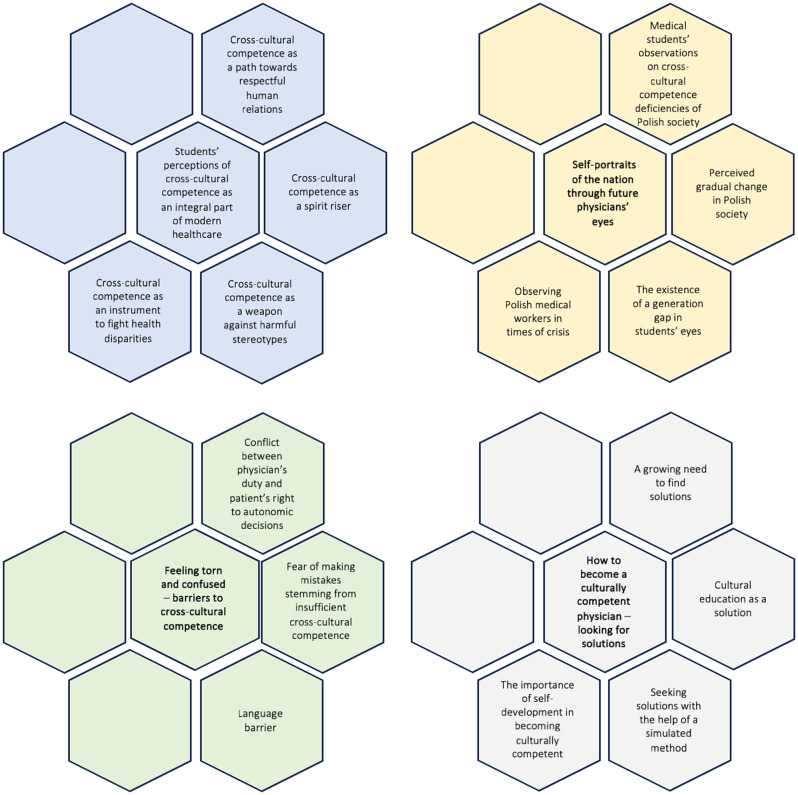
The conducted thematic analysis allowed for the development of four themes, which showed that Polish medical students perceived skills and knowledge necessary to facilitate culturally congruent care as indispensable to form quality patient-doctor relations, believed that lack of cultural sensitivity may lead to dangerous stereotype formation and insufficient competence may be the source of stress and anxiety resulting in confusion and lack of confidence. Finally, numerous suggestions have been made by participants on how to improve their cross-cultural competence. Students emphasized, however, the role of medical education with active and experiential learning methods, including simulation-based training, in the process of equipping them with the knowledge and skills necessary to provide best quality care to culturally diverse patients.
Our analysis indicated that Polish medical students seem to hold positive attitudes towards cultural competence development and view it as an important component of physician professionalism.
波兰人口数据的变化,加上越来越多的文化和语言多样化的患者,这就要求医学教育做出新的调整,以培养未来的医生能够跨文化有效地工作。然而,对于波兰医学生获得跨文化知识和技能的意愿、与不同文化背景的患者互动的愿望、对跨文化培训的期望和需求,以及他们在文化能力培养道路上面临的挑战,人们知之甚少。
因此,在这项研究中,我们对 15 名医学生进行了半结构化访谈,并进行了主题分析,以更深入地了解医学生对增强跨文化能力的看法。
进行的主题分析得出了四个主题,这些主题表明,波兰医学生认为促进文化上一致的护理所需的技能和知识对于形成高质量的医患关系是不可或缺的,他们认为缺乏文化敏感性可能导致危险的刻板印象形成,而能力不足可能是导致压力和焦虑的根源,从而导致困惑和缺乏信心。最后,参与者提出了许多关于如何提高他们跨文化能力的建议。然而,学生们强调,在为他们提供提供给文化多样化患者最佳护理所需的知识和技能的过程中,医学教育应该采用主动和体验式的学习方法,包括基于模拟的培训。
我们的分析表明,波兰医学生似乎对文化能力发展持积极态度,并将其视为医生专业精神的重要组成部分。