Kim David E, Watson Joseph L, Juergens David, Majumder Sagardip, Sonigra Ria, Gerben Stacey R, Kang Alex, Bera Asim K, Li Xinting, Baker David
Department of Biochemistry, University of Washington, Seattle, WA 98195.
Institute for Protein Design, University of Washington, Seattle, WA 98195.
bioRxiv. 2025 Jan 6:2024.07.22.604663. doi: 10.1101/2024.07.22.604663.
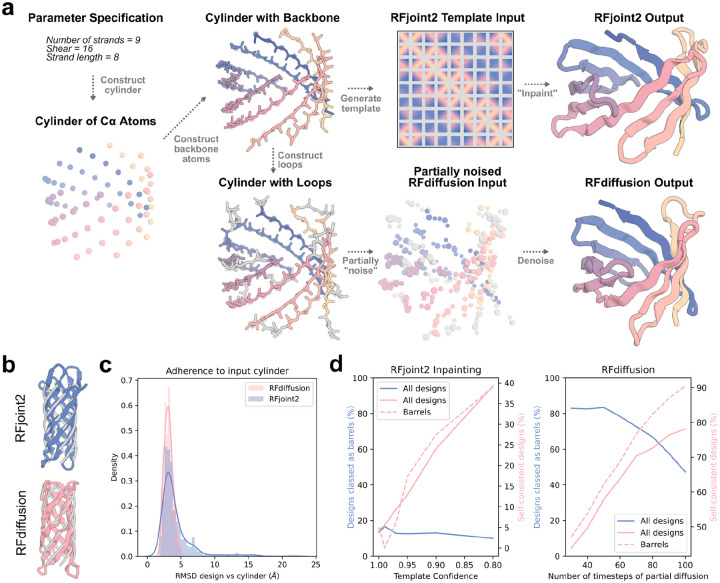
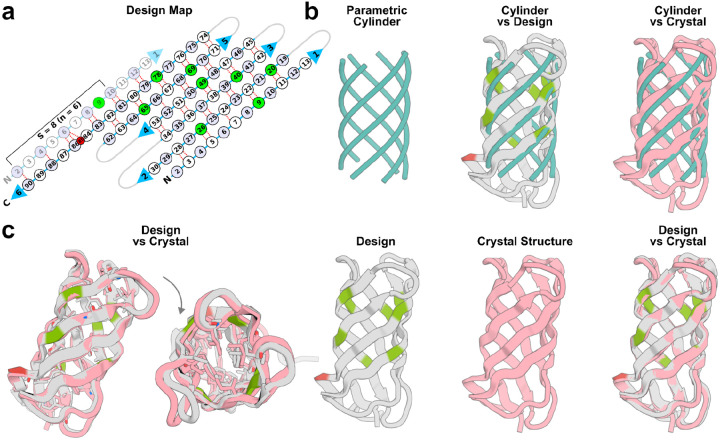
Francis Crick's global parameterization of coiled coil geometry has been widely useful for guiding design of new protein structures and functions. However, design guided by similar global parameterization of beta barrel structures has been less successful, likely due to the deviations from ideal barrel geometry required to maintain inter-strand hydrogen bonding without introducing backbone strain. Instead, beta barrels have been designed using 2D structural blueprints; while this approach has successfully generated new fluorescent proteins, transmembrane nanopores, and other structures, it requires expert knowledge and provides only indirect control over the global shape. Here we show that the simplicity and control over shape and structure provided by parametric representations can be generalized beyond coiled coils by taking advantage of the rich sequence-structure relationships implicit in RoseTTAFold based design methods. Starting from parametrically generated barrel backbones, both RFjoint inpainting and RFdiffusion readily incorporate backbone irregularities necessary for proper folding with minimal deviation from the idealized barrel geometries. We show that for beta barrels across a broad range of beta sheet parameterizations, these methods achieve high in silico and experimental success rates, with atomic accuracy confirmed by an X-ray crystal structure of a novel barrel topology, and de novo designed 12, 14, and 16 stranded transmembrane nanopores with conductances ranging from 200 to 500 pS. By combining the simplicity and control of parametric generation with the high success rates of deep learning based protein design methods, our approach makes the design of proteins where global shape confers function, such as beta barrel nanopores, more precisely specifiable and accessible.
弗朗西斯·克里克对卷曲螺旋几何结构的全局参数化在指导新蛋白质结构和功能的设计方面广泛有用。然而,由β桶结构的类似全局参数化指导的设计却不太成功,这可能是由于为了维持链间氢键而不引入主链应变,需要偏离理想的桶状几何结构。相反,β桶是使用二维结构蓝图设计的;虽然这种方法成功地产生了新的荧光蛋白、跨膜纳米孔和其他结构,但它需要专业知识,并且只能对全局形状进行间接控制。在这里,我们表明,通过利用基于RoseTTAFold的设计方法中隐含的丰富序列-结构关系,参数化表示所提供的形状和结构的简单性和可控性可以推广到卷曲螺旋之外。从参数化生成的桶状主链开始,RFjoint修复和RFdiffusion都能轻松地纳入正确折叠所需的主链不规则性,且与理想化的桶状几何结构的偏差最小。我们表明,对于广泛的β折叠参数化的β桶,这些方法在计算机模拟和实验中都取得了很高的成功率,通过一种新型桶状拓扑结构的X射线晶体结构证实了原子精度,并从头设计了12、14和16股跨膜纳米孔,其电导范围为200至500 pS。通过将参数化生成的简单性和可控性与基于深度学习的蛋白质设计方法的高成功率相结合,我们的方法使具有全局形状赋予功能的蛋白质设计,如β桶纳米孔,更精确地可指定和可实现。