Hewitt Rick A, Dalton Kevin M, Mendez Derek, Wang Harrison K, Klureza Margaret A, Brookner Dennis E, Greisman Jack B, McDonagh David, Šrajer Vukica, Sauter Nicholas K, Brewster Aaron S, Hekstra Doeke R
Department of Molecular and Cellular Biology, Harvard University, Cambridge, MA 02138.
Linac Coherent Light Source, SLAC National Accelerator Laboratory, Menlo Park, 94025, CA, USA.
bioRxiv. 2024 Jul 23:2024.07.23.604358. doi: 10.1101/2024.07.23.604358.
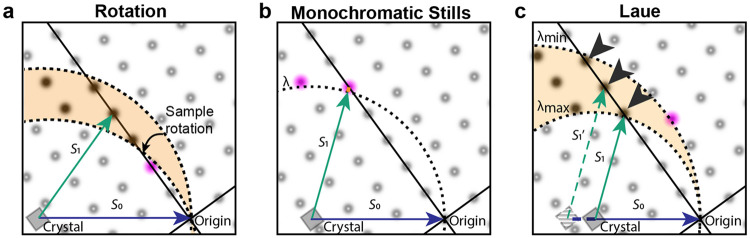
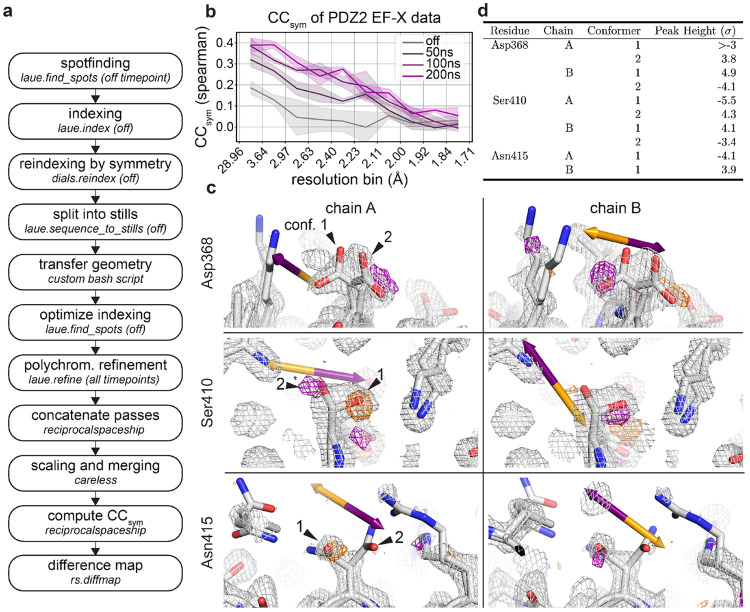
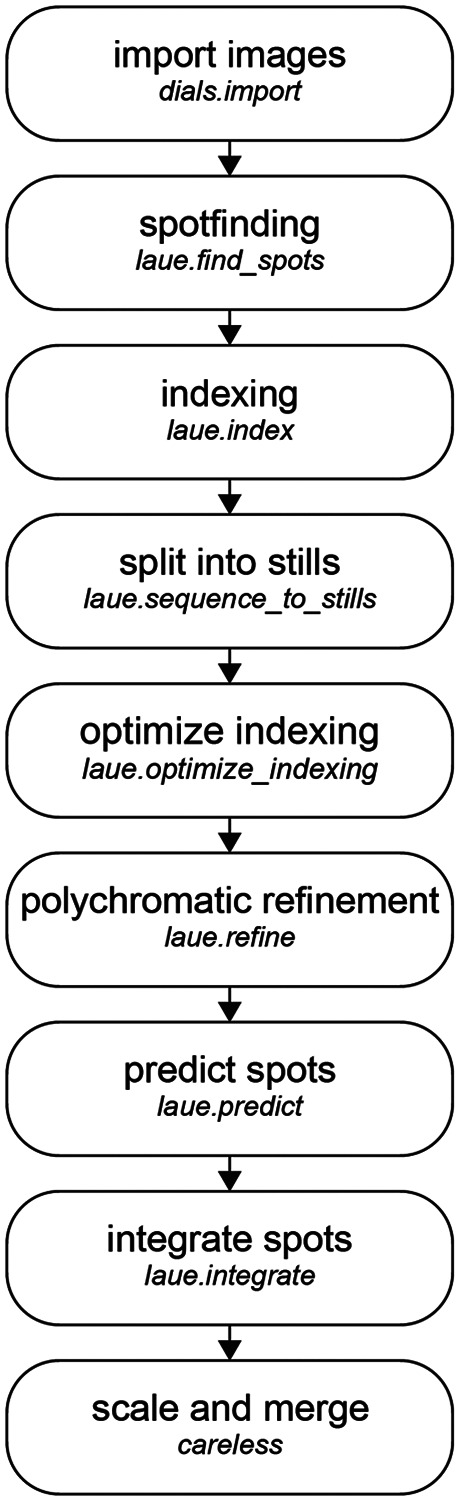
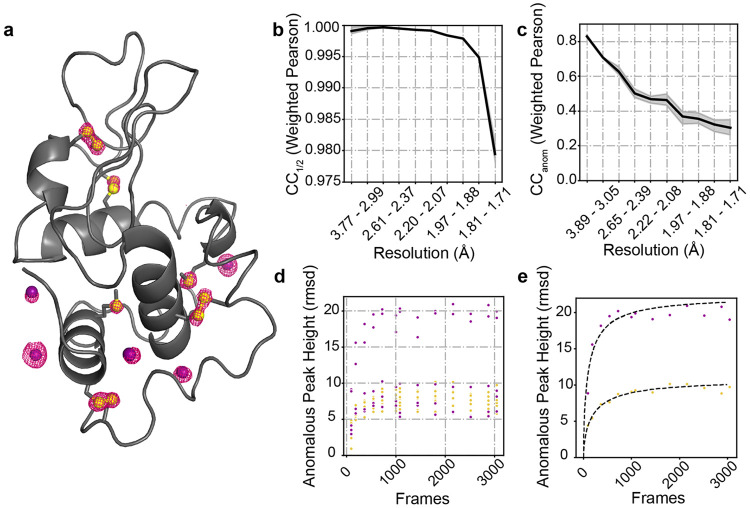
Most X-ray sources are inherently polychromatic. Polychromatic ("pink") X-rays provide an efficient way to conduct diffraction experiments as many more photons can be used and large regions of reciprocal space can be probed without sample rotation during exposure-ideal conditions for time-resolved applications. Analysis of such data is complicated, however, causing most X-ray facilities to discard >99% of X-ray photons to obtain monochromatic data. Key challenges in analyzing polychromatic diffraction data include lattice searching, indexing and wavelength assignment, correction of measured intensities for wavelength-dependent effects, and deconvolution of harmonics. We recently described an algorithm, Careless, that can perform harmonic deconvolution and correct measured intensities for variation in wavelength when presented with integrated diffraction intensities and assigned wavelengths. Here, we present Laue-DIALS, an open-source software pipeline that indexes and integrates polychromatic diffraction data. Laue-DIALS is based on the dxtbx toolbox, which supports the DIALS software commonly used to process monochromatic data. As such, Laue-DIALS provides many of the same advantages: an open-source, modular, and extensible architecture, providing a robust basis for future development. We present benchmark results showing that Laue-DIALS, together with Careless, provides a suitable approach to the analysis of polychromatic diffraction data, including for time-resolved applications.
大多数X射线源本质上都是多色的。多色(“粉色”)X射线提供了一种进行衍射实验的有效方法,因为可以使用更多的光子,并且在曝光期间无需样品旋转就能探测到倒易空间的大片区域——这是时间分辨应用的理想条件。然而,此类数据分析很复杂,导致大多数X射线设施会丢弃超过99%的X射线光子以获取单色数据。分析多色衍射数据的关键挑战包括晶格搜索、指标化和波长分配、对波长相关效应的测量强度进行校正以及谐波去卷积。我们最近描述了一种名为Careless的算法,当给出积分衍射强度和指定波长时,该算法可以进行谐波去卷积并校正测量强度随波长的变化。在此,我们展示了Laue-DIALS,这是一种用于对多色衍射数据进行指标化和积分的开源软件管道。Laue-DIALS基于dxtbx工具箱,该工具箱支持常用于处理单色数据的DIALS软件。因此,Laue-DIALS具有许多相同的优点:开源、模块化且可扩展的架构,为未来的发展提供了坚实的基础。我们展示的基准测试结果表明,Laue-DIALS与Careless一起,为多色衍射数据的分析提供了一种合适的方法,包括用于时间分辨应用。