Hawkesbury Institute for the Environment, Western Sydney University, Locked Bag 1797, Penrith, NSW, 2751, Australia.
Department of Entomology, University of Wisconsin-Madison, 1630 Linden Dr. Madison, Madison, WI, 53706, USA.
BMC Ecol Evol. 2024 Aug 2;24(1):104. doi: 10.1186/s12862-024-02293-4.
Understanding connections between biodiversity and ecosystem services can be enhanced by shifting focus from species richness to functional trait-based approaches, that when paired with comparative phylogenetic methods can provide even deeper insights. We investigated the functional ecology and phylogenetic diversity of pollination services provided by hymenopteran insects visiting apple flowers in orchards surrounded by either 'natural' or 'disturbed' landscapes in New South Wales, Australia. We assessed whether morphological and behavioural traits (hairiness, body size, glossa length, pollen load purity, and probability of loose pollen) exhibited non-random phylogenetic patterns. Then, explored whether bees, the primary pollinators in this system, filled unique or overlapping functional entities (FEs). For each landscape, we calculated phylogenetic diversity and used FEs to assess functional richness, evenness, and diversion.
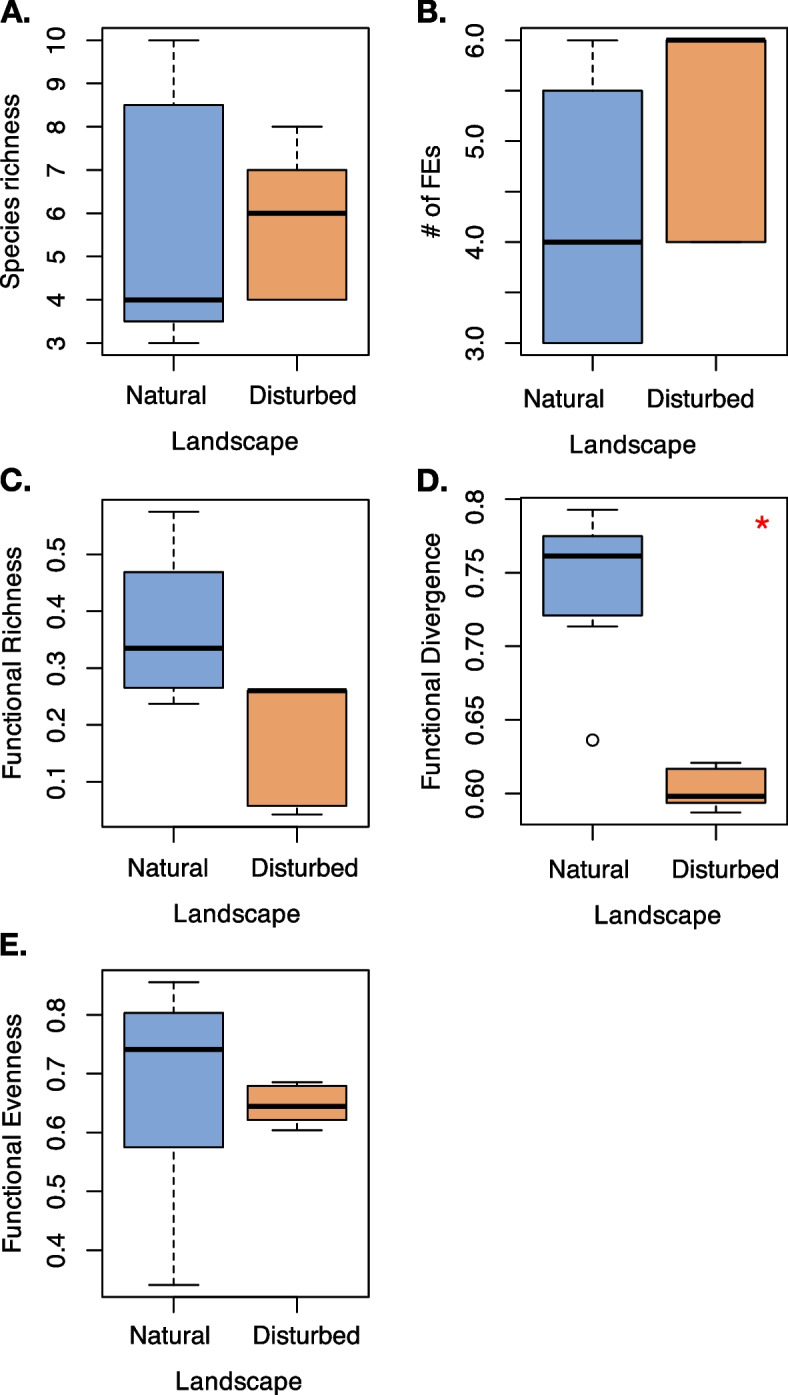
A phylogenomic matrix based on ultraconserved elements (UCEs; 1,382,620 bp from 1,969 loci) was used to infer a fully-resolved and well-supported maximum likelihood phylogeny for 48 hymenopteran morphospecies. There was no significant difference in species richness between landscape categories. Pollinator communities at natural sites had higher phylogenetic complexity (X = 2.37) and functional divergence (x̄ = 0.74 ± 0.02 s.e.) than disturbed sites (X = 1.65 and x̄ = 0.6 ± 0.01 s.e.). Hairiness showed significant phylogenetic clustering (K = 0.94), whereas body size, glossa length, and loose pollen showed weaker non-random phylogenetic patterns (K between 0.3-0.5). Pollen load purity showed no association with phylogeny. The assemblage of 17 bee morphospecies comprised nine FEs: eight FEs consisted of native bees with three containing 65% of all native bee taxa. The introduced honey bee (Apis mellifera) occupied a unique FE, likely due to its different evolutionary history. Both landscape types supported six FEs each with three overlapping: two native bee FEs and the honey bee FE.
Bee hairiness was the only functional trait to exhibit demonstrable phylogenetic signal. Despite differences in species richness, and functional and phylogenetic diversity between orchard landscape types, both maintained equal bee FE numbers. While no native bee taxon was analogous to the honey bee FE, four native bee FEs shared the same hairiness level as honey bees. Health threats to honey bee populations in Australia will likely disrupt pollination services to apple, and other pollination-dependent food crops, given the low level of functional redundancy within the investigated pollinator assemblages.
通过从物种丰富度转向基于功能性状的方法,将焦点转移,可以增强对生物多样性和生态系统服务之间联系的理解,当与比较系统发育方法结合使用时,甚至可以提供更深入的见解。我们研究了在澳大利亚新南威尔士州果园中,访问苹果花的膜翅目昆虫提供的传粉服务的功能生态学和系统发育多样性,这些果园周围是“自然”或“干扰”的景观。我们评估了形态和行为特征(多毛性、体型大小、舌长、花粉负荷纯度和松散花粉的可能性)是否表现出非随机的系统发育模式。然后,探索了在这个系统中主要的传粉媒介蜜蜂是否填补了独特或重叠的功能实体(FE)。对于每个景观,我们计算了系统发育多样性,并使用 FE 来评估功能丰富度、均匀度和分散度。
基于超保守元件(UCE;来自 1969 个基因座的 1382620bp)的基因组矩阵用于推断 48 种膜翅目形态种的完全解决且支持良好的最大似然系统发育关系。景观类别之间的物种丰富度没有显著差异。自然地点的传粉者群落具有更高的系统发育复杂性(X=2.37)和功能发散(x̄=0.74±0.02 s.e.),而受干扰的地点(X=1.65 和 x̄=0.6±0.01 s.e.)。多毛性表现出显著的系统发育聚类(K=0.94),而体型大小、舌长和松散花粉则表现出较弱的非随机系统发育模式(K 在 0.3-0.5 之间)。花粉负荷纯度与系统发育没有关联。由 17 种蜜蜂形态种组成的集合包括 9 个 FE:8 个 FE 由本地蜜蜂组成,其中 3 个包含所有本地蜜蜂类群的 65%。引入的蜜蜂(Apis mellifera)占据了一个独特的 FE,可能是由于其不同的进化历史。两种景观类型都支持 6 个 FE,其中 3 个重叠:两个本地蜜蜂 FE 和蜜蜂 FE。
蜜蜂的多毛性是唯一表现出明显系统发育信号的功能特征。尽管果园景观类型之间在物种丰富度、功能和系统发育多样性方面存在差异,但它们都保持了相同数量的蜜蜂 FE。虽然没有任何本地蜜蜂类群类似于蜜蜂 FE,但有四个本地蜜蜂 FE 具有与蜜蜂相同的多毛性水平。由于调查的传粉者集合内功能冗余程度低,澳大利亚蜜蜂种群面临的健康威胁可能会破坏对苹果和其他依赖传粉的粮食作物的传粉服务。