Takekita Yoshiteru, Hiraoka Shuichi, Iwama Yasuhiro, Matsui Daisuke, Aoki Nobuatsu, Ogata Haruhiko, Funatsuki Toshiya, Shimizu Toshiyuki, Murase Yuji, Shimamoto Yutaro, Koshikawa Yosuke, Kato Masaki
Department of Neuropsychiatry, Faculty of Medicine, Kansai Medical University, 10-15 Fumizono-cho, Moriguchi, Osaka, 570-8506, Japan.
Meiji Seika Pharma Co., Ltd., Tokyo, Japan.
Ann Gen Psychiatry. 2024 Aug 2;23(1):29. doi: 10.1186/s12991-024-00512-2.
The continuation rates of pharmacotherapy in schizophrenia exhibit variability, a phenomenon influenced by the specific antipsychotic agent prescribed and patient-related factors such as age and duration of illness. In this context, our study aims to elucidate the predictors of medication continuation for asenapine sublingual tablets, characterized by unique formulation properties.
Our investigation leveraged real-world data collected through post-marketing surveillance in Japan, comprising 3236 cases. Utilizing multivariate logistic regression analysis, we identified patient-related factors associated with medication continuation as the primary outcome measure, subsequently employing survival analysis for further evaluation. Additionally, adverse event occurrence was assessed as a secondary outcome measure.
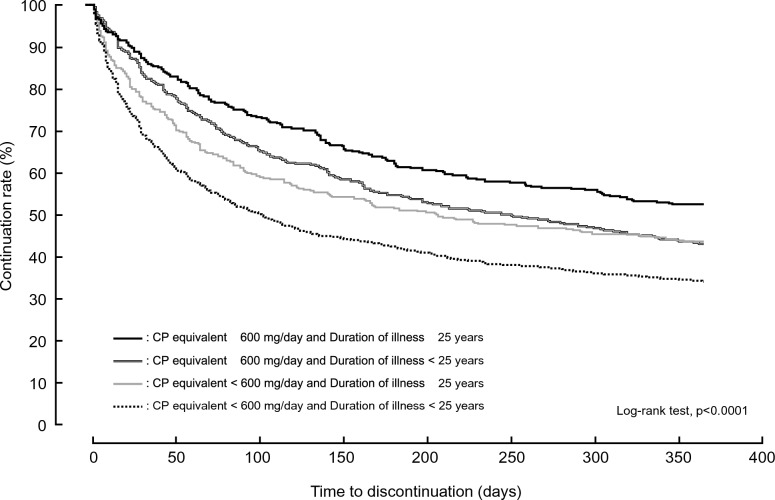
Multivariate logistic regression analysis unveiled significant predictors of asenapine continuation, notably including patient-related factors such as a chlorpromazine equivalent dose exceeding 600 mg/day and an illness duration of 25 years or more. While the overall continuation rate stood at 40.6%, patients exhibiting factors such as a chlorpromazine equivalent dose surpassing 600 mg/day or an illness duration exceeding 25 years demonstrated continuation rates of 46.3% and 47.9%, respectively. Remarkably, patients presenting both factors showcased the highest continuation rate at 52.5%.
Our findings shed light on distinct patient-related predictors of asenapine continuation, deviating from those observed with other antipsychotic medications. This underscores the necessity of recognizing that predictive factors for antipsychotic medication continuation vary across different agents. Moving forward, elucidating these predictive factors for various antipsychotic medications holds paramount importance in schizophrenia treatment, facilitating the delivery of tailored therapeutic interventions for individual patients.
精神分裂症药物治疗的持续率存在差异,这一现象受所开具的特定抗精神病药物以及年龄和病程等患者相关因素的影响。在此背景下,我们的研究旨在阐明具有独特剂型特性的阿立哌唑舌下片药物持续使用的预测因素。
我们的调查利用了通过日本上市后监测收集的真实世界数据,包括3236例病例。利用多因素逻辑回归分析,我们确定与药物持续使用相关的患者相关因素作为主要结局指标,随后采用生存分析进行进一步评估。此外,将不良事件的发生作为次要结局指标进行评估。
多因素逻辑回归分析揭示了阿立哌唑持续使用的显著预测因素,特别是包括患者相关因素,如氯丙嗪等效剂量超过600mg/天和病程25年或更长。虽然总体持续率为40.6%,但氯丙嗪等效剂量超过600mg/天或病程超过25年等因素的患者的持续率分别为46.3%和47.9%。值得注意的是,同时具备这两个因素的患者持续率最高,为52.5%。
我们的研究结果揭示了阿立哌唑持续使用的不同患者相关预测因素,与其他抗精神病药物观察到的因素不同。这凸显了认识到抗精神病药物持续使用的预测因素因药物不同而有所差异的必要性。展望未来,阐明各种抗精神病药物的这些预测因素在精神分裂症治疗中至关重要,有助于为个体患者提供量身定制的治疗干预措施。