The neurosurgery, Nanyang Central Hospital, Nanyang, Henan, 473000, China.
Shaanxi Provincial People's Hospital, Xi'an, Shaanxi, 710086, China.
BMC Neurol. 2024 Aug 3;24(1):270. doi: 10.1186/s12883-024-03774-1.
The nutritional status and inflammatory responses of patients with aneurysmal subarachnoid hemorrhage (aSAH) play a vital prognostic role. We investigated the relationship between preoperative prognostic nutritional index (PNI)、neutrophil/albumin ratio (NAR)、platelet/albumin ratio (PAR) and other factors and the clinical prognosis of patients who underwent clipping for aSAH and its predictive model.
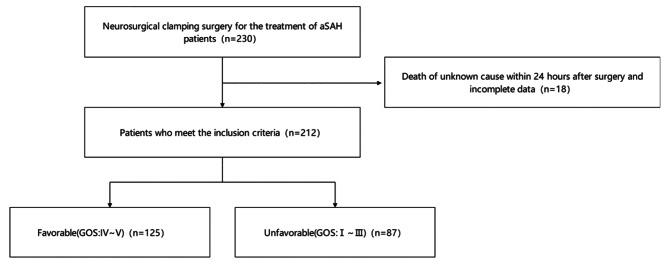
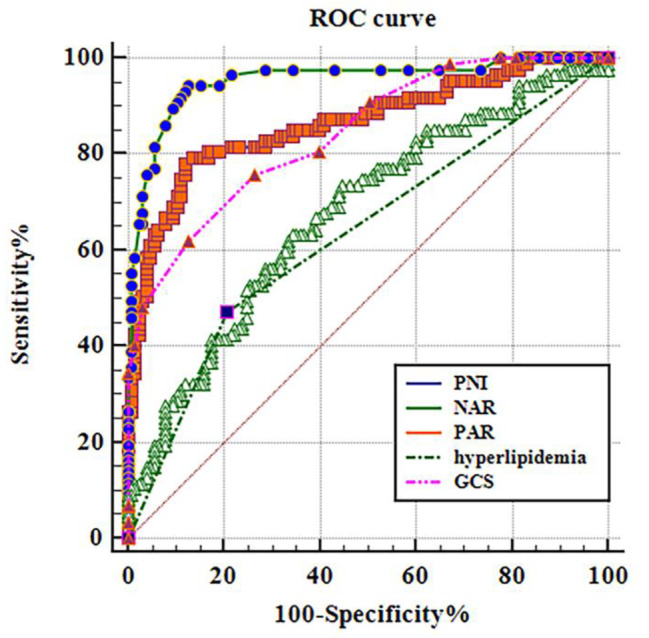
The clinical data of 212 patients with aSAH who underwent neurosurgery at Nanyang Central Hospital between 2018 and 2023 were retrospectively analyzed. Based on the Glasgow Outcome Scale (GOS) score at 6 months postoperatively, the patients were categorized into two groups: poor (GOSI-III) and good (GOSIV-V) prognosis groups. Multivariate logistic regression analysis was performed to determine the predictive value of preoperative PNI、NAR、PAR、hyperlipidemia and Glasgow Coma Scale (GCS) for prognosis. Furthermore, nomograms and prognostic prediction models were constructed. Receiver operating characteristic curves and area under the curve (AUC) were utilized to determine the predictive values.
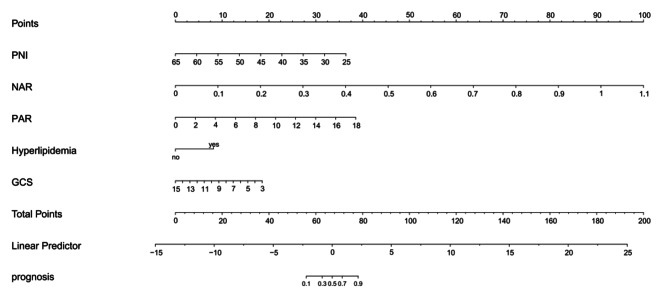
Multivariate logistic regression analysis revealed that PNI (OR = 1.250, 95%CI 1.060 ~ 1.475, P = 0.008), NAR (OR = 0.000, 95%CI 0.000 ~ 0.004, P = 0.000), PAR(OR = 0.515, 95%CI 0.283 ~ 0.937, P = 0.030), hyperlipidemia (OR = 4.627, 95%CI 1.166 ~ 18.367, P = 0.029), and GCS(OR = 1.446, 95%CI 1.041 ~ 2.008, P = 0.028) are independent risk factors for poor postoperative prognosis. The total score of the nomogram was 200, and the AUC value was 0.972.
PNI and NAR can reflect the nutritional status and inflammatory responses of patients.They are significantly associated with the postoperative prognosis of patients with aSAH. Comprehensively analyzing PNI and NAR combined with other clinical indicators can more effectively guide treatment and help predict prognosis.
动脉瘤性蛛网膜下腔出血(aSAH)患者的营养状况和炎症反应对预后起着至关重要的作用。本研究旨在探讨术前预后营养指数(PNI)、中性粒细胞/白蛋白比值(NAR)、血小板/白蛋白比值(PAR)与其他因素与 aSAH 患者夹闭术后临床预后的关系及其预测模型。
回顾性分析 2018 年至 2023 年期间在南阳中心医院接受神经外科手术的 212 例 aSAH 患者的临床资料。根据术后 6 个月的格拉斯哥预后评分(GOS),将患者分为预后不良(GOSI-III)和预后良好(GOSIV-V)两组。采用多因素 logistic 回归分析术前 PNI、NAR、PAR、高脂血症和格拉斯哥昏迷评分(GCS)对预后的预测价值。此外,还构建了列线图和预后预测模型。采用受试者工作特征曲线和曲线下面积(AUC)来评估预测价值。
多因素 logistic 回归分析显示,PNI(OR=1.250,95%CI 1.0601.475,P=0.008)、NAR(OR=0.000,95%CI 0.0000.004,P=0.000)、PAR(OR=0.515,95%CI 0.2830.937,P=0.030)、高脂血症(OR=4.627,95%CI 1.16618.367,P=0.029)和 GCS(OR=1.446,95%CI 1.041~2.008,P=0.028)是术后预后不良的独立危险因素。列线图的总分为 200,AUC 值为 0.972。
PNI 和 NAR 可反映患者的营养状况和炎症反应,与 aSAH 患者术后预后显著相关。综合分析 PNI 和 NAR 结合其他临床指标,可更有效地指导治疗并帮助预测预后。