Wang Lihao, Lv Haohua, Zhao Yaohong, Wang Chenglong, Luo Huijian, Lin Haoyang, Xie Jiabao, Zhu Wenguo, Zhong Yongchun, Liu Bin, Yu Jianhui, Zheng Huadan
Key Laboratory of Optoelectronic Information and Sensing Technologies of Guangdong Higher Education Institutes, and Department of Optoelectronic Engineering, Jinan University, Guangzhou 510632, China.
Guangdong Key Laboratory of Electric Power Equipment Reliability, Electric Power Research Institute of Guangdong Power Grid Co., Ltd., Guangzhou, Guangdong 510080, China.
Photoacoustics. 2024 Jun 28;38:100629. doi: 10.1016/j.pacs.2024.100629. eCollection 2024 Aug.
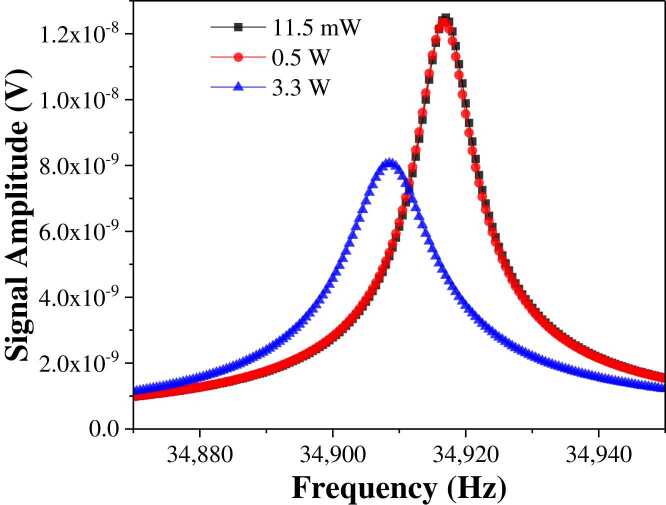
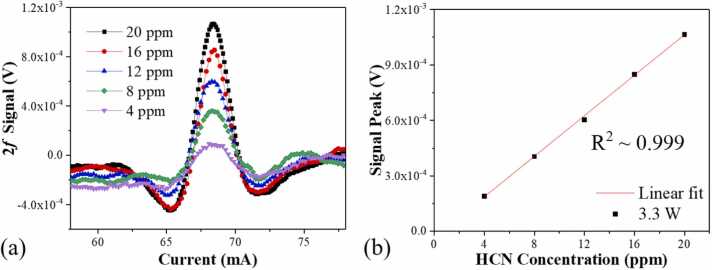
Hydrogen cyanide (HCN) is a toxic industrial chemical, necessitating low-level detection capabilities for safety and environmental monitoring. This study introduces a novel approach for detecting hydrogen cyanide (HCN) using a clamp-type custom quartz tuning fork (QTF) integrated with a dual-tube acoustic micro-resonator (AmR) for enhanced photoacoustic gas sensing. The design and optimization of the AmR geometry were guided by theoretical simulation and experimental validation, resulting in a robust on-beam QEPAS (Quartz-Enhanced Photoacoustic Spectroscopy) configuration. To boost the QEPAS sensitivity, an Erbium-Doped Fiber Amplifier (EDFA) was incorporated, amplifying the laser power by approximately 286 times. Additionally, a transformer-based U-shaped neural network, a machine learning filter, was employed to refine the photoacoustic signal and reduce background noise effectively. This combination yielded a significantly low detection limit for HCN at 0.89 parts per billion (ppb) with a rapid response time of 1 second, marking a substantial advancement in optical gas sensing technologies. Key modifications to the QTF and innovative use of AmR lengths were validated under various experimental conditions, affirming the system's capabilities for real-time, high-sensitivity environmental monitoring and industrial safety applications. This work not only demonstrates significant enhancements in QEPAS but also highlights the potential for further technological advancements in portable gas detection systems.
氰化氢(HCN)是一种有毒的工业化学品,因此需要具备低水平检测能力以进行安全和环境监测。本研究介绍了一种检测氰化氢(HCN)的新方法,该方法使用一种夹式定制石英音叉(QTF),其与双管声学微谐振器(AmR)集成,以增强光声气体传感。AmR几何结构的设计和优化以理论模拟和实验验证为指导,从而形成了一种稳健的光束上石英增强光声光谱(QEPAS)配置。为提高QEPAS灵敏度,引入了掺铒光纤放大器(EDFA),将激光功率放大了约286倍。此外,采用了基于变压器的U形神经网络(一种机器学习滤波器)来优化光声信号并有效降低背景噪声。这种组合使得HCN的检测限低至十亿分之0.89(ppb),响应时间仅为1秒,这标志着光气传感技术取得了重大进展。在各种实验条件下验证了对QTF的关键改进以及对AmR长度的创新使用,证实了该系统在实时、高灵敏度环境监测和工业安全应用方面的能力。这项工作不仅展示了QEPAS的显著增强,还突出了便携式气体检测系统进一步技术进步的潜力。