School of Public Health, Jilin University, Changchun, China.
Front Public Health. 2024 Jul 22;12:1367644. doi: 10.3389/fpubh.2024.1367644. eCollection 2024.
Persistent infections caused by certain viruses and parasites have been associated with multiple diseases and substantial mortality. Heavy metals are ubiquitous environmental pollutants with immunosuppressive properties. This study aimed to determine whether heavy metals exposure suppress the immune system, thereby increasing the susceptibility to persistent infections.
Using data from NHANES 1999-2016, we explored the associations between heavy metals exposure and persistent infections: Cytomegalovirus (CMV), Epstein-Barr Virus (EBV), Hepatitis C Virus (HCV), Herpes Simplex Virus Type-1 (HSV-1), (), and and ( spp.) by performing logistic regression, weighted quantile sum (WQS) and Bayesian kernel machine regression (BKMR) models. Mediation analysis was used to determine the mediating role of host immune function in these associations.
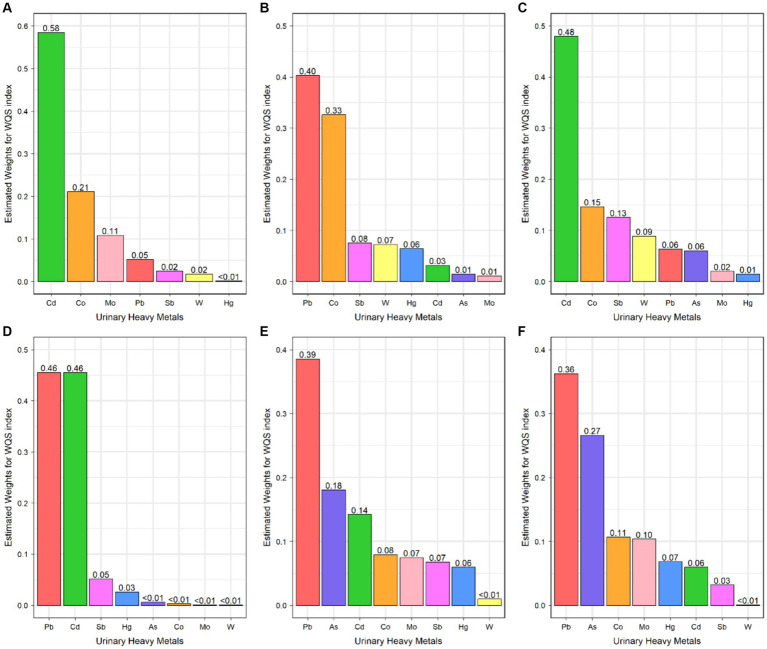
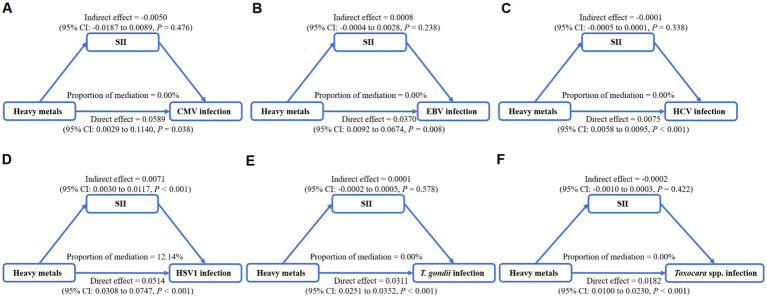
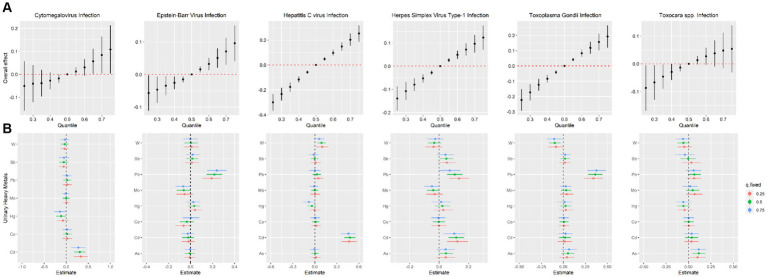
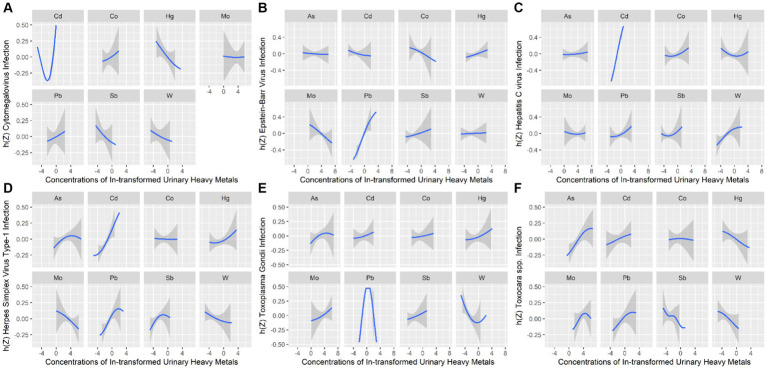
Logistic regression analysis revealed positive associations between multiple heavy metals and the increased risk of persistent infections. In WQS models, the heavy metals mixture was associated with increased risks of several persistent infections: CMV (OR: 1.58; 95% CI: 1.17, 2.14), HCV (OR: 2.94; 95% CI: 1.68, 5.16), HSV-1 (OR: 1.25; 95% CI: 1.11, 1.42), (OR: 1.97; 95% CI: 1.41, 2.76), and spp. (OR: 1.76; 95% CI: 1.16, 2.66). BKMR models further confirmed the combined effects of heavy metals mixture and also identified the individual effect of arsenic, cadmium, and lead. On mediation analysis, the systemic immune inflammation index, which reflects the host's immune status, mediated 12.14% of the association of mixed heavy metals exposure with HSV-1 infection.
The findings of this study revealed that heavy metals exposure may increase susceptibility to persistent infections, with the host's immune status potentially mediating this relationship. Reducing exposure to heavy metals may have preventive implications for persistent infections, and further prospective studies are needed to confirm these findings.
某些病毒和寄生虫引起的持续性感染与多种疾病和大量死亡有关。重金属是具有免疫抑制特性的普遍存在的环境污染物。本研究旨在确定重金属暴露是否会抑制免疫系统,从而增加持续性感染的易感性。
我们利用 1999-2016 年 NHANES 数据,通过逻辑回归、加权分位数总和(WQS)和贝叶斯核机器回归(BKMR)模型,探讨了重金属暴露与持续性感染(巨细胞病毒(CMV)、EB 病毒(EBV)、丙型肝炎病毒(HCV)、单纯疱疹病毒 1 型(HSV-1)、单纯疱疹病毒 2 型(HSV-2)、人类乳头瘤病毒(HPV)和脲原体和支原体( spp.))之间的关联。中介分析用于确定宿主免疫功能在这些关联中的中介作用。
逻辑回归分析显示,多种重金属与持续性感染风险增加呈正相关。在 WQS 模型中,重金属混合物与多种持续性感染的风险增加相关:CMV(OR:1.58;95%CI:1.17,2.14)、HCV(OR:2.94;95%CI:1.68,5.16)、HSV-1(OR:1.25;95%CI:1.11,1.42)、(OR:1.97;95%CI:1.41,2.76)和 spp.(OR:1.76;95%CI:1.16,2.66)。BKMR 模型进一步证实了重金属混合物的综合效应,并确定了砷、镉和铅的单独效应。在中介分析中,反映宿主免疫状态的系统免疫炎症指数,介导了混合重金属暴露与 HSV-1 感染关联的 12.14%。
本研究结果表明,重金属暴露可能增加持续性感染的易感性,宿主的免疫状态可能介导这种关系。减少重金属暴露可能对持续性感染具有预防意义,需要进一步的前瞻性研究来证实这些发现。